Texas Tax, Title and License Calculator (2026 Estimate)
Texas charges a flat 6.25% motor vehicle sales tax on cars, trucks and motorcycles. On top of that, you pay a $28 or $33 title fee and registration, which starts at $50.75 for most cars before county and state add-ons.
This tax title and license calculator in Texas helps you estimate those costs before you sign. Enter the price, trade-in, rebate and county to see the tax and the government fees. The guide below explains each number so you can check the math yourself.
Rates and fees checked against the Texas Comptroller and TxDMV on October 1, 2026. This is an independent estimate, not an official government quote.
Other State Calculators
On this page20 sections
- Other State Calculators
- Texas Vehicle Tax and Fees at a Glance
- How Texas Vehicle Tax Is Calculated
- Texas Vehicle Sales Tax Rate
- How Much Tax Do You Pay on a Car in Texas?
- Texas Title Fees
- Texas Registration and License Plate Fees
- How Trade-Ins Affect Vehicle Tax in Texas
- Rebates, Discounts and Dealer Fees
- Private-Party Vehicle Purchases in Texas
- Buying a Vehicle Out of State
- Moving to Texas With Your Vehicle
- Electric Vehicle and Hybrid Fees in Texas
- Exemptions and Special Cases
- How to Calculate Texas Tax, Title and License Manually
- What the Estimate Includes
- What the Estimate Does Not Include
- Common Mistakes to Avoid
- Frequently Asked Questions
- Official Sources
Texas Vehicle Tax and Fees at a Glance
| Charge | Amount | Who sets it |
| Motor vehicle sales tax | 6.25% of the taxable amount | State (Comptroller) |
| Title application fee | $28 or $33, based on your county | State (TxDMV) |
| Base registration (car or light truck) | $50.75 + $1 TexasSure = $51.75 | State (TxDMV) |
| Local county fee | $0 to $31.50 | Your county |
| Processing and handling fee | $4.75 | State (TxDMV) |
| Inspection program replacement fee | $7.50 a year, or $16.75 for a new vehicle (two years) | State |
| Electric vehicle fee | $200 a year, or $400 for a new EV with two-year registration | State |
| New resident tax | $90 instead of sales tax (if eligible) | State |
| Gift tax | $10 | State |
Texas does not add city or county sales tax to a vehicle purchase. The 6.25% rate is the same in Houston, Dallas, El Paso or a small rural county. What changes by county is the title fee and the local registration fee.
How Texas Vehicle Tax Is Calculated
The basic formula is simple:
Vehicle tax = taxable amount × 6.25%
The hard part is the taxable amount. Texas figures it two different ways, depending on who sold you the vehicle.
Buying from a licensed dealer
For new and used cars bought from a Texas dealer, the taxable amount is the sales price, minus your trade-in and any dealer discounts. Rebates passed to you also come off. The dealer collects the tax and files the title paperwork for you.
Example from the Comptroller: a $42,000 vehicle with a $15,000 trade-in has a taxable value of $27,000. Tax is $27,000 × 6.25% = $1,687.50.
Buying from a private seller
For a used vehicle bought from a private person, Texas compares what you paid to the vehicle’s standard presumptive value (SPV). SPV is a value based on similar sales in Texas. You pay tax on whichever is higher:
- the price you actually paid, or
- 80% of the SPV
This rule stops people from writing a low price on the paperwork to cut the tax. You can look up a vehicle’s SPV on the TxDMV website using the VIN. Other states check private sales their own way. North Carolina’s highway use tax skips the price entirely and uses a market value schedule the DMV adopts.
Texas Vehicle Sales Tax Rate
The Texas motor vehicle sales tax rate is 6.25%. It applies to new and used vehicles, dealer sales and private sales. It is a separate tax from the general Texas sales tax you pay at a store.
Because there is no local add-on, you never need a city or ZIP code rate for the tax itself. You only need your county to get the right title fee and local registration fee. That single statewide rate is unusual. California vehicle sales tax starts at 7.25% and reaches 11.75% once district taxes are added, so two buyers at the same dealer can owe very different amounts.
How Much Tax Do You Pay on a Car in Texas?
Here is a quick lookup. These assume a dealer sale with no trade-in and no rebate.
| Taxable amount | Texas sales tax (6.25%) |
| $10,000 | $625 |
| $20,000 | $1,250 |
| $25,000 | $1,562.50 |
| $30,000 | $1,875 |
| $40,000 | $2,500 |
| $50,000 | $3,125 |
So the answer to “How much tax on a $30,000 car in Texas?” is $1,875, before any trade-in or rebate.
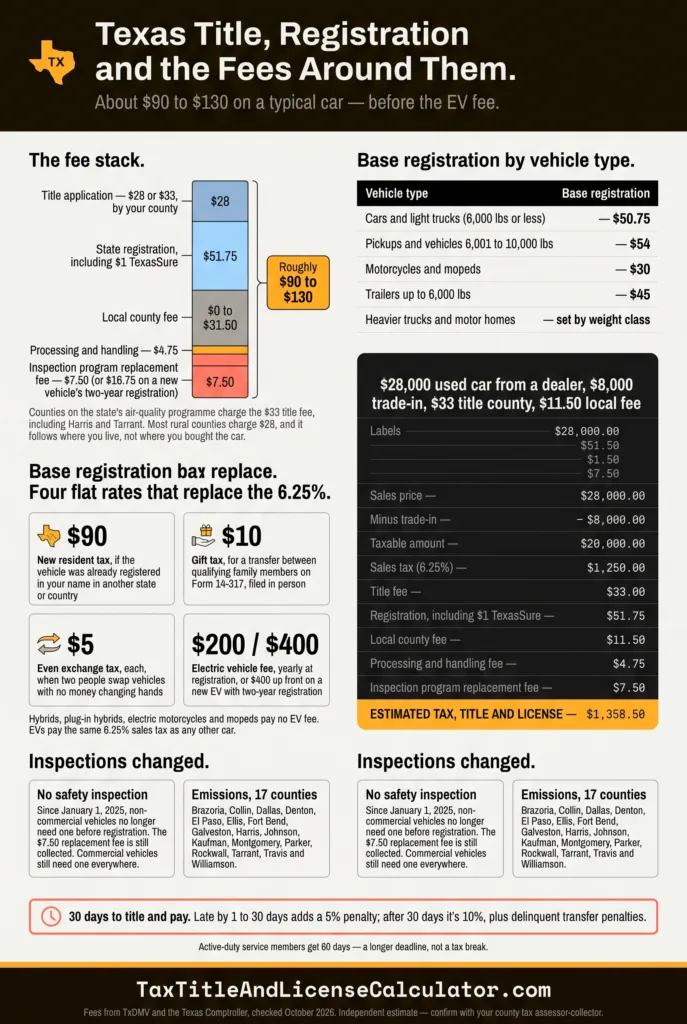
Example 1: Used car from a dealer, with a trade-in
Assumptions: $28,000 price, $8,000 trade-in, county charges the $33 title fee and an $11.50 local fee (a typical metro amount).
| Item | Amount |
| Sales price | $28,000.00 |
| Minus trade-in | − $8,000.00 |
| Taxable amount | $20,000.00 |
| Sales tax (6.25%) | $1,250.00 |
| Title fee | $33.00 |
| Registration (state, incl. $1 TexasSure) | $51.75 |
| Local county fee (assumed) | $11.50 |
| Processing and handling fee | $4.75 |
| Inspection program replacement fee | $7.50 |
| Estimated tax, title and license | $1,358.50 |
Your county’s local fee can be anywhere from $0 to $31.50, so your total may move by a few dollars. Dealer fees are not included here.
Example 2: Private-party used car
Assumptions: you paid $9,000. The SPV is $14,000. 80% of SPV is $11,200.
- Taxable amount: $11,200 (higher than $9,000)
- Sales tax: $11,200 × 6.25% = $700
- If you had paid $9,000 on a car with no SPV issue, tax would have been $562.50
If you truly paid less because the car has damage or high miles, a certified appraisal can lower the taxable value. See the private-party section below.
Example 3: New car with a rebate
Assumptions: $40,000 price, $2,000 manufacturer rebate passed to you and shown separately on the contract, no trade-in.
- Taxable amount: $40,000 − $2,000 = $38,000
- Sales tax: $38,000 × 6.25% = $2,375
New vehicles sold by a dealer usually get a first registration that lines up with a two-year inspection, so the inspection replacement fee is $16.75 instead of $7.50. A new EV also pays $400 up front. Ask the dealer for the itemized TT&L line.
Texas Title Fees
The Texas title application fee is $28 or $33. Which one you pay depends on your county of residence, not where the car was bought. Counties tied to the state’s air-quality and emissions program charge $33. That includes big metro counties such as Harris and Tarrant. Most rural counties charge $28.
Other title-related charges you might see:
| Title charge | Amount |
| Title application (most counties) | $28 |
| Title application (certain counties) | $33 |
| Transfer of current registration (when plates stay valid) | $2.50 |
| Rebuilt salvage fee | $65 |
| Certified copy of title (mailed) | $2.00 |
| Certified copy of title (in person at a TxDMV regional center) | $5.45 |
You must title the vehicle in your name within 30 days of the sale. Missing that deadline can bring delinquent transfer penalties on top of any late tax penalty.
Texas Registration and License Plate Fees
Registration is the “license” part of tax, title and license. For a standard car or light truck, the state base fee is $50.75. Texas adds $1 for the TexasSure insurance verification program, so the registration line usually shows $51.75. Standard plates come with registration.
Base registration by vehicle type
| Vehicle type | Base registration fee |
| Cars and light trucks (6,000 lbs or less) | $50.75 |
| Pickups and vehicles 6,001 to 10,000 lbs | $54 |
| Motorcycles and mopeds | $30 |
| Trailers up to 6,000 lbs | $45 |
| Heavier trucks and motor homes | Set by weight class |
Fees added to registration
- Local county fee: $0 to $31.50. Counties can charge up to $10 for roads and bridges, up to $1.50 for child safety, and some can add up to $20 for long-term transportation projects.
- Processing and handling fee: $4.75. This covers stickers, renewal notices and county processing.
- Inspection program replacement fee: $7.50. This is the state’s share of the old inspection fee. It is collected at registration. A new vehicle pays $16.75 because its first registration covers two years.
- Specialty plates: extra, only if you choose them.
Do you still need a safety inspection in Texas?
No, not for most personal vehicles. Since January 1, 2025, non-commercial vehicles no longer need a safety inspection before registration. You still pay the $7.50 replacement fee at registration.
If you live in one of these 17 counties, you still need a passing emissions test: Brazoria, Collin, Dallas, Denton, El Paso, Ellis, Fort Bend, Galveston, Harris, Johnson, Kaufman, Montgomery, Parker, Rockwall, Tarrant, Travis and Williamson. Commercial vehicles still need a safety inspection everywhere.
License plates from dealers
Since July 1, 2025, Texas dealers issue metal license plates at the time of sale instead of paper temporary tags. This does not change the tax. It just means your plates usually arrive with the car.
How Trade-Ins Affect Vehicle Tax in Texas
Yes, a trade-in lowers your Texas vehicle tax. When you trade a vehicle to the seller as part of the deal, you pay tax only on the difference.
The trade-in credit is based on the value of your old car, not your equity. If your old car is worth $15,000 and you still owe $6,000 on it, the credit is still $15,000.
A $10,000 trade-in saves you $625 in tax ($10,000 × 6.25%). The trade has to be part of the same transaction with the same seller. Selling your old car privately and buying from a dealer later does not give you the credit.
Some states do allow it. The Missouri trade-in tax credit counts a private sale of your old car within 180 days either side of the purchase.
Rebates, Discounts and Dealer Fees
Texas taxes the “total consideration,” which means the full amount you pay for the vehicle itself. Some items reduce it and some do not.
| Item | Taxed in Texas? |
| Vehicle price | Yes |
| Accessories installed before the sale | Yes |
| Dealer discount | No, it lowers the taxable price |
| Manufacturer rebate passed to you (stated separately) | No, it lowers the taxable price |
| Trade-in value | No, it lowers the taxable price |
| Documentary fee (stated separately) | No |
| Title, registration and other government fees | No |
A documentary fee is the dealer’s charge for handling paperwork. It is not a government fee. It is not taxed when it is listed on its own line, but you still pay it, so ask about it before you agree on a price.
This is worth checking state by state. Tennessee car sales tax treats the documentary fee as part of the sales price and taxes it at 7%.
Private-Party Vehicle Purchases in Texas
When you buy from a private seller, you pay the tax yourself at your county tax assessor-collector’s office. Do it within 30 calendar days of the sale date, along with the title and registration.
Bring these items:
- The title, signed over to you, with the date and odometer reading
- Form 130-U, Application for Texas Title and/or Registration, signed by you and the seller
- Proof of Texas liability insurance
- Your photo ID
- A Vehicle Inspection Report if you live in an emissions county and no record shows in the state system
TxDMV suggests the seller come with you to the county office. A clerk can spot title problems before you file.
If you paid less than the SPV
You can pay tax on a certified appraisal instead of 80% of SPV. The appraisal must come from a licensed insurance adjuster or a licensed motor vehicle dealer. Use the Comptroller’s Used Motor Vehicle Certified Appraisal form, and get it within 20 working days of the purchase.
Vehicles where SPV does not apply
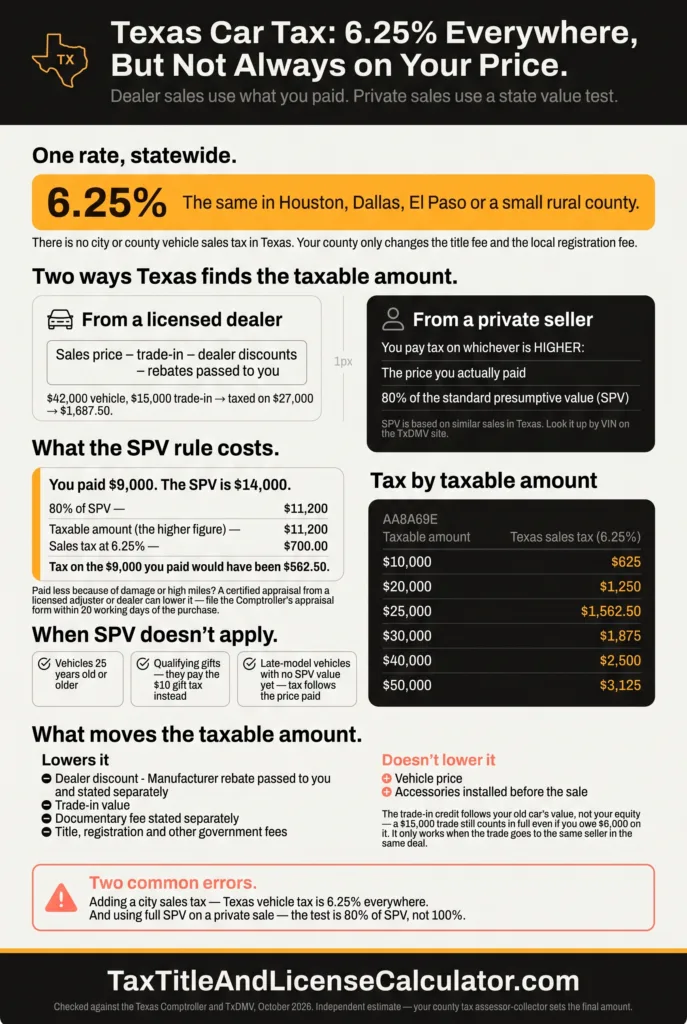
- Vehicles 25 years old or older
- Qualifying gifts (they pay the $10 gift tax instead)
- Late-model vehicles with no SPV value yet (tax is based on the price paid)
Buying a Vehicle Out of State
If you are a Texas resident and buy a vehicle in another state, you owe Texas use tax of 6.25% when you bring it home. Texas gives you credit for sales or use tax you already paid to the other state.
Example: you buy a $30,000 car in a state with a 4% tax and pay $1,200 there. Texas tax would be $1,875. You owe the difference, $675. If the other state charged 6.25% or more, you usually owe nothing extra to Texas.
You have 30 calendar days from the date the vehicle enters Texas to title it and pay. If you bought from a private seller out of state, the SPV rule still applies.
Moving to Texas With Your Vehicle
New residents pay a flat $90 new resident tax instead of 6.25%, as long as the vehicle was already registered in your name in another state or country.
You must title and register within 30 days of becoming a Texas resident. You still pay the title fee, registration and local fees. Bring your out-of-state title, proof of Texas insurance and an emissions report if your county requires one.
Moving the other way can cost nothing. Iowa vehicle tax exempts a car you already used in the state you moved from, so you pay only the title and registration fees.
Electric Vehicle and Hybrid Fees in Texas
Texas does not charge a higher sales tax on electric vehicles. EVs pay the same 6.25%. The difference is at registration.
- Fully electric vehicles (10,000 lbs or less): $200 extra at each annual registration.
- New EVs issued two years of registration: $400 at the first registration.
- Hybrids and plug-in hybrids: no EV fee. Not every state stops at fully electric cars. Arkansas vehicle sales tax charges plug-in hybrids $100 a year and regular hybrids $50.
- Electric motorcycles and mopeds: no EV fee.
The EV fee is added on top of the standard registration and local fees.
Exemptions and Special Cases
Gifts between family members
A vehicle given as a gift pays a $10 gift tax instead of sales tax. The giver must be a spouse, parent or stepparent, grandparent or grandchild, child or stepchild, sibling, guardian, a decedent’s estate or a qualifying 501(c)(3) nonprofit. Both people sign Form 14-317, the Affidavit of Motor Vehicle Gift Transfer, and file in person.
Even trades
If two people swap vehicles with no money changing hands, each pays a $5 even exchange tax.
Active-duty military
Active-duty service members get 60 days instead of 30 to title, register and pay the tax. This is a longer deadline, not a tax break.
Vehicles modified for a person with an orthopedic disability
A vehicle modified so a person with an orthopedic disability can drive or ride in it can be exempt from motor vehicle tax. It must be used for that person at least 80% of the time. You file Form 14-318 with supporting documents.
Heavy diesel vehicles
Diesel vehicles over 14,000 pounds pay an extra emissions surcharge: 1% of the price for model year 1997 and newer, or 2.5% for 1996 and older.
How to Calculate Texas Tax, Title and License Manually
- Find the taxable amount. Dealer sale: price minus trade-in, dealer discounts and rebates. Private sale: the higher of the price or 80% of SPV.
- Multiply by 6.25% to get the sales tax.
- Add the title fee: $28 or $33 based on your county.
- Add registration: $51.75 for most cars ($50.75 base plus $1).
- Add your county’s local fee ($0 to $31.50).
- Add the $4.75 processing fee and the inspection replacement fee: $7.50, or $16.75 for a new vehicle.
- Add $200 if the vehicle is fully electric (or $400 for a new EV with two-year registration).
The result is your estimated tax, title and license. Dealer charges and optional products come on top.
What the Estimate Includes
A Texas auto tax title and license calculator estimate usually covers the government costs of putting a vehicle on the road:
- 6.25% motor vehicle sales tax (or use tax, gift tax or new resident tax)
- Title application fee
- State registration fee
- County local fee
- Processing and handling fee
- Inspection program replacement fee
- EV fee, when it applies
What the Estimate Does Not Include
- Dealer documentary fee
- Extended warranties, service contracts and GAP insurance
- Auto insurance
- Loan interest
- The emissions test fee paid at the inspection station
- Specialty or personalized plate charges
- Late tax penalties or delinquent title transfer penalties
Common Mistakes to Avoid
- Adding a city sales tax. Texas vehicle tax is 6.25% everywhere. There is no local vehicle sales tax.
- Using full SPV for a private sale. The test is 80% of SPV, not 100%.
- Assuming a private sale lets you skip a trade-in rule. The trade-in credit only works when the trade goes to the seller in the same deal.
- Budgeting for a safety inspection. Most personal vehicles no longer need one, but the $7.50 fee still appears at registration.
- Forgetting the EV fee. A fully electric car adds $200 a year, or $400 up front on a new EV.
- Missing the 30-day deadline. Late tax brings a 5% penalty in the first 30 days, then 10%.
- Treating the doc fee as a government fee. It is a dealer charge, so it can be negotiated or compared.
Frequently Asked Questions
How much is tax, title and license on a car in Texas?
Plan on 6.25% of the taxable price, plus about $90 to $130 in title and registration fees for a typical car. For example, a $20,000 taxable amount means $1,250 in tax plus fees.
Is there a tax title and license calculator for Texas from the state?
TxDMV offers an SPV lookup for used vehicles, not a full TT&L calculator. Your county tax office calculates the final amount when you title the vehicle.
Does Texas charge sales tax on used cars?
Yes. Used cars pay the same 6.25%. Dealer sales use the price after trade-in and discounts. Private sales use the higher of the price or 80% of SPV.
Does a trade-in reduce sales tax in Texas?
Yes. You pay tax only on the price minus the trade-in value, as long as the trade goes to the same seller in the same deal.
How much is a title transfer in Texas?
The title application fee is $28 or $33, depending on your county. If the current registration stays with the car, add a $2.50 registration transfer fee.
How much does it cost to register a car in Texas?
Most cars pay $51.75 in state registration, $0 to $31.50 in local fees, $4.75 processing and $7.50 for the inspection replacement fee. That is roughly $64 to $96 a year before any EV fee. A new vehicle pays $16.75 instead of $7.50 for the inspection fee.
Is the dealer documentary fee taxed in Texas?
No, not when it is listed separately on the contract. It is still a cost you pay to the dealer.
What happens if I pay Texas vehicle tax late?
Paying 1 to 30 days late adds a 5% penalty. After 30 days, the penalty is 10%. Delinquent title transfer penalties can also apply.
Can a tax title license calculator in Texas give my exact amount?
It gives a close estimate. The county tax assessor-collector sets the final figure, based on your county fees, the vehicle’s SPV on the day you file and your paperwork.
Do I pay Texas tax if I moved here with my car?
If the car was already registered in your name in another state, you pay the $90 new resident tax instead of 6.25%. Title and registration fees still apply.
Official Sources
- Texas Comptroller of Public Accounts: Motor Vehicle Sales and Use Tax (comptroller.texas.gov/taxes/motor-vehicle/sales-use.php)
- Texas Comptroller: Motor Vehicle Tax Guide, Publication 96-254, including Total Consideration and Orthopedically Handicapped Persons sections
- Texas Department of Motor Vehicles: Register Your Vehicle (txdmv.gov/motorists/register-your-vehicle)
- Texas Department of Motor Vehicles: Buying or Selling a Vehicle (txdmv.gov/motorists/buying-or-selling-a-vehicle)
- Texas Department of Motor Vehicles: Standard Presumptive Value (txdmv.gov/spv-calculator)
- Tarrant County Tax Office: Title Fees and Taxes
- Harris County Tax Office: Buying a Used Motor Vehicle
- Texas Tax Code Chapter 152 (statutes.capitol.texas.gov)
This page is an independent estimate tool and guide. It is not affiliated with TxDMV, the Texas Comptroller or any county. Fees and rules can change, so confirm the final amount with your county tax assessor-collector before you pay.
William researches vehicle taxes, title fees, registration charges and DMV requirements across the United States. His work focuses on turning state-specific fee schedules, tax guidance, registration requirements and statutory information into practical explanations for vehicle buyers and owners. He cross-checks calculator inputs against official state revenue departments, motor vehicle agencies and published fee schedules, paying particular attention to differences between sales tax, title fees, registration charges and local or county taxes. He also reviews state-level changes so that calculator results and supporting articles reflect the latest available requirements rather than relying on outdated third-party estimates.
About this site →