Tax, Title and License Calculator 2026 by State
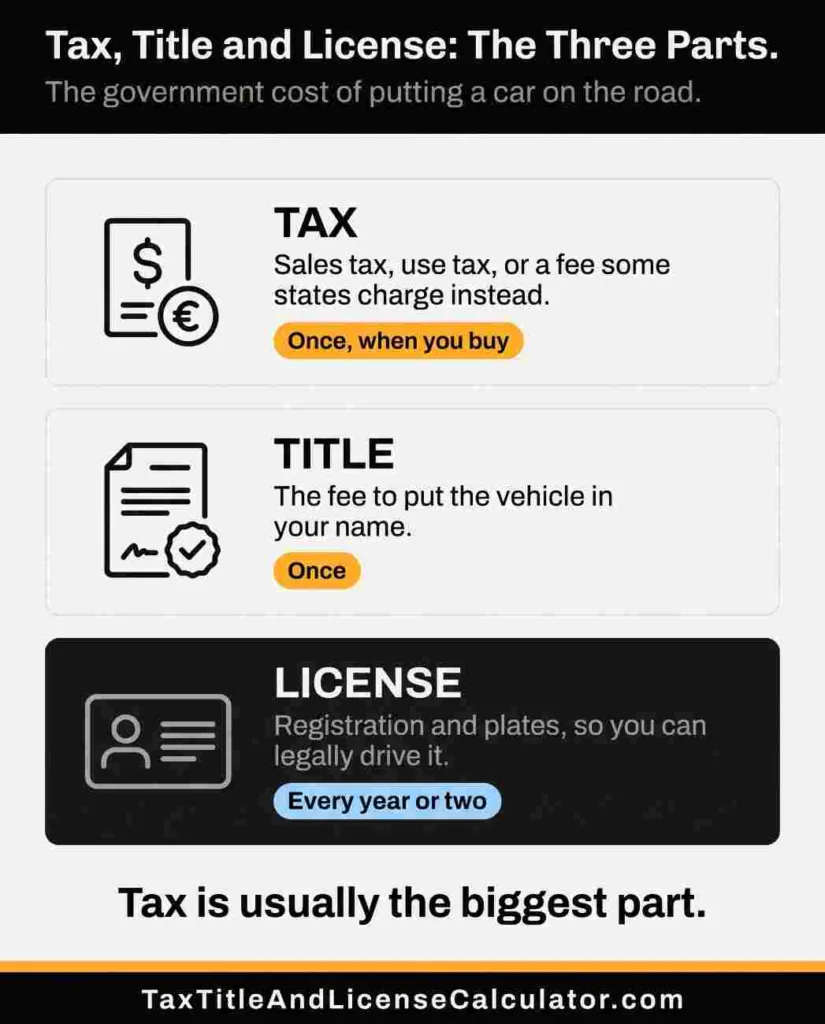
Tax, title and license (TTL) is what you pay the government when you buy a vehicle. That’s the tax on the purchase, the title fee to put it in your name, and the license (registration and plates) to drive it. Tax is usually the biggest part. Every state does this differently, so the guide below explains how the costs are figured and what changes them.
Pick Your State
Each page breaks down what that state charges in tax, title and registration, with real numbers and a calculator.
On this page16 sections
- Pick Your State
- Tax, Tag and Title: What’s Included
- How to Calculate Tax, Title and License
- What Affects Your Total
- How States Tax a Car: Five Systems
- Do Trade-Ins Lower the Tax?
- Are Rebates and Dealer Fees Taxed?
- Dealer vs Private-Party Sales
- How Registration Fees Are Set
- Yearly Taxes That Come With Registration
- Electric and Hybrid Vehicle Fees
- Buying a Car Out of State or Moving
- What Tax, Title and License Doesn’t Include
- Common Mistakes to Avoid
- Frequently Asked Questions
- How We Research the Numbers
Tax, Tag and Title: What’s Included
“Tax, tag and title” and “tax, title and license” mean the same thing. “Tag” is just another word for your license plate and registration.
| Part | What it is | How often |
|---|---|---|
| Tax | Sales tax, use tax, or a fee or excise tax some states charge instead | Once, when you buy |
| Title | The fee to put the vehicle in your name | Once |
| License (tag, registration) | The fee to register the vehicle and get plates | Every year or two |
| Lien fee | Records your lender on the title | Once, if you finance |
| Local fees | County or city charges in some states | Varies |
| EV or hybrid fee | Extra yearly fee in many states | Every year |
How to Calculate Tax, Title and License
TTL = (taxable price × tax rate) + title fee + registration fee + other required fees
- Find the taxable price. Start with the price. Then apply your state’s rules for trade-ins, rebates and dealer fees.
- Find your tax rate. Use your state rate plus any local rate. In most states, it’s based on where you live, not where you buy.
- Multiply the taxable price by the rate.
- Add the title fee, plus a lien fee if you have a loan.
- Add registration, which may be flat or based on weight, age or value.
- Add any extra fees, like county fees or an EV fee.
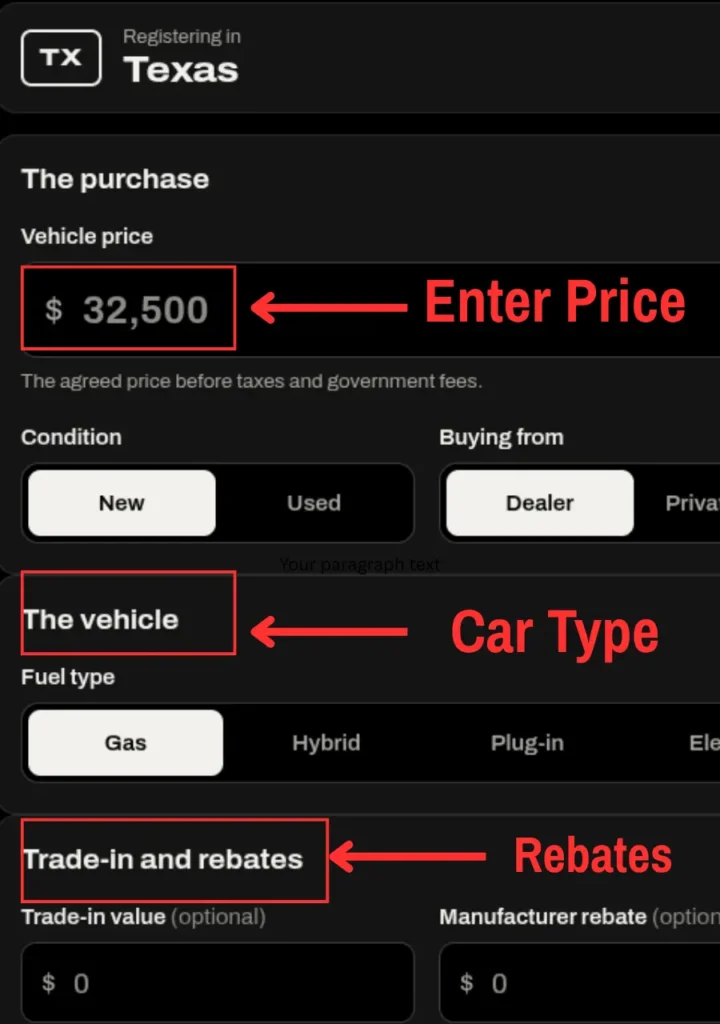
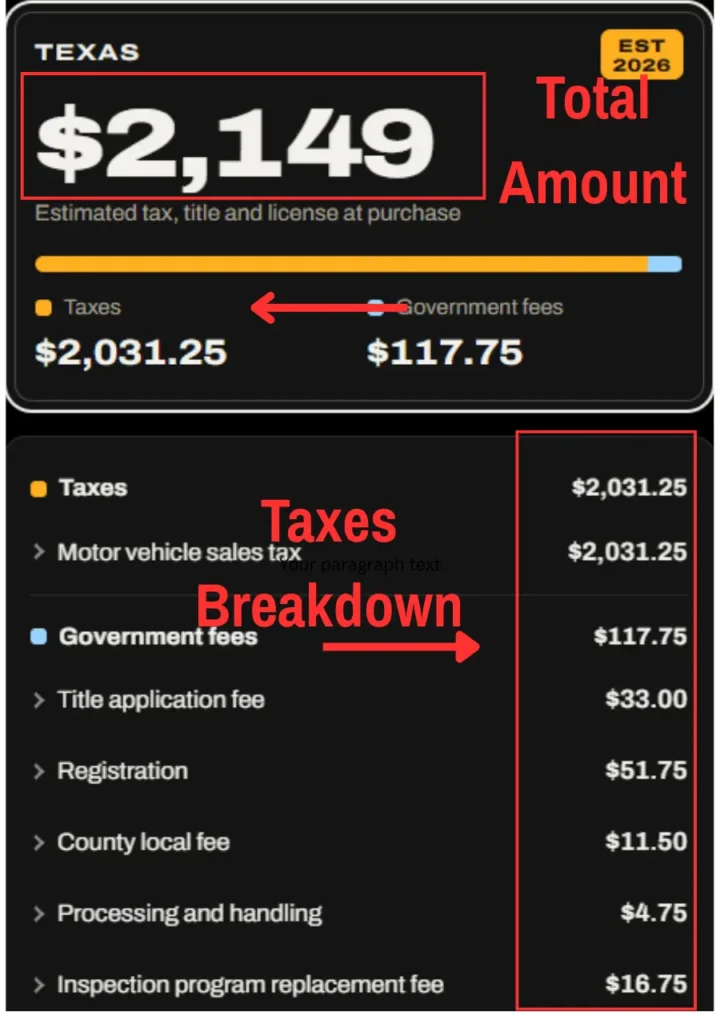
The calculator does these steps for you, using each state’s own rules.
What Affects Your Total
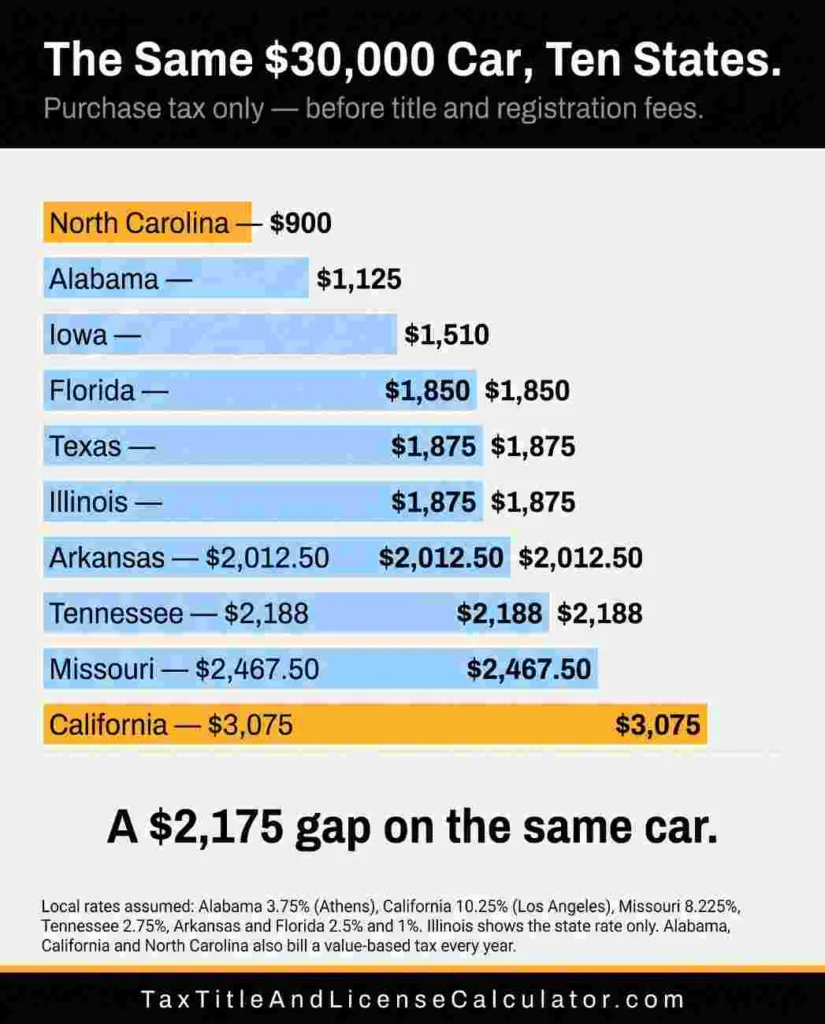
Your state’s tax system matters most. The same $30,000 car can cost under $2,000 in tax, title and license in one state and over $3,500 in another. Local tax rates, trade-in rules and how your state sets registration explain most of the gap. The cheap end often comes from a cap. Florida’s county surtax stops at the first $5,000 of the price, and Arkansas charges no state tax at all on a used car under $4,000.
How States Tax a Car: Five Systems
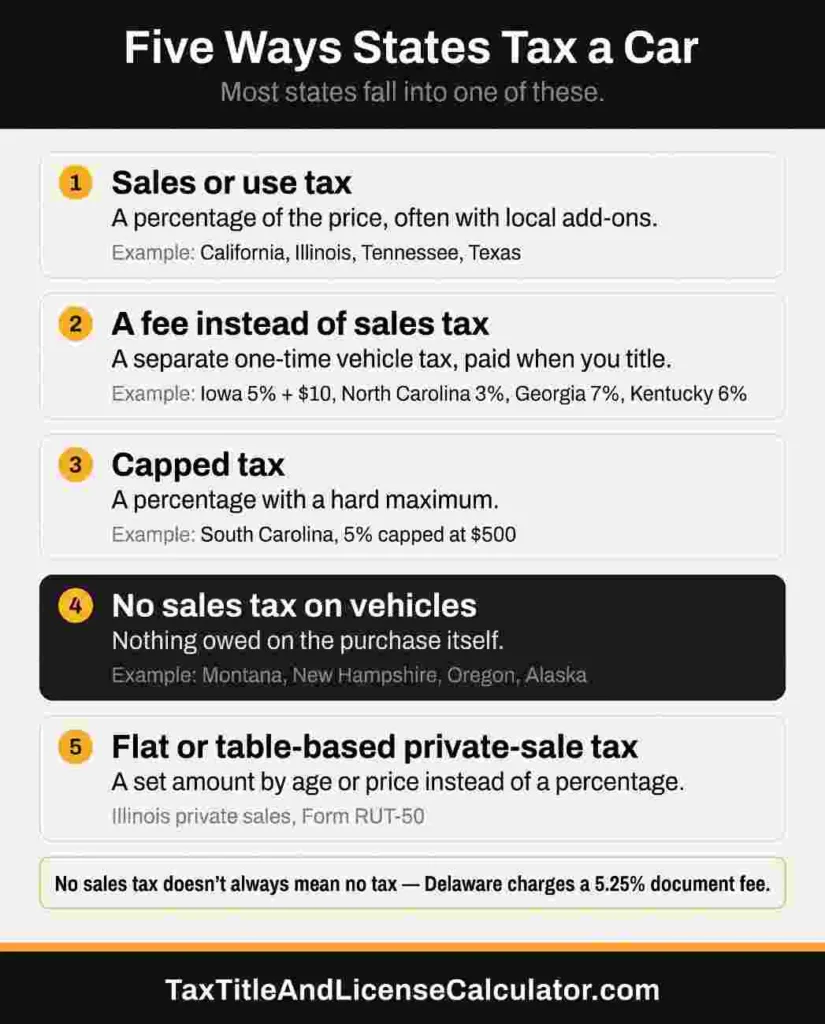
States don’t all use plain sales tax. Most fall into one of these groups.
| System | How it works | Examples |
|---|---|---|
| Sales or use tax | A percentage of the price, often with local add-ons | California, Illinois, Tennessee, Texas |
| One-time fee or excise tax instead of sales tax | A separate vehicle tax or fee, paid when you title | Iowa (5% + $10), North Carolina (3% highway use tax), Georgia (7% title ad valorem tax), Kentucky (6% usage tax) |
| Capped tax | A percentage with a maximum | South Carolina (5%, capped at $500) |
| No sales tax on vehicles | No state tax on the purchase | Montana, New Hampshire, Oregon (small privilege tax on new cars from Oregon dealers), Alaska (some local taxes) |
| Flat or table-based private-sale tax | A set amount by age or price instead of a percentage | Illinois private sales (Form RUT-50) |
Delaware has no sales tax, but it charges a 5.25% document fee when you title a vehicle. So “no sales tax” doesn’t always mean no tax.
Do Trade-Ins Lower the Tax?
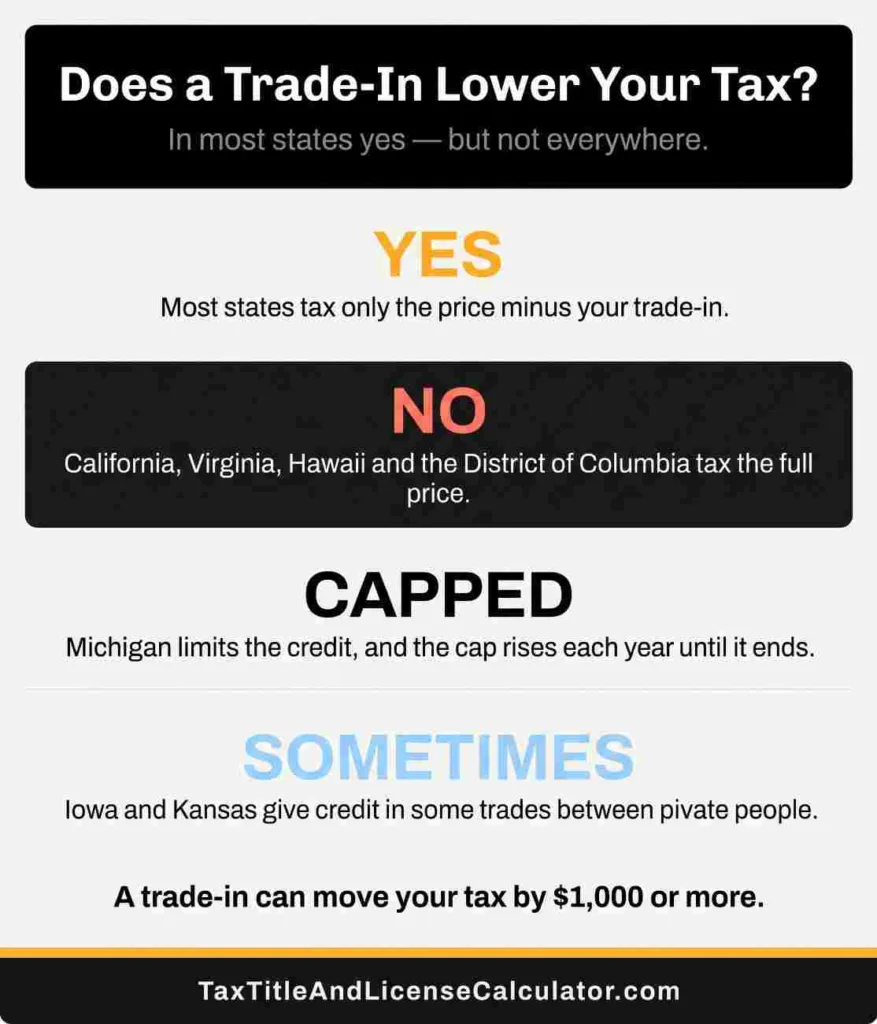
In most states, yes. You pay tax only on the price minus your trade-in. But not everywhere:
- No trade-in credit: California taxes the full price, and so do Virginia, Hawaii and the District of Columbia.
- Capped credit: Michigan limits the credit, and the cap rises each year until it ends.
- Private trades count: Iowa’s fee for new registration gives credit in some trades between private people, and Kansas does too.
A trade-in can change your tax by $1,000 or more, so check your state’s rule before you plan your budget.
Are Rebates and Dealer Fees Taxed?
Manufacturer rebates are treated two ways. Some states tax the price before the rebate, including California, Illinois and Tennessee. Others subtract it first, like Iowa and Missouri.
Dealer discounts usually lower the taxable price, because they cut what you actually pay. Documentary (doc) fees are taxed in many states, including California, Tennessee and Illinois, and many states cap them.
Dealer vs Private-Party Sales
A private sale isn’t automatically tax-free. In most states, you pay the tax yourself when you title the vehicle at the DMV, county office or tax collector.
Some states use a value floor so a low price on the bill of sale doesn’t cut the tax. Texas taxes the higher of the price or 80% of a standard value, and North Carolina uses a market value schedule instead of the price. Illinois charges a flat amount from a chart for private sales.
Many states also exempt gifts and sales between close family members, but the list of who counts is different in each state.
How Registration Fees Are Set
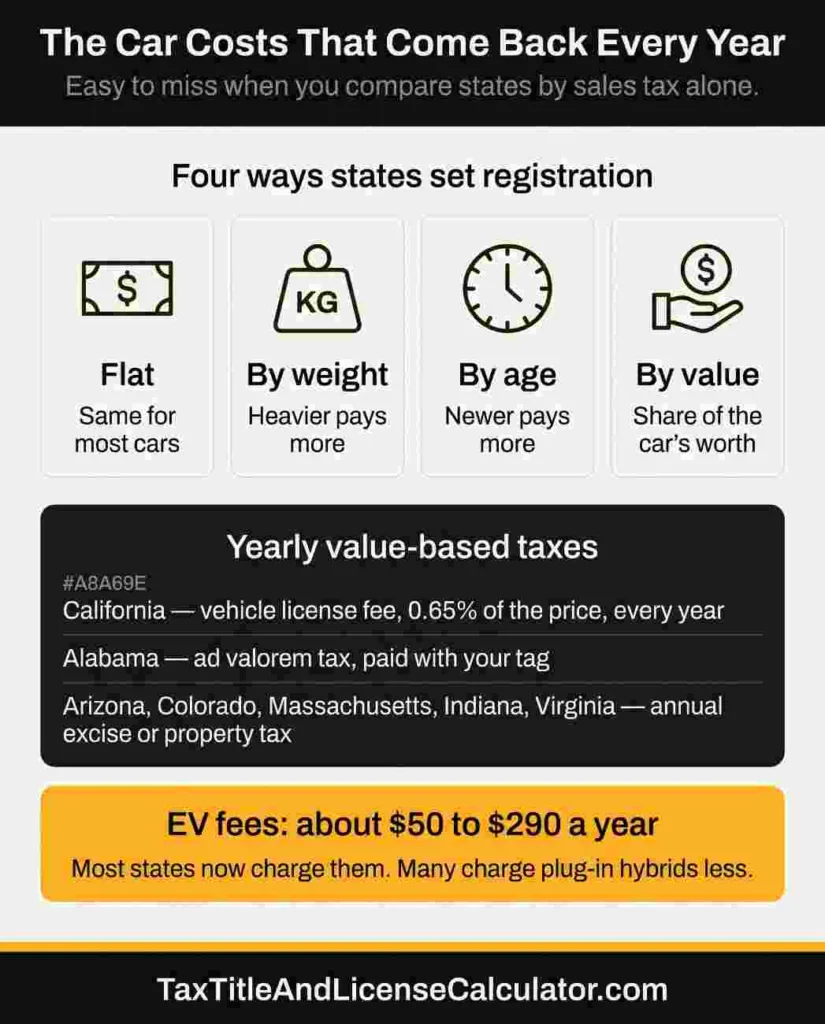
This is why your registration may not match your neighbor’s. States set it in different ways:
- Flat fee: the same for most cars.
- By weight: heavier vehicles pay more.
- By age: newer vehicles pay more.
- By value or list price: a percentage of the vehicle’s value or original sticker price. Iowa uses 1% of list price plus a weight charge.
Some states register for two years at a time, so the first bill can look large.
Yearly Taxes That Come With Registration
In many states, your yearly registration includes a tax based on the vehicle’s value. It usually drops as the car ages.
- California’s vehicle license fee: 0.65% of the price, every year.
- Alabama’s ad valorem tax, paid with your tag.
- Annual excise or property taxes in states like Arizona, Colorado, Massachusetts, Indiana and Virginia.
These are easy to miss when you compare states by sales tax alone.
Electric and Hybrid Vehicle Fees
Most states now charge electric vehicles an extra yearly fee to make up for lost gas tax. As of 2026, these run from about $50 to around $290 a year. Many states charge plug-in hybrids a smaller fee, and some charge regular hybrids too.
Some states charge the fee only at renewal, not when you first buy. The calculator follows each state’s rule.
Buying a Car Out of State or Moving
Buying out of state: you generally owe tax where you register the car, not where you buy it. Most states give credit for sales tax you already paid to another state, so you pay only the difference.
Moving to a new state: many states don’t charge tax on a car you already owned and used before you moved, though rules and time limits vary. You’ll still pay title and registration fees, usually within 20 to 30 days of becoming a resident.
What Tax, Title and License Doesn’t Include
TTL covers government charges. It doesn’t include:
- The vehicle price itself
- Dealer doc fees (unless your state taxes them, and then only the tax part)
- Extended warranties and add-ons
- Insurance
- Loan interest
- Inspection and emissions test costs
Your out-the-door price is the vehicle price plus TTL plus dealer fees and add-ons.
Common Mistakes to Avoid
- Using your city’s store sales tax rate. Many states tax cars at a different rate.
- Assuming a trade-in always lowers the tax. It doesn’t in every state.
- Subtracting a rebate. Many states tax the price before rebates.
- Thinking private sales are tax-free. Most aren’t.
- Budgeting only the first year. Value-based yearly taxes can be large.
- Using old fees. States change them often, and several did in 2025 and 2026. We log every confirmed change on our rate and fee updates page.
Frequently Asked Questions
What is tax, title and license?
It’s the government cost of buying and registering a vehicle: the tax on the purchase, the title fee and the registration (license plate) fee.
What are tax, title and license fees?
They’re the government charges on a vehicle purchase: sales or use tax, the title fee, registration and plates, and sometimes a lien fee, local fees or an EV fee. Dealer fees like the doc fee aren’t part of them.
Is tax, tag and title the same as tax, title and license?
Yes. “Tag” means your license plate and registration.
How do I calculate tax, title and license?
Multiply the taxable price by your state and local tax rate. Then add the title fee, registration fee and any other required fees. Our calculator applies your state’s rules automatically.
How much is tax, title and license on a $30,000 car?
Often $1,500 to $3,500, depending on your state and local rate. States with no sales tax on vehicles can be much less.
Which states don’t charge sales tax on cars?
Montana, New Hampshire and Oregon have no sales tax on vehicles, and Alaska has none at the state level. Delaware has no sales tax but charges a document fee when you title.
Can I roll tax, title and license into my car loan?
Often, yes. Many lenders let you finance TTL, but you’ll pay interest on it. Ask your lender.
How We Research the Numbers
TaxTitleAndLicenseCalculator.com is an independent site. It isn’t affiliated with any DMV or state agency.
For each state, we check rates and fees against official sources: the state DMV, the department of revenue, state laws and county offices. Our methodology explains how we handle conflicting figures, and our data sources page lists what we rely on.
Rates move. When a state changes a fee, we log it on the rate and fee updates page, and each state page shows the date its numbers were last checked.
We don’t take payment to feature a state or a lender. Our editorial policy covers how we write and correct these pages.
Our results are estimates. Your DMV, county office or tax collector sets the final amount.
William researches vehicle taxes, title fees, registration charges and DMV requirements across the United States. His work focuses on turning state-specific fee schedules, tax guidance, registration requirements and statutory information into practical explanations for vehicle buyers and owners. He cross-checks calculator inputs against official state revenue departments, motor vehicle agencies and published fee schedules, paying particular attention to differences between sales tax, title fees, registration charges and local or county taxes. He also reviews state-level changes so that calculator results and supporting articles reflect the latest available requirements rather than relying on outdated third-party estimates.
About this site →