North Carolina Vehicle Tax Calculator: Highway Use Tax & Tag
North Carolina doesn’t charge sales tax on cars. Instead, you pay a one-time 3% highway use tax when the title is transferred, plus a $66.75 title fee and a $46.25 registration fee for most cars. Then, every year, you pay vehicle property tax to your county along with your tag renewal.
Use our North Carolina vehicle tax calculator to estimate the auto tax, title and tag cost when you buy a new or used car. The guide below also explains the yearly property tax and how to pay NC vehicle tax online.
Rates and fees checked against NCDMV and North Carolina law on October 1, 2026. This is an independent estimate. NCDMV and your county set the final amounts.
Other State Calculators
On this page17 sections
- Other State Calculators
- North Carolina Car Taxes at a Glance
- Vehicle Sales Tax in North Carolina: The 3% Highway Use Tax
- How the Highway Use Tax Is Calculated
- How Much Is the Car Tax in North Carolina?
- Moving to North Carolina or Buying Out of State
- Highway Use Tax Exemptions
- North Carolina Title, Tag and Regional Fees
- NC Vehicle Property Tax: The Yearly Car Tax
- How to Pay NC Vehicle Tax
- Inspections
- How to Estimate North Carolina Vehicle Tax by Hand
- What This Estimate Includes
- What This Estimate Does Not Include
- Common Mistakes to Avoid
- Frequently Asked Questions
- Official Sources
North Carolina Car Taxes at a Glance
| Charge | Amount | When you pay |
| Highway use tax (HUT) | 3% of the vehicle’s value | Once, when you title |
| HUT for new residents | Up to $250 | Once, when you title |
| Certificate of title | $66.75 | Once per title |
| Registration (private passenger) | $46.25 | Every year |
| Regional taxes (Wake, Durham, Orange) | $15 ($8 transit + $7 county) | Every year |
| Electric / plug-in hybrid fee | $214.50 / $107.25 | Every year |
| Vehicle property tax | County and city rate × value | Every year, with your tag |
| Safety inspection | $13.60 ($30 with emissions) | Every year |
Vehicle Sales Tax in North Carolina: The 3% Highway Use Tax
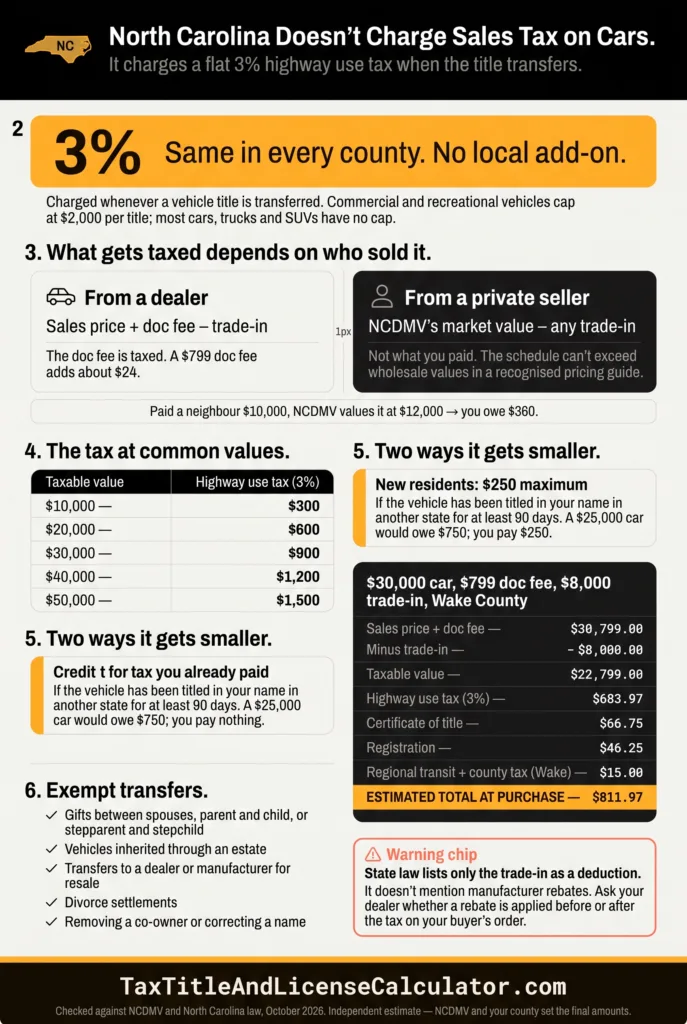
The highway use tax is North Carolina’s vehicle sales tax. It’s 3%, it’s the same in every county, and there’s no local add-on. It’s charged whenever a vehicle title is transferred, and the money goes to the state Highway Trust Fund and General Fund.
That flat rate is rare. California vehicle sales tax starts at 7.25% and climbs past 11.75% once district taxes are added, and your rate changes with your address.
Commercial vehicles and recreational vehicles have a cap of $2,000 per title. For most cars, trucks and SUVs, there’s no cap.
How the Highway Use Tax Is Calculated
Highway use tax = taxable value × 3%
What counts as the taxable value depends on who sold you the car.
| Purchase | Taxable value |
| From a dealer | Sales price + doc fee − trade-in |
| From a private seller | Market value from NCDMV’s schedule − any trade-in the seller gave you |
| Other transfers | Market value |
Dealer sales
The dealer taxes the sales price, including accessories on the car when you take it home. NCDMV’s fee chart says the doc fee is included and the trade-in comes off. A $799 doc fee adds about $24 in tax.
Private sales
In a private sale, the tax isn’t based on what you paid. It’s based on the vehicle’s market value from a schedule NCDMV adopts. By law, that schedule can’t go above wholesale values in a recognized pricing guide. A handful of states ignore the price you paid like this. Illinois private party vehicle use tax drops the percentage entirely and charges a flat amount set by the car’s age or price band.
Are rebates taken off?
State law only lists a trade-in as a deduction. It doesn’t mention manufacturer rebates. Ask your dealer whether a rebate is applied before or after the tax on your buyer’s order. Some states settle this clearly in the buyer’s favor. Missouri car sales tax subtracts a manufacturer rebate before the tax is figured, and the state’s own calculator tells buyers to do it.
How Much Is the Car Tax in North Carolina?
| Taxable value | Highway use tax (3%) |
| $10,000 | $300 |
| $20,000 | $600 |
| $30,000 | $900 |
| $40,000 | $1,200 |
| $50,000 | $1,500 |
So a $30,000 car in North Carolina costs $900 in highway use tax before any trade-in.
Example 1: Dealer purchase in Wake County
Assumptions: $30,000 price, $799 doc fee, $8,000 trade-in, gas car, registered in Wake County.
| Item | Amount |
| Sales price + doc fee | $30,799.00 |
| Minus trade-in | − $8,000.00 |
| Taxable value | $22,799.00 |
| Highway use tax (3%) | $683.97 |
| Certificate of title | $66.75 |
| Registration | $46.25 |
| Regional transit + county tax (Wake) | $15.00 |
| Estimated total at purchase | $811.97 |
Your first property tax bill comes within about 60 days (see below). A loan adds a lien recording fee.
Example 2: Private sale
You pay a neighbor $10,000. NCDMV’s schedule values the car at $12,000. The highway use tax is $12,000 × 3% = $360, paid at the license plate agency when you title the car.
Moving to North Carolina or Buying Out of State
New residents: $250 maximum
If your vehicle has been titled in your name in another state for at least 90 days, the highway use tax is capped at $250. A $25,000 car would normally owe $750, but you pay $250. Other states handle incoming cars their own way. Texas tax, title and license charges new residents a flat $90 instead of a capped percentage.
Buying in another state
If you paid sales tax or a similar tax to another state within 90 days before applying for your North Carolina title, you can get credit for it. If you paid 4% on a $30,000 car ($1,200), that’s more than NC’s $900, so you’d owe no highway use tax.
Highway Use Tax Exemptions
- Gifts between spouses, a parent and child, or a stepparent and stepchild
- Vehicles inherited through an estate
- Transfers to a dealer or manufacturer for resale
- Transfers in a divorce settlement
- Removing a co-owner or correcting a name on a title
NCDMV lists a few more, including some vehicles modified for a person with a disability. Bring proof of the relationship or the court papers when you title.
North Carolina Title, Tag and Regional Fees
These are the fees that went into effect with NCDMV’s 2024 fee adjustment:
| Fee | Amount |
| Certificate of title | $66.75 |
| Registration, private passenger vehicle | $46.25 |
| Registration, private truck under 4,000 lbs | $46.25 |
| Lien recording | $25.50 |
| Regional transit tax (Wake, Durham, Orange) | $8.00 |
| County vehicle tax (Wake, Durham, Orange) | $7.00 |
| Regional transportation tax (Randolph County) | $1.00 |
Electric vehicle and plug-in hybrid fees
On top of registration, fully electric vehicles pay $214.50 a year and plug-in hybrids pay $107.25 a year. Regular hybrids don’t pay an extra fee. North Carolina’s is among the highest in the country, though others are catching up. Tennessee car sales tax charges electric vehicles $200 a year now, rising to $274 on January 1, 2027.
NC Vehicle Property Tax: The Yearly Car Tax
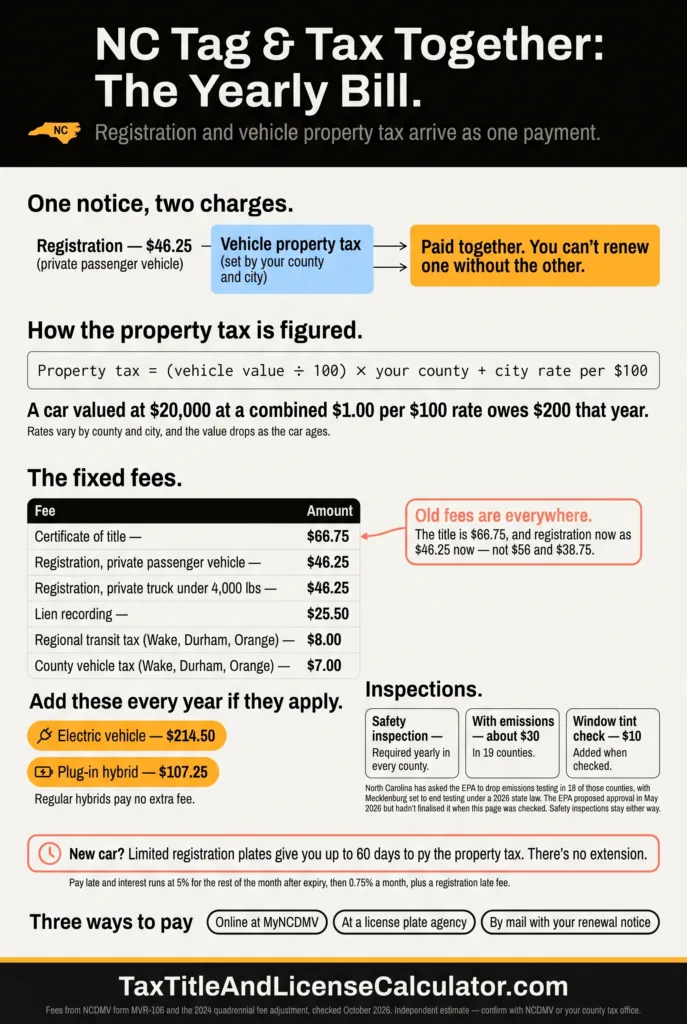
North Carolina also taxes vehicles as personal property. Your county assessor sets the vehicle’s value, and your county and city tax rates are applied to it. The bill comes with your tag renewal under the Tag & Tax Together program, so you pay both at once.
A few states bundle it the same way. Alabama ad valorem tax is also collected with your tag, which is why a renewal bill there is much bigger than the $23 plate fee suggests.
Property tax = (vehicle value ÷ 100) × your county + city rate per $100
Example: a car valued at $20,000 in an area with a combined rate of $1.00 per $100 owes $200 that year. Rates vary by county and city, and the value drops as the car ages.
New vehicles
When you buy a car, you get limited registration plates and up to 60 days before the property tax is due. You must pay it before that limited registration ends. There’s no extension.
How to Pay NC Vehicle Tax
You pay NC vehicle tax and your registration fee together. You can’t renew one without the other. Choose one of these:
- Online through MyNCDMV
- In person at a license plate agency
- By mail using your renewal notice
What if you pay late?
Interest of 5% applies for the rest of the month after your tag expires. After that, it’s 0.75% a month until you pay. A late fee on the registration also starts the day after it expires.
Inspections
Every county requires a yearly safety inspection, which costs $13.60. In 19 counties, the inspection also includes an emissions test, and the total is about $30. Window tint checks add $10.
North Carolina has asked the EPA to drop emissions testing in 18 of those counties, with Mecklenburg also set to end testing under a 2026 state law. EPA proposed approval in May 2026 but hadn’t finalized it when this page was checked. Safety inspections will stay either way.
How to Estimate North Carolina Vehicle Tax by Hand
- Find the taxable value: dealer price plus doc fee, or NCDMV’s market value for a private sale.
- Subtract your trade-in.
- Multiply by 3%. Cap it at $250 if you’re a new resident with a car titled elsewhere 90+ days.
- Subtract any tax you paid another state in the last 90 days.
- Add $66.75 for the title and $46.25 for registration.
- Add regional taxes if you live in Wake, Durham, Orange or Randolph County.
- Add $214.50 for an EV or $107.25 for a plug-in hybrid.
Then plan for the yearly property tax with each renewal.
What This Estimate Includes
- 3% highway use tax with trade-in
- $66.75 title fee
- $46.25 registration fee
- Regional transit and county taxes where they apply
- EV and plug-in hybrid fees
What This Estimate Does Not Include
- Yearly vehicle property tax (set by your county)
- Lien recording fee
- Inspection fees
- Late interest and fees
- Dealer add-ons, insurance and loan interest
Common Mistakes to Avoid
- Adding local sales tax. NC charges a flat 3% highway use tax, not local sales tax.
- Using your price on a private sale. The tax uses NCDMV’s market value.
- Leaving out the doc fee. It’s part of the taxable price at a dealer.
- Using old fees. The title is $66.75 and registration is $46.25 now, not $56 and $38.75.
- Forgetting the property tax. It comes due with every tag renewal.
- Missing the limited registration deadline. New-car property tax must be paid before it ends.
Frequently Asked Questions
Does North Carolina have sales tax on cars?
Not regular sales tax. North Carolina charges a 3% highway use tax instead when a vehicle title is transferred.
How much is North Carolina car tax on a $30,000 car?
The highway use tax is $900. With an $8,000 dealer trade-in, it drops to $660.
What is the NC auto tax for new residents?
If the vehicle has been titled in your name in another state for at least 90 days, the highway use tax is capped at $250.
How do I pay my NC vehicle tax?
Pay it with your registration renewal online at MyNCDMV, at a license plate agency, or by mail. Property tax and tag fees are paid together.
How much are title and tag fees in North Carolina?
The title is $66.75 and registration for a private passenger vehicle is $46.25 a year. Wake, Durham and Orange counties add $15 in regional taxes.
Do electric cars pay more in North Carolina?
Yes. EVs pay an extra $214.50 a year and plug-in hybrids pay $107.25.
What happens if I pay NC vehicle tax late?
You’ll owe 5% interest for the rest of the month after expiration, then 0.75% a month, plus a registration late fee.
Official Sources
- NCDMV: MVR-106, Title & Registration Fee Chart (Rev. 04/26)
- NCDMV: Vehicle Taxes (highway use tax and exemptions)
- NCDMV: Vehicle Property Taxes (Tag & Tax Together)
- NCDOT: 2024 DMV Quadrennial Fee Adjustment (§ 20-4.02)
- N.C. General Statutes Chapter 105, Article 5A (§§ 105-187.3, 105-187.6, 105-187.7)
- NC DEQ: Inspection and Maintenance (I/M) Program
- U.S. EPA: Proposed approval of North Carolina emissions testing changes (May 8, 2026)
This page is an independent estimate tool and guide. It isn’t affiliated with NCDMV, NCDOT or any county. Fees, rates and inspection rules can change, so confirm your final amount with NCDMV or your county tax office before you pay.
William researches vehicle taxes, title fees, registration charges and DMV requirements across the United States. His work focuses on turning state-specific fee schedules, tax guidance, registration requirements and statutory information into practical explanations for vehicle buyers and owners. He cross-checks calculator inputs against official state revenue departments, motor vehicle agencies and published fee schedules, paying particular attention to differences between sales tax, title fees, registration charges and local or county taxes. He also reviews state-level changes so that calculator results and supporting articles reflect the latest available requirements rather than relying on outdated third-party estimates.
About this site →