North Dakota Tax, Title and License Calculator (ND)
Compare nearby states
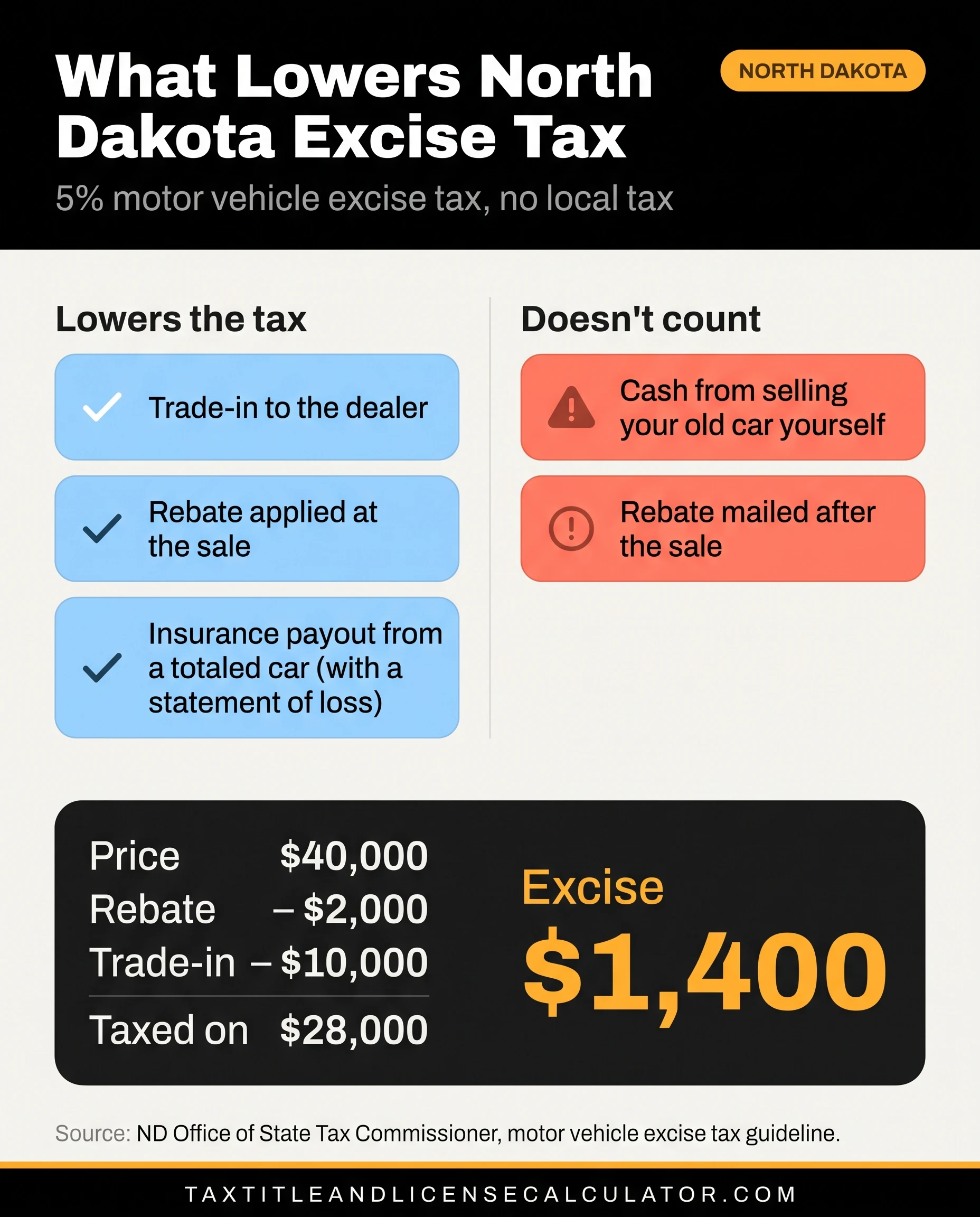
North Dakota charges a 5% motor vehicle excise tax on a car’s price after any trade-in and rebates. There’s no city or county tax. Registration is set by the car’s weight and how long it’s been registered, from $49 to $274 a year, and a title costs $5.
Use this tax, title and license calculator for North Dakota to estimate the excise tax and NDDOT fees on a new or used car. The guide below explains each rule and shows the math.
Checked against the ND Office of State Tax Commissioner, the NDDOT passenger fee schedule and ND.gov title guidance on October 13, 2026. This is an independent estimate. The NDDOT Motor Vehicle Division sets your final amount.
North Dakota Car Tax and Fees at a Glance
| Charge | Amount | Notes |
|---|---|---|
| Motor vehicle excise tax | 5% | After trade-in and rebates; no local tax |
| Title | $5 | Once |
| Registration (12 months) | $49 to $274 | By weight and years registered |
| Electric vehicle road use fee | $120 a year | On top of registration |
| Plug-in hybrid road use fee | $50 a year | On top of registration |
On this page13 sections
- North Dakota Car Tax and Fees at a Glance
- How North Dakota Excise Tax Is Calculated
- How Much Is Car Tax in North Dakota?
- North Dakota Registration Fees
- Title and EV Fees
- Gifts, Family Transfers and Military
- Moving to North Dakota or Buying Out of State
- How to Use an ND Vehicle Tax, Title and License Calculator by Hand
- What This Estimate Includes
- What This Estimate Does Not Include
- Common Mistakes to Avoid
- Frequently Asked Questions
- Official Sources
How North Dakota Excise Tax Is Calculated
Excise tax = (price − trade-in − rebates applied at sale) × 5%
The excise is collected by the NDDOT Motor Vehicle Division for the State Tax Commissioner. Many dealers send it in for you; private buyers pay it when they title the car. The plates and title aren’t issued until it’s paid.
Neighbors use different systems. South Dakota charges a 4% excise tax, and Iowa charges a one-time fee for new registration instead.
Does a trade-in lower the tax?
Yes. A trade-in comes off the price before tax. Cash you get from selling your old car to someone else doesn’t count as a trade-in on your next purchase.
Insurance money from a totaled car can count as a trade-in credit if you bring a notarized statement of loss. That statement is good for three years.
Do rebates lower the tax?
Yes. A manufacturer discount, incentive or rebate applied at the time of sale comes off the taxable price.
What’s included in the taxable price?
Accessories, dealer prep, freight and delivery are taxed. Title, registration and document fees, extended warranties and service contracts aren’t.
How Much Is Car Tax in North Dakota?
| Taxable price | Excise tax (5%) |
|---|---|
| $20,000 | $1,000 |
| $30,000 | $1,500 |
| $40,000 | $2,000 |
| $50,000 | $2,500 |
Example 1: New car from a Fargo dealer
Assumptions: $40,000 price, $2,000 rebate at the sale, $10,000 trade-in, 4,700-lb vehicle, first-year registration.
| Item | Amount |
|---|---|
| Taxable price | $28,000.00 |
| Excise tax (5%) | $1,400.00 |
| Registration, 12 months (4,500 to 4,999 lbs, newest group) | $111.00 |
| Title | $5.00 |
| Estimated total | $1,516.00 |
Add $120 if it’s an EV or $50 for a plug-in hybrid.
Example 2: Private sale
You buy a used car from a stranger for $9,000. The excise is $450, paid to the Motor Vehicle Division when you title it, plus $5 for the title and registration for its weight and age.
North Dakota Registration Fees
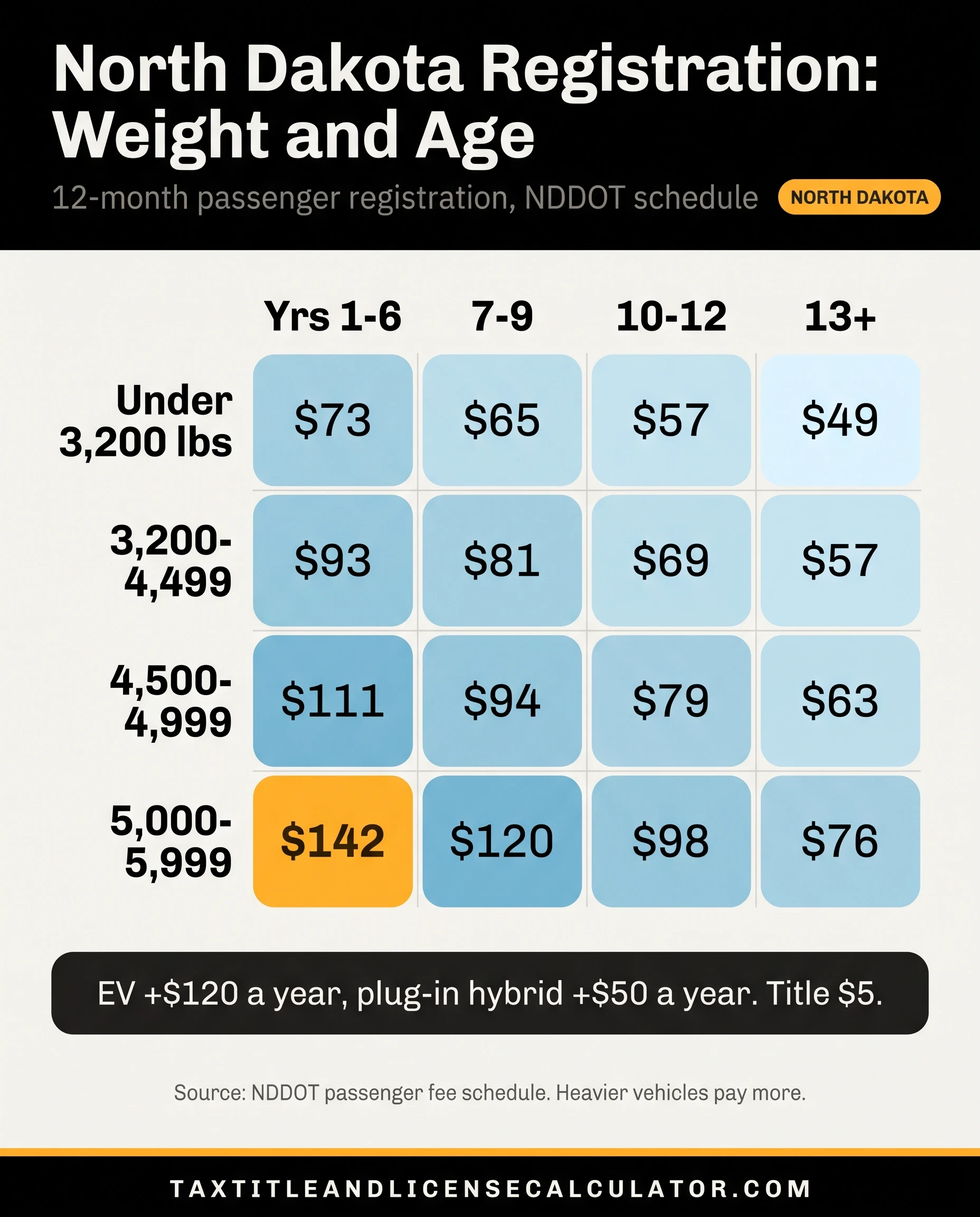
North Dakota sets 12-month registration by weight and by how many years the vehicle has been registered, counted from the year it was first registered. Fees drop as the car ages. The table below uses the NDDOT schedule (2025 edition) for a full 12 months; a shorter period is prorated by month.
| Weight | Years 1–6 | Years 7–9 | Years 10–12 | Year 13+ |
|---|---|---|---|---|
| Under 3,200 lbs | $73 | $65 | $57 | $49 |
| 3,200 to 4,499 lbs | $93 | $81 | $69 | $57 |
| 4,500 to 4,999 lbs | $111 | $94 | $79 | $63 |
| 5,000 to 5,999 lbs | $142 | $120 | $98 | $76 |
| 6,000 to 6,999 lbs | $175 | $146 | $117 | $89 |
| 7,000 to 7,999 lbs | $208 | $172 | $137 | $102 |
| 8,000 to 8,999 lbs | $241 | $199 | $157 | $115 |
| 9,000 lbs and over | $274 | $225 | $177 | $128 |
North Dakota has no yearly property tax on cars. By contrast, Kansas collects county property tax at registration.
Title and EV Fees
A North Dakota title transfer costs $5. EVs pay a $120 yearly road use fee and plug-in hybrids pay $50, on top of registration. Regular hybrids don’t pay an extra fee.
Gifts, Family Transfers and Military
Gifts are exempt between spouses, parents and children, grandparents and grandchildren, and siblings. Inheritances, transfers to a joint owner and transfers to a former spouse within one year of a divorce are exempt too.
A no-payment transfer to or from someone entering, serving in or just leaving the military is exempt with certification. Disabled veterans with a 100% service-connected rating can get up to two vehicles exempt.
Moving to North Dakota or Buying Out of State
North Dakota credits sales, use or excise tax you paid to another state, as long as that state gives a similar credit. If you bought or titled the car in a state with no sales or vehicle excise tax, such as Alaska, Delaware, Montana, New Hampshire or Oregon, you’ll owe North Dakota excise on its current market value when you title it here.
See also: Montana: no sales tax; a registration fee by vehicle age.
How to Use an ND Vehicle Tax, Title and License Calculator by Hand
- Start with the price, including accessories, prep and freight.
- Subtract your trade-in and any rebate applied at the sale.
- Multiply by 5%.
- Find registration in the table for your weight and years registered.
- Add the $5 title fee.
- Add $120 for an EV or $50 for a plug-in hybrid.
What This Estimate Includes
- 5% motor vehicle excise tax
- Trade-in and rebate credits
- Registration by weight and age (12 months)
- $5 title
- EV and plug-in hybrid fees
What This Estimate Does Not Include
- Prorated partial-year registration
- Specialty plates and lien fees
- Dealer add-ons, insurance and loan costs
Common Mistakes to Avoid
- Adding a local sales tax. North Dakota has none on vehicles.
- Counting cash from a private sale as a trade-in. It isn’t one.
- Forgetting the insurance-proceeds credit after a totaled car.
- Bringing a car from a no-tax state and expecting no tax. You’ll pay 5% of its market value.
- Using the model year instead of the year first registered for registration.
Frequently Asked Questions
- What is the tax on a car in North Dakota?
It’s a 5% motor vehicle excise tax on the price after trade-in and rebates, with no local tax.
How does a tax title and license calculator for ND work?
It subtracts your trade-in and rebate, applies 5%, then adds registration by weight and age, the $5 title and any EV fee.
- How much is registration in North Dakota?
For 12 months, $49 to $274 depending on weight and how long the car has been registered. Most newer cars pay $73 to $142.
Is a car from my parents taxed in North Dakota?
No. Gifts between parents and children, spouses, grandparents and grandchildren, and siblings are exempt.
How much is the EV fee in North Dakota?
It’s $120 a year for an EV and $50 for a plug-in hybrid.
Official Sources
- ND Office of State Tax Commissioner: Motor Vehicle Excise Tax guideline
- N.D. Admin. Code 81-05.1-01: Motor vehicle excise tax
- NDDOT: Passenger vehicle fee schedule
- ND.gov: Title and registration guidance
This page is an independent estimate tool and guide. It isn’t affiliated with the NDDOT or the Office of State Tax Commissioner. Rates and fees can change, so confirm your total before you pay.
William researches vehicle taxes, title fees, registration charges and DMV requirements across the United States. His work focuses on turning state-specific fee schedules, tax guidance, registration requirements and statutory information into practical explanations for vehicle buyers and owners. He cross-checks calculator inputs against official state revenue departments, motor vehicle agencies and published fee schedules, paying particular attention to differences between sales tax, title fees, registration charges and local or county taxes. He also reviews state-level changes so that calculator results and supporting articles reflect the latest available requirements rather than relying on outdated third-party estimates.
About this site →