Indiana Vehicle Sales Tax Calculator: 7% Tax, Title & Plates
Indiana vehicle sales tax is 7% of the taxable price, and it’s the same everywhere in the state. No county or city adds local sales tax on a car. A like-kind trade-in lowers the taxable price, but a manufacturer rebate doesn’t.
Rates and fees checked against the Indiana Department of Revenue and the Indiana Bureau of Motor Vehicles (BMV) on October 2, 2026. This is an independent estimate. The BMV sets your final amount.
Use our Indiana vehicle sales tax calculator to estimate the tax on a new or used car, plus the BMV title, registration and annual excise tax. The guide below explains each charge, so you can check the math yourself.
On this page16 sections
- Vehicle Tax Calculators for Nearby States
- Indiana Vehicle Tax and Fees at a Glance
- How Indiana Vehicle Sales Tax Is Calculated
- What Counts in the Taxable Price
- How Much Is Car Sales Tax in Indiana?
- Indiana Vehicle Excise Tax
- Indiana Title, Registration and Plate Fees
- Private Sales, Gifts and Family Transfers
- Buying Out of State or Moving to Indiana
- Emissions Testing
- How to Use an Indiana Vehicle Sales Tax Calculator by Hand
- What This Estimate Includes
- What This Estimate Does Not Include
- Common Mistakes to Avoid
- Frequently Asked Questions
- Official Sources
Indiana Vehicle Tax and Fees at a Glance
| Charge | Amount | Notes |
|---|---|---|
| Sales tax | 7% of the taxable price | Statewide; no local sales tax |
| Vehicle excise tax | $12 to $532 a year (passenger cars) | Based on original MSRP and age; paid at every registration |
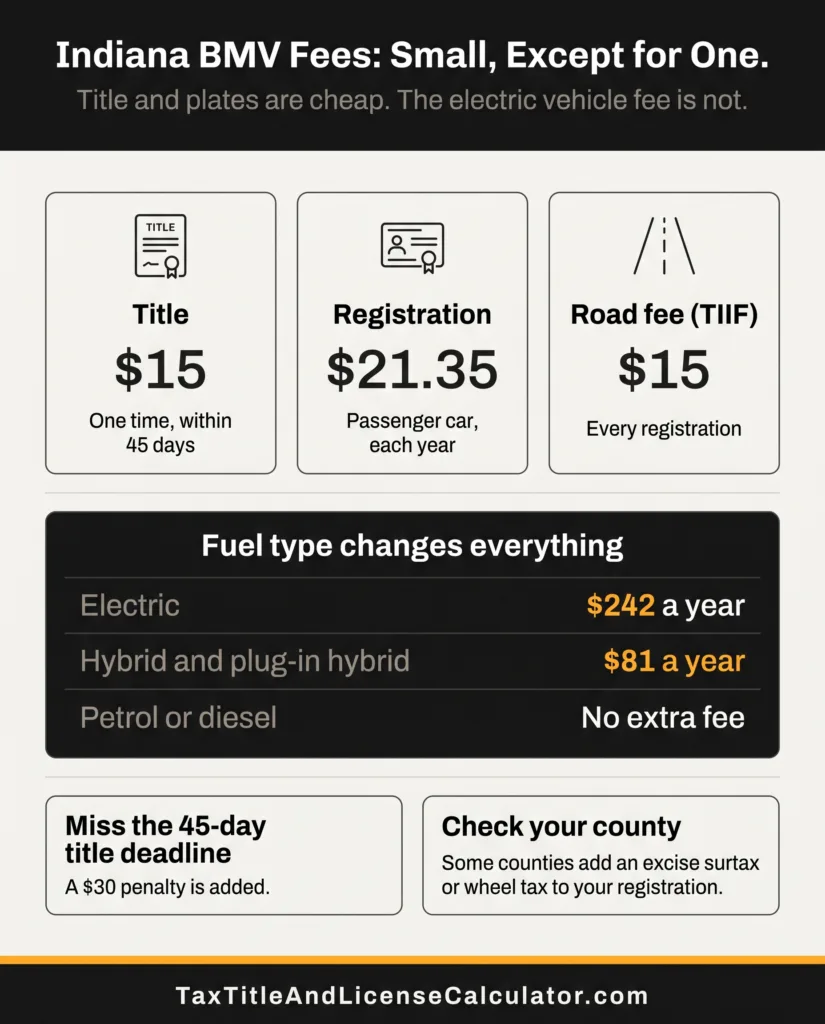
| Title fee | $15 | One time; speed title is $25 extra |
| Registration (passenger) | $21.35 a year | Rate since Jan. 1, 2026 |
| Transportation Infrastructure Improvement Fee | $15 a year | Charged on every registration |
| Electric vehicle fee | $242 a year | At first registration and each renewal |
| Hybrid fee | $81 a year | Includes plug-in hybrids |
| County excise surtax / wheel tax | Varies | Only where your county or city adopted one |
How Indiana Vehicle Sales Tax Is Calculated
The math is short because Indiana uses one rate:
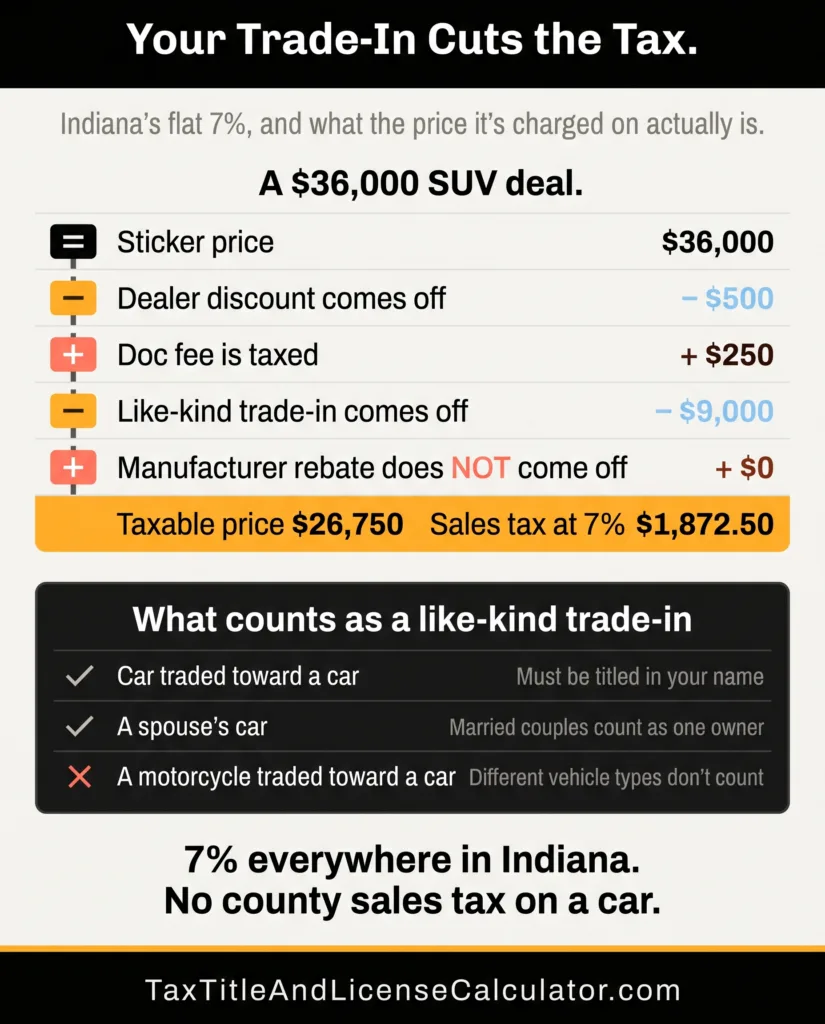
Sales tax = (price − dealer discount + doc fee − like-kind trade-in) × 7%
The Indiana Department of Revenue (DOR) collects the tax. If you buy from an Indiana dealer, the dealer collects it and gives you Form ST-108 as proof. If you buy from a private seller, you pay it at a BMV branch when you apply for the title.
The rate doesn’t change by county. Indianapolis, Fort Wayne and a rural county all pay 7%. Local taxes in Indiana show up later, on your registration, as an excise surtax or wheel tax.
What Counts in the Taxable Price
Does a trade-in lower the tax in Indiana?
Yes, if it’s a like-kind exchange. That means you trade a car for a car (or a trailer for a trailer), the trade-in is titled in your name, and it happens as part of the same deal. A $40,000 truck with a $12,000 trade-in is taxed on $28,000.
A few details trip people up:
- Different vehicle types don’t count. A motorcycle traded toward a car isn’t like-kind, so it doesn’t lower the tax.
- Selling to one dealer and buying from another doesn’t count. The trade must be with the dealer selling you the new vehicle.
- Married couples count as one owner. A trade in one spouse’s name can apply to a car titled to the other. The dealer may ask for your marriage license.
- Loan balance doesn’t matter. The full trade-in value still lowers the price, and negative equity rolled into the new loan isn’t taxed.
- Lease buyouts can count. A leased car works as a trade-in only if it was bought out first and sales tax was paid on that buyout.
Are rebates taxed in Indiana?
Yes. A manufacturer rebate is treated as a payment, not a price cut. You pay tax on the price before the rebate, whether the rebate goes to you or to the dealer.
Two kinds of savings do lower the tax. A dealer discount cuts the price. A manufacturer price reduction that’s never paid to you or the dealer does too. So does a manufacturer employee-purchase discount.
Is the dealer doc fee taxed?
Yes. Indiana treats a documentation fee as part of the sale, so it’s taxed at 7%. A separately listed convenience fee for handling your BMV title and plates isn’t taxed.
As of July 1, 2026, the Indiana Secretary of State says it won’t take action against doc fees of $261.72 or less. The fee must be listed on its own line on your bill of sale.
How Much Is Car Sales Tax in Indiana?
Here’s the 7% tax at common prices. Use your taxable price, after the trade-in and any dealer discount.
| Taxable price | Indiana sales tax (7%) |
|---|---|
| $10,000 | $700 |
| $15,000 | $1,050 |
| $20,000 | $1,400 |
| $25,000 | $1,750 |
| $30,000 | $2,100 |
| $35,000 | $2,450 |
| $40,000 | $2,800 |
| $50,000 | $3,500 |
So a $30,000 car in Indiana costs $2,100 in sales tax. There’s no local add-on to work out.
Example 1: New SUV from an Indiana dealer
Assumptions: $36,000 price, $500 dealer discount, $250 doc fee, $1,000 manufacturer rebate, $9,000 trade-in, original MSRP $37,000, gas engine, registered in a county with no surtax. Check the fees for Rhode Island.
| Item | Amount |
|---|---|
| Price | $36,000.00 |
| Minus dealer discount | − $500.00 |
| Plus doc fee | + $250.00 |
| Rebate (not subtracted) | $0.00 |
| Minus trade-in | − $9,000.00 |
| Taxable price | $26,750.00 |
| Sales tax (7%) | $1,872.50 |
| Title fee | $15.00 |
| Registration | $21.35 |
| Transportation Infrastructure Improvement Fee | $15.00 |
| Vehicle excise tax (Class 16, new) | up to $469.00 |
| Estimated total | up to $2,392.85 |
The excise tax is “up to” because the BMV lowers your first bill when you buy partway through your registration year. If this were an electric SUV, add $242.
Example 2: Used car from a private seller
You buy a 2019 sedan from a neighbor for $14,000. Its original MSRP was $27,500 (Class 14), and it’s 7 years old for 2026 registration.
- Sales tax: $14,000 × 7% = $980, paid at the BMV branch
- Title, registration and TIIF: $51.35
- Excise tax: up to $91
Estimated total: up to $1,122.35, plus any county surtax or wheel tax.
Example 3: Car bought out of state
You live in Indiana and buy a $30,000 car from a dealer in another state, which charges you 5% ($1,500). Indiana tax would be $2,100. When you title it here, the BMV gives you credit for the $1,500 and you pay the $600 difference.
Indiana Vehicle Excise Tax
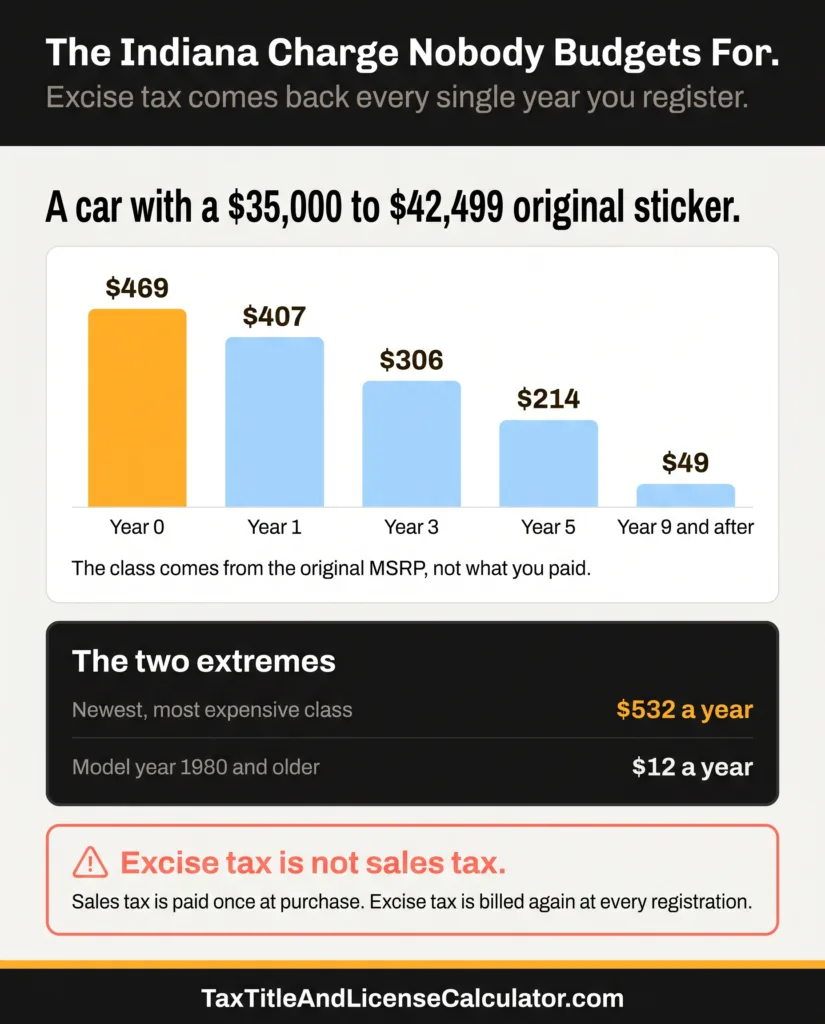
This is the charge most people don’t expect. Indiana doesn’t charge personal property tax on cars. Instead, you pay a vehicle excise tax every year when you register.
It’s based on two things: the vehicle’s class, set by its original MSRP, and its age. Age is the year you register minus the model year. The tax drops as the car gets older, and it bottoms out after year nine.
| Original MSRP (class) | Age 0 | Age 1 | Age 3 | Age 5 | Age 9+ |
|---|---|---|---|---|---|
| $15,000–$17,999 (11) | $207 | $179 | $135 | $94 | $21 |
| $18,000–$21,999 (12) | $250 | $217 | $163 | $114 | $26 |
| $22,000–$24,999 (13) | $300 | $260 | $184 | $121 | $30 |
| $25,000–$29,999 (14) | $350 | $304 | $228 | $160 | $36 |
| $30,000–$34,999 (15) | $406 | $353 | $257 | $169 | $42 |
| $35,000–$42,499 (16) | $469 | $407 | $306 | $214 | $49 |
| $42,500 and over (17) | $532 | $461 | $347 | $242 | $50 |
Source: BMV passenger vehicle excise table. Cars with an MSRP under $15,000 fall in Classes 1–10 and pay less. Model year 1980 and older pay a flat $12.
When you sell or trade a car, you can apply for a credit or refund of part of its excise tax with State Form 55296. The credit can go toward the excise on your next vehicle.
Indiana Title, Registration and Plate Fees
| Fee | Amount |
|---|---|
| Certificate of title | $15 |
| Speed title (faster processing) | $25 extra |
| Late title penalty (after 45 days) | $30 |
| Passenger vehicle registration | $21.35 a year |
| Transportation Infrastructure Improvement Fee | $15 a year |
| Late registration penalty | $15 |
| Transfer plate to another vehicle you own | $9.50 |
| Temporary permit | $18 |
| Personalized plate message | $45 extra |
| VIN inspection (out-of-state vehicles) | Free at a BMV branch; up to $5 by a police officer |
Title deadline: apply for the title within 45 days of buying the vehicle, or you’ll pay the $30 penalty. Dealers usually handle this for you. In a private sale, it’s on you.
County and city taxes: some counties charge a county vehicle excise surtax, and some cities charge a municipal tax or wheel tax. These are added to your registration, not your sales tax. The amount depends on your address, so check the BMV Quick Quote tool for your exact total.
Electric vehicle and hybrid fees
Indiana adds a supplemental fee when you first register and at every renewal:
- Electric vehicles: $242 a year
- Hybrids, including plug-in hybrids: $81 a year
These amounts rise with an inflation index, so check the BMV fee chart each year.
Private Sales, Gifts and Family Transfers
A private sale is taxed just like a dealer sale: 7% of the price you paid. You pay it at the BMV branch with your title application. Bring the signed title and a bill of sale showing the price.
Gifts and inheritances are exempt. If no money changes hands, claim the exemption on Form ST-108E (Exemption 7). Taking over the seller’s loan payments counts as payment, so that’s taxed unless you were already on the original loan.
Selling to family isn’t exempt. Indiana has no family-sale exemption. If your parent sells you a car for $8,000, you owe $560. The family exemption (Exemption 11) only covers adding or removing a spouse, child, parent, grandparent or sibling on a title you already own.
Buying Out of State or Moving to Indiana
Indiana residents who buy out of state
The BMV gives you credit for sales tax you paid to another state. If you paid less than 7%, you pay the difference when you title the car in Indiana, as in Example 3. If the other state charged nothing, you owe the full 7%.
Shopping across the line? Our Kentucky and Ohio guides show what dealers there charge, which helps you figure the Indiana difference.
Any vehicle coming from another state needs a VIN inspection before Indiana will title it. A BMV branch does it for free.
Nonresidents buying from an Indiana dealer
If you live in another state and will title the car there within 30 days, the Indiana dealer still collects sales tax, but at your home state’s state-level rate, capped at 7%. Local rates from your state aren’t included. You’ll sign Form ST-108NR.
If your home state has no sales tax on vehicles, the dealer collects nothing. If the dealer delivers the car to you outside Indiana, the sale isn’t taxed in Indiana either.
Indiana’s dealer only collects the tax. Your home state still handles the title and plates, so check our Illinois tax, title and license calculator or Michigan tax, title and license calculator for those costs.
Out-of-state LLC titling
Some Indiana residents tried skipping the tax by titling a car through an LLC in a state with no sales tax, like Montana. Indiana presumes that’s tax evasion. You’ll owe the 7% plus penalties, and for purchases after June 30, 2026, an extra $500 penalty per vehicle.
New Indiana residents
If you move here with a car you bought, titled and registered while living in another state, you don’t pay Indiana sales tax on it. You’ll claim Exemption 8 on Form ST-108E. You’ll still pay the title, registration, TIIF and excise tax. You have 60 days after becoming a resident to title and register.
Emissions Testing
Only Lake and Porter counties require it. Gas vehicles registered there with a gross weight rating of 9,000 pounds or less get tested every two years through the Clean Air Car Check program. The four newest model years are exempt. No other Indiana county has emissions testing or a safety inspection.
How to Use an Indiana Vehicle Sales Tax Calculator by Hand
- Start with the price and add any doc fee.
- Subtract any dealer discount or manufacturer price reduction. Don’t subtract a manufacturer rebate.
- Subtract your like-kind trade-in value.
- Multiply by 7%. Subtract any sales tax you already paid to another state.
- Add the $15 title, $21.35 registration and $15 TIIF.
- Look up your excise tax in the BMV class table by MSRP and age.
- Add $242 for an EV or $81 for a hybrid, plus any county surtax or wheel tax.
What This Estimate Includes
- 7% Indiana sales tax
- Trade-in credit for like-kind trades
- Rebate treatment (taxed)
- $15 title fee
- $21.35 registration and $15 TIIF
- Vehicle excise tax by MSRP class and age
- EV or hybrid supplemental fee
What This Estimate Does Not Include
- Dealer doc fee (add it to the price yourself)
- County excise surtax and municipal wheel tax
- First-year excise reduction for buying mid-year
- Speed title, late penalties and specialty plates
- Insurance, loan interest and dealer add-ons
Common Mistakes to Avoid
- Adding county sales tax. Indiana has none on vehicles. Some online calculators get this wrong.
- Subtracting the rebate. Indiana taxes the price before a manufacturer rebate.
- Forgetting the doc fee. It’s part of the taxable price.
- Counting a trade-in from a different dealer. It only counts in the same deal.
- Treating a family sale like a gift. Only a true gift, with no payment, is exempt.
- Confusing excise tax with sales tax. Sales tax is paid once. Excise tax comes back every year.
- Missing the 45-day title deadline. It costs $30.
Frequently Asked Questions
What is the vehicle sales tax in Indiana?
It’s 7% of the taxable price, statewide. Counties and cities don’t add local sales tax to vehicle purchases.
How much is sales tax on a $30,000 car in Indiana?
It’s $2,100. If you have a like-kind trade-in, subtract it first. A $10,000 trade drops the tax to $1,400.
Do you pay sales tax on a used car in Indiana?
Yes. Used cars are taxed at 7%, whether you buy from a dealer or a private seller. In a private sale, you pay at the BMV when you title the car.
Do I pay sales tax on a car gifted by a family member?
No, if it’s a true gift with no payment. Claim Exemption 7 on Form ST-108E. If you pay anything, even to a parent, it’s taxed.
Is the Indiana excise tax the same as sales tax?
No. Sales tax is a one-time 7% charge on the purchase. Excise tax is an annual charge on your registration, based on the car’s original MSRP and age.
Do I pay Indiana sales tax if I live in another state?
Usually, yes, at your home state’s state-level rate, up to 7%, if you title the car at home within 30 days. If your state has no sales tax, you pay none in Indiana.
Is an Indiana vehicle sales tax calculator estimate exact?
The sales tax part is exact once you know the taxable price. The excise tax and local surtax depend on your address and timing, so the BMV sets the final total.
Official Sources
- Indiana Department of Revenue: Sales Tax Information Bulletin #28S, Sales of Motor Vehicles and Trailers (May 2026)
- Indiana Department of Revenue: Sales Tax Information Bulletin #84, Sales Tax Collection on Sales of Motor Vehicles (May 2026)
- Indiana Department of Revenue: Form ST-108E, Certificate of Gross Retail or Use Tax Exemption
- Indiana BMV: Fee Chart (revised Jan. 1, 2026)
- Indiana BMV: Excise Tax Information
- Indiana BMV: Vehicle Registration Fees and Taxes
- Indiana BMV: Buying and Selling a Vehicle
- Indiana BMV: Vehicle Emissions Testing Program
- Indiana Secretary of State, Auto Dealer Services: Documentation Preparation Fee Adjustment in 2026
This page is an independent estimate tool and guide. It isn’t affiliated with the Indiana Department of Revenue or the Indiana BMV. Rates and fees can change, so confirm your total with the BMV before you pay.
William researches vehicle taxes, title fees, registration charges and DMV requirements across the United States. His work focuses on turning state-specific fee schedules, tax guidance, registration requirements and statutory information into practical explanations for vehicle buyers and owners. He cross-checks calculator inputs against official state revenue departments, motor vehicle agencies and published fee schedules, paying particular attention to differences between sales tax, title fees, registration charges and local or county taxes. He also reviews state-level changes so that calculator results and supporting articles reflect the latest available requirements rather than relying on outdated third-party estimates.
About this site →