Michigan Vehicle Sales Tax Calculator: Tax, Title and Plates
Compare nearby states
Michigan charges a flat 6% sales tax on a car, with no county or city add-on. In 2026, only the first $12,000 of a trade-in lowers the tax, and manufacturer rebates don’t lower it at all. You also pay a $15 title fee and a yearly registration based on the car’s original list price.
Use this Michigan vehicle sales tax calculator to estimate the tax, title and registration on a new or used car, from a dealer or a private seller. The guide below shows each rule and the math.
Checked against the Michigan Department of Treasury, MCL 257.801 and Secretary of State fee information on October 13, 2026. This is an independent estimate. The Secretary of State sets your final amount.
Michigan Car Tax and Fees at a Glance
| Charge | Amount | Notes |
|---|---|---|
| Sales or use tax | 6% | Statewide, no local tax |
| Trade-in credit limit | $12,000 in 2026 | Rises $1,000 a year; no limit from 2029 |
| Title fee | $15 | Once |
| Registration | Based on list price | Drops 10% a year for the first three renewals |
| EV fee | $267 a year (2026) | Light electric vehicles, on top of registration |
| Plug-in hybrid fee | About $113 a year (2026) | On top of registration |
| Plate fee | $5 | New standard plate |
On this page12 sections
- Michigan Car Tax and Fees at a Glance
- How Michigan Car Sales Tax Is Calculated
- How Much Is Car Sales Tax in Michigan?
- Michigan Registration Fees
- Private Sales and Family Transfers in Michigan
- Buying a Car Out of State
- How to Estimate Michigan Tax, Title and Plates by Hand
- What This Estimate Includes
- What This Estimate Does Not Include
- Common Mistakes to Avoid
- Frequently Asked Questions
- Official Sources
How Michigan Car Sales Tax Is Calculated
Sales tax = (price + dealer fees − trade-in up to $12,000) × 6%
Michigan’s rate is the same everywhere in the state. A dealer collects sales tax. In a private sale, you pay the same 6% as use tax to the Secretary of State when you title the car.
How does the Michigan trade-in cap work?
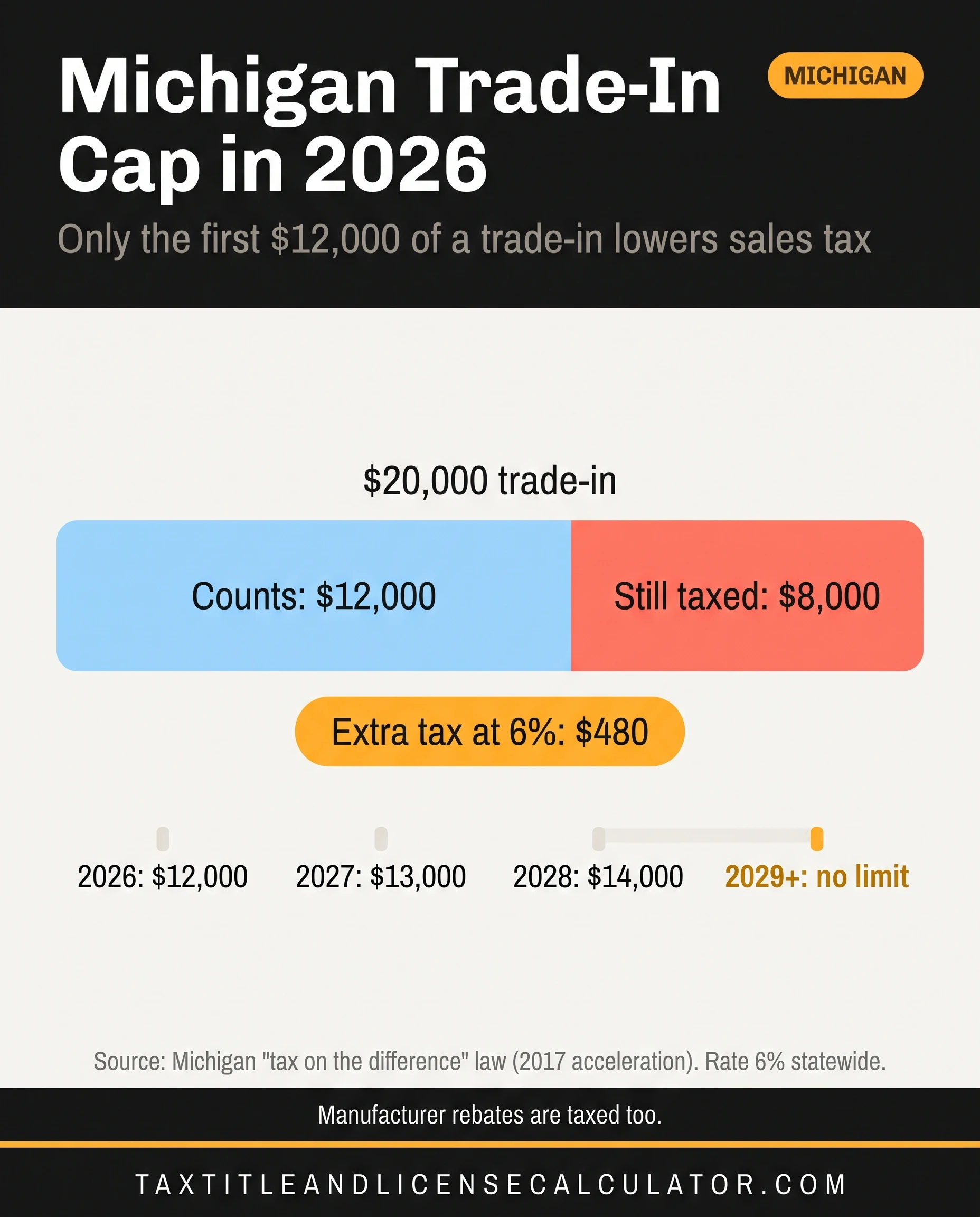
Michigan lets you subtract a trade-in only up to a yearly limit. The limit is $12,000 in 2026, $13,000 in 2027 and $14,000 in 2028. From January 1, 2029, there’s no limit. Anything above the cap is still taxed.
Say your trade-in is worth $20,000 in 2026. Only $12,000 comes off the price, so $8,000 of trade value is still taxed. That costs $480 more than if the full trade-in counted.
- Are rebates taxed in Michigan?
Yes. Michigan taxes the price before a manufacturer rebate, so a $2,000 factory rebate doesn’t lower your tax. Lawmakers have proposed exempting rebates, but check with the dealer before you assume a change. A dealer discount does lower the taxable price.
Is the doc fee taxed?
Yes. The dealer documentary fee is part of the price you pay the dealer, so it’s included in the 6%.
How Much Is Car Sales Tax in Michigan?
| Taxable price | Sales tax (6%) |
|---|---|
| $20,000 | $1,200 |
| $30,000 | $1,800 |
| $40,000 | $2,400 |
| $50,000 | $3,000 |
Example 1: New car from a Detroit dealer
Assumptions: $42,000 price, $250 doc fee, $2,000 manufacturer rebate, $15,000 trade-in, $43,000 list price, 2026 purchase.
| Item | Amount |
|---|---|
| Price + doc fee (rebate isn’t subtracted) | $42,250.00 |
| Minus trade-in, capped at $12,000 | − $12,000.00 |
| Taxable price | $30,250.00 |
| Sales tax (6%) | $1,815.00 |
| Title fee | $15.00 |
| First-year registration ($43,000 list price) | $256.00 |
| Estimated total | $2,086.00 |
Add $267 for an EV or about $113 for a plug-in hybrid, plus the plate fee and small service fees.
Example 2: Private sale
You buy a used car from a stranger for $11,000. You pay $660 in use tax at the Secretary of State when you transfer the title. If you buy it from your sister instead, it’s tax-free.
Michigan Registration Fees
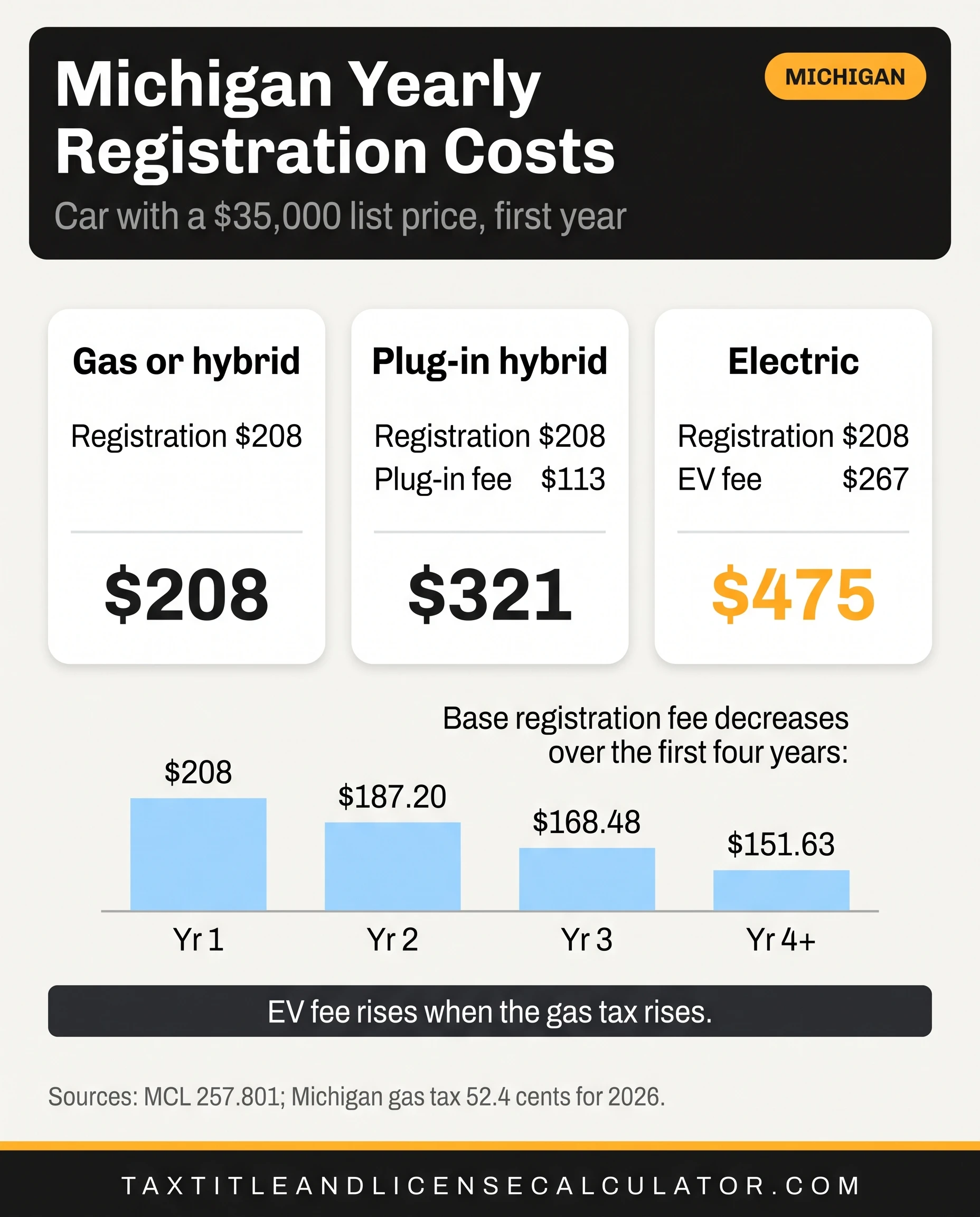
Michigan bases yearly registration on the car’s list price when new, not what you paid. The fee is $36 up to a $6,000 list price, $40 up to $7,000 and $46 up to $8,000. After that it rises $6 for each extra $1,000.
The fee drops 10% at each of the first three renewals, then stays flat. You renew on your birthday.
| Registration year | Fee on a $35,000 list price |
|---|---|
| First year | $208 |
| Second year | $187.20 |
| Third year | $168.48 |
| Fourth year and later | $151.63 |
Michigan isn’t the only state that ties a yearly charge to the original price. Indiana’s yearly excise tax uses MSRP classes, and Maine also bases its excise on MSRP.
Michigan EV and plug-in hybrid fees
Michigan adds a yearly fee for electric and plug-in hybrid cars on top of registration. Part of it is tied to the gas tax: EVs pay $5 and plug-in hybrids $2.50 for every cent the gas tax is above 19 cents.
With the gas tax at 52.4 cents for 2026, a light EV pays $267 a year and a plug-in hybrid about $113. That’s among the highest in the country. For comparison, Washington charges $225 for EVs.
Private Sales and Family Transfers in Michigan
A private sale is taxed at 6% use tax. You pay it at a Secretary of State office when you transfer the title, based on the price you paid.
Michigan exempts transfers between a spouse, parent, sibling, child, grandparent, grandchild, stepparent, stepchild, stepsibling, legal ward or guardian, and in-laws (parent-, sibling-, child- and grandparent-in-law). Nieces, nephews, aunts, uncles and cousins aren’t exempt.
Buying a Car Out of State
If you live in Michigan and buy a car in another state, you owe Michigan’s 6% use tax when you title it here. Tax properly paid to the other state is credited, so you pay only the difference. Bring the bill of sale showing the tax paid.
How to Estimate Michigan Tax, Title and Plates by Hand
- Start with the price and add the doc fee.
- Subtract your trade-in, up to $12,000 in 2026. Don’t subtract a rebate.
- Multiply by 6%.
- Add the $15 title fee.
- Find your registration from the list price, using the schedule above.
- Add $267 for an EV or about $113 for a plug-in hybrid.
- Add the $5 plate fee if you need a new plate.
What This Estimate Includes
- 6% sales or use tax
- The 2026 trade-in cap
- Rebates taxed
- $15 title and registration by list price
- EV and plug-in hybrid fees
What This Estimate Does Not Include
- Plate and small service fees
- Specialty or personalized plates
- Dealer add-ons, insurance and loan costs
- Late fees
Common Mistakes to Avoid
- Subtracting the full trade-in. Only $12,000 counts in 2026.
- Subtracting the rebate. Michigan taxes it.
- Adding a local sales tax. Michigan has none.
- Using the price you paid for registration. It’s based on list price.
- Budgeting an old EV fee. It’s $267 in 2026.
- Paying tax on a transfer from a sibling or in-law. Those are exempt.
Frequently Asked Questions
- What is the sales tax on a car in Michigan?
It’s 6% statewide, with no local add-on. Private buyers pay the same 6% as use tax.
How does a Michigan vehicle sales tax calculator handle trade-ins?
It subtracts your trade-in up to the yearly cap, which is $12,000 in 2026. Any trade-in value above that is still taxed.
How much is tax on a $30,000 car in Michigan?
It’s $1,800 before any trade-in.
How much is the Michigan EV registration fee?
For 2026, it’s $267 a year for a light EV and about $113 for a plug-in hybrid, on top of regular registration.
Is a car from my brother tax-free in Michigan?
Yes. Transfers between siblings are on Michigan’s exempt list, along with spouses, parents, children, grandparents, step-relatives and in-laws.
Official Sources
- Michigan Legislature: MCL 257.801 (registration tax)
- Michigan Treasury: Revenue Administrative Bulletin 2018-5 (exempt family transfers)
- Michigan Treasury: 2026 motor fuel tax rate change
- Michigan House: Trade-in credit acceleration analysis
- Michigan Senate Fiscal Agency: EV and PHEV registration fees (SB 593 analysis)
- Michigan Secretary of State: Plates and tabs
This page is an independent estimate tool and guide. It isn’t affiliated with the Michigan Secretary of State or Department of Treasury. Rates and fees can change, so confirm your total before you pay.
William researches vehicle taxes, title fees, registration charges and DMV requirements across the United States. His work focuses on turning state-specific fee schedules, tax guidance, registration requirements and statutory information into practical explanations for vehicle buyers and owners. He cross-checks calculator inputs against official state revenue departments, motor vehicle agencies and published fee schedules, paying particular attention to differences between sales tax, title fees, registration charges and local or county taxes. He also reviews state-level changes so that calculator results and supporting articles reflect the latest available requirements rather than relying on outdated third-party estimates.
About this site →