Alaska Tax, Title and License Calculator
Alaska has no state sales tax. Some cities and boroughs charge their own. You also pay a $15 title fee, $100 for two years of registration and a motor vehicle registration tax. In Anchorage, that tax is $70 to $150 for two years, based on the car's model year.
Use this Alaska tax, title and license calculator to estimate your costs. Below you'll find the registration tax by area, the local sales tax rules and three worked examples. Hawaii also has no sales tax, but it taxes dealers instead.
Checked against the Alaska Division of Motor Vehicles (DMV) on October 22, 2026. This is an independent estimate. The DMV and your local government set the final amounts.
Alaska Car Costs at a Glance
| Charge | Amount | Notes |
|---|---|---|
| State sales tax | None | Alaska has no statewide sales tax |
| Local sales tax | Varies | Set by your city or borough; some cap the taxable amount |
| Title | $15 | Waived if you get a registration only |
| Lien recording | $15 | Waived if you get a registration only |
| Registration, passenger car | $100 | For 24 months |
| Registration tax, Anchorage and Mat-Su | $70–$150 | For 24 months, by model year |
| Registration tax, other areas | Varies | Some areas charge nothing |
| Walk-in fee | $10 | May apply to in-person visits |
On this page14 sections
- Alaska Car Costs at a Glance
- Does Alaska Have Sales Tax on Cars?
- Alaska Title and Lien Fees
- Alaska Registration: $100 for Two Years
- What Is the Alaska Motor Vehicle Registration Tax?
- How Much Does It Cost to Register a Car in Alaska?
- Moving to Alaska and Buying From Out of State
- EVs, Leases and Other Special Cases
- How to Calculate Alaska Costs by Hand
- What This Estimate Includes
- What This Estimate Does Not Include
- Common Mistakes to Avoid
- Frequently Asked Questions
- Official Sources
Does Alaska Have Sales Tax on Cars?
Not at the state level. Alaska's state government charges no sales tax, according to the Office of the State Assessor. But there are more than 100 local taxing places. Cities and boroughs can charge their own sales tax and use tax.
Rates and rules differ. Some places tax only the first part of a purchase. The Kenai Peninsula Borough, for example, applies its tax to the first $500 of a sale. Ask your city or borough how it treats cars.
Neighbors in the lower 48 differ. Montana and Oregon also have no general sales tax, but both charge other fees when you register.
Local sales tax = taxable amount × your local rate

Alaska Title and Lien Fees
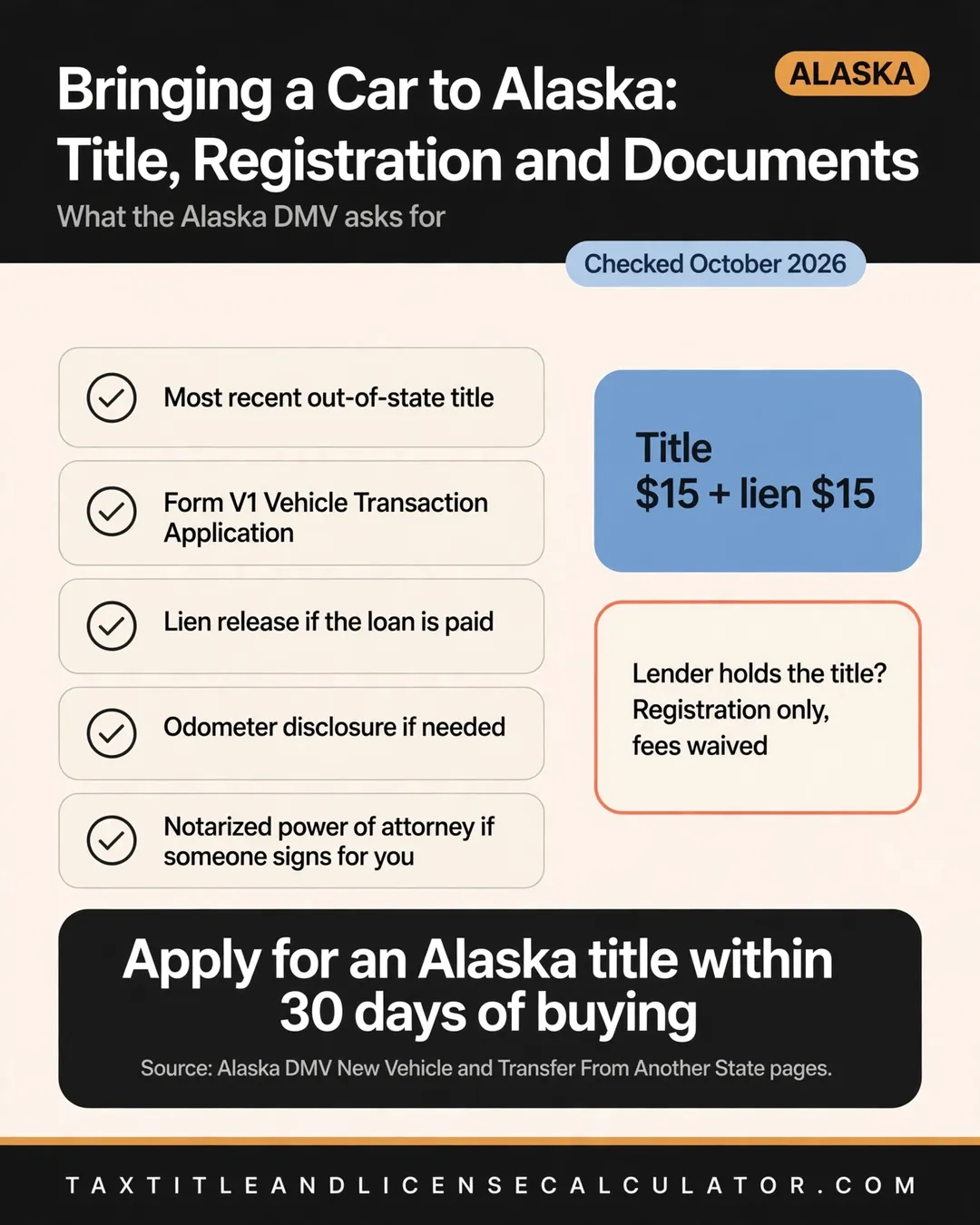
An Alaska title costs $15. Recording a lien costs $15. The law says you must apply for a title in your name within 30 days of buying a vehicle.
If your out-of-state title is already in your name and the lender holds it, Alaska issues a registration only. In that case the DMV waives both the $15 title fee and the $15 lien fee. The car must be in Alaska.
| Fee | Amount |
|---|---|
| Title | $15 |
| Lien recording | $15 |
| Manufactured home title | $100 |
| Walk-in fee (in person, may apply) | $10 |
Alaska Registration: $100 for Two Years
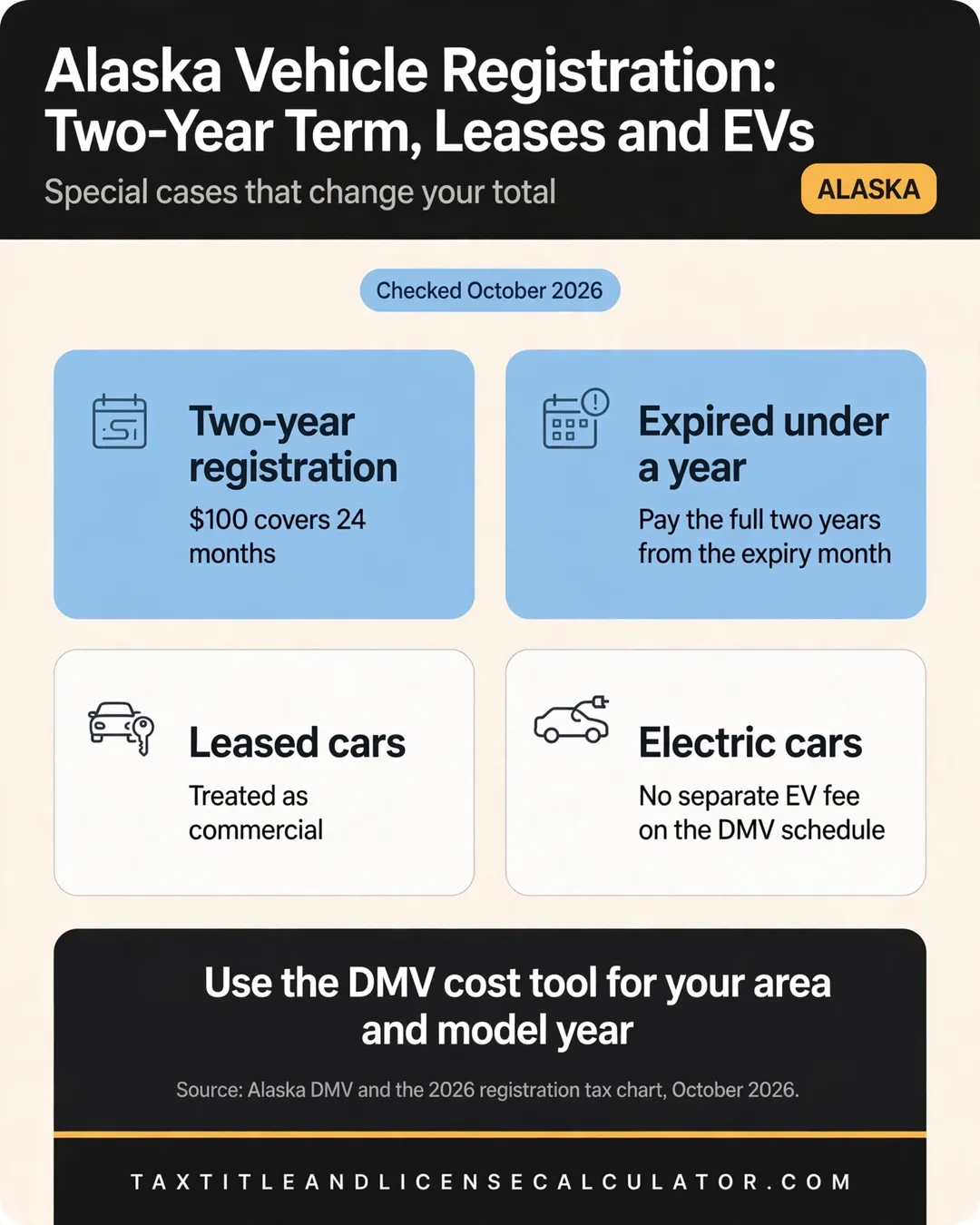
Alaska registers passenger vehicles for two years at a time. The state fee is $100 for the full 24 months. That's about $50 a year. Standard plates have no renewal fee. Specialty plates have their own purchase and renewal fees.
If your registration has been expired less than a year, you pay the full two-year fee starting the month it expired. After more than a year, registration starts over. Leased vehicles, including cars, are treated as commercial.
What Is the Alaska Motor Vehicle Registration Tax?
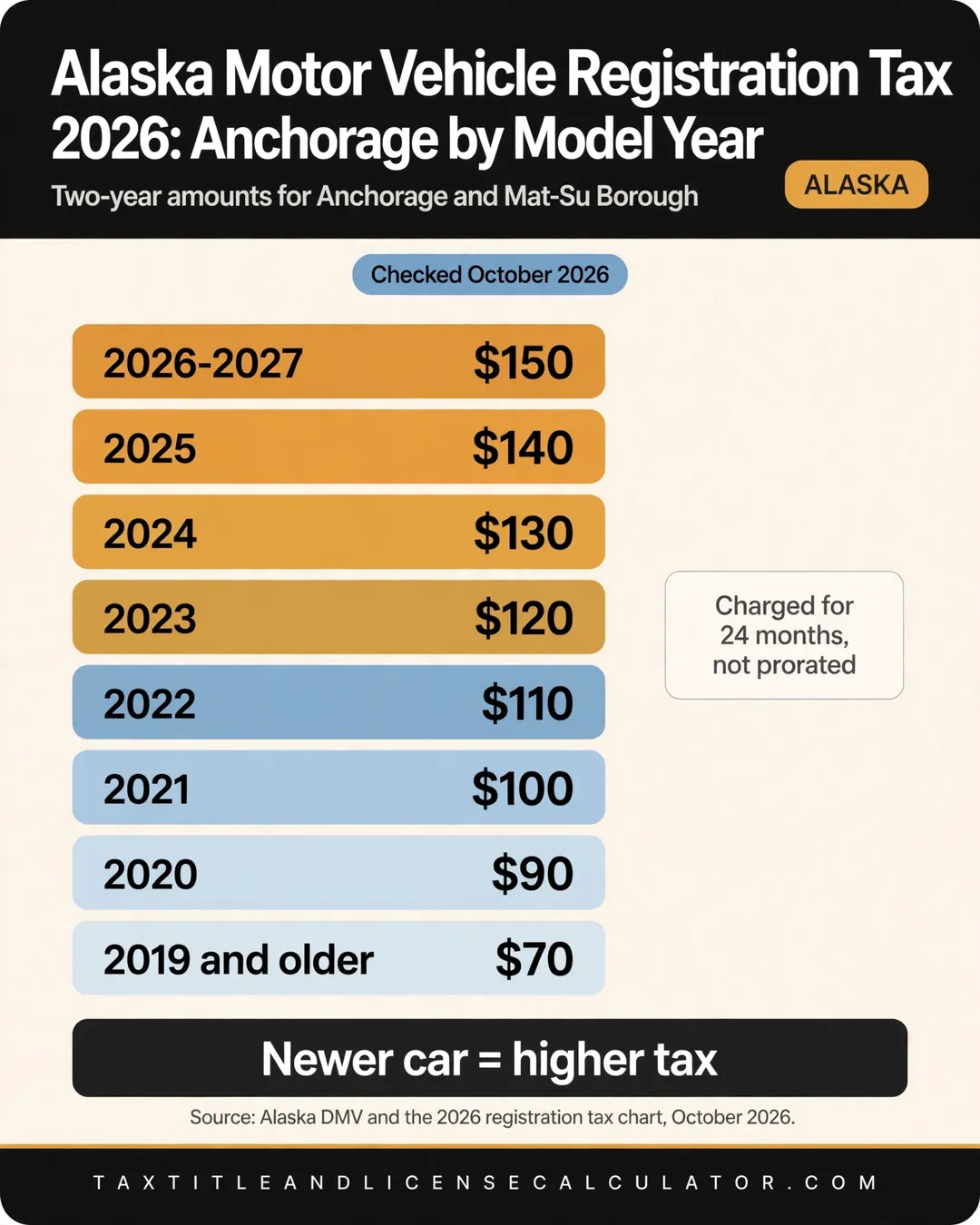
The motor vehicle registration tax (MVRT) is a local tax collected by the DMV when you register. It isn't a sales tax. Not every area charges it. The amount depends on where you live and the car's model year.
The tax is collected when you first register or renew. It isn't prorated. A registration can't last more than 24 months, so the tax covers two years.
Anchorage and Mat-Su Borough
| Model year | Registration tax (2 years) |
|---|---|
| 2026 or 2027 | $150 |
| 2025 | $140 |
| 2024 | $130 |
| 2023 | $120 |
| 2022 | $110 |
| 2021 | $100 |
| 2020 | $90 |
| 2019 and older | $70 |
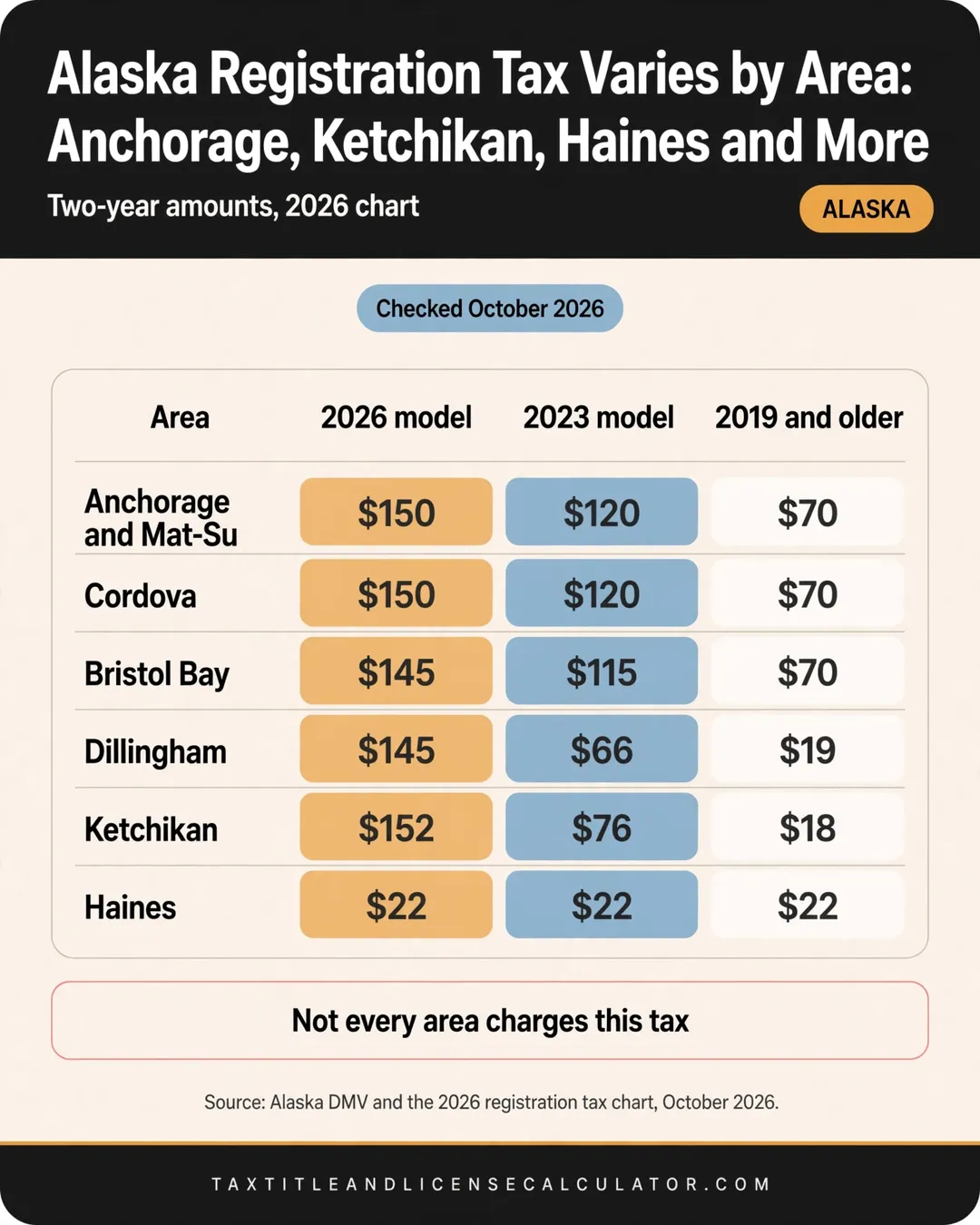
Other areas on the 2026 chart
| Area | 2026 model | 2023 model | 2019 and older |
|---|---|---|---|
| Bristol Bay | $145 | $115 | $70 |
| Cordova | $150 | $120 | $70 |
| Dillingham | $145 | $66 | $19 |
| Ketchikan | $152 | $76 | $18 |
| Haines | $22 for every model year | $22 | $22 |
The chart header says it is for registrations that expire in 2026. The DMV will publish a new one. Use the DMV's online registration cost tool for your exact total.
How Much Does It Cost to Register a Car in Alaska?
Example 1: New truck in Anchorage with a loan
Assumptions: 2026 model, $45,000 price, car loan, no local sales tax in your area.
| Item | Amount |
|---|---|
| Title | $15.00 |
| Lien recording | $15.00 |
| Registration, 2 years | $100.00 |
| Registration tax, 2026 model, Anchorage | $150.00 |
| Estimated total | $280.00 |
Example 2: Used 2021 car in Anchorage
Assumptions: $18,000 price, no loan, no local sales tax.
| Item | Amount |
|---|---|
| Title | $15.00 |
| Registration, 2 years | $100.00 |
| Registration tax, 2021 model, Anchorage | $100.00 |
| Estimated total | $215.00 |
Example 3: Car bought where a local tax applies
Assumptions: $30,000 price, 2024 model, registered in Ketchikan, a 2.5% local rate with no cap (an example only; your city may add its own tax or cap it), no loan.
| Item | Amount |
|---|---|
| Local sales tax at 2.5% (example) | $750.00 |
| Title | $15.00 |
| Registration, 2 years | $100.00 |
| Registration tax, 2024 model, Ketchikan | $102.00 |
| Estimated total | $967.00 |
These totals cover two years of registration. That's about $140 a year for Example 1 and $107.50 a year for Example 2.
Moving to Alaska and Buying From Out of State
If you bring a car from another state, you need to transfer your out-of-state title and register in Alaska. Send the most recent title and pay the $15 title fee. If a lender holds the title, you may get a registration only.
Documents the DMV may ask for include a signed Vehicle Transaction Application (Form V1), a lien release, an odometer disclosure and a notarized power of attorney if someone signs for you. Newer vehicles without a federal compliance label need a letter from the maker.
Buying from a seller in Idaho or another state doesn't add an Alaska state tax. Ask your city or borough whether a local use tax applies, because local governments may charge one.
EVs, Leases and Other Special Cases
Alaska's DMV fee schedule lists no separate yearly fee for electric cars. EVs pay the same registration and registration tax as other cars of the same model year.
A leased car is treated as commercial, even if it is a regular car. Commercial vehicles have different registration terms and tax amounts. Ask the DMV or use its cost tool before you sign a lease.
Trucks over 8,000 lbs have extra title requirements. Camper shells aren't titled or registered.
How to Calculate Alaska Costs by Hand
- Ask your city or borough for its sales tax rate and any cap. Multiply the taxable amount by it. Many places have none.
- Add $15 for the title, and $15 if you have a loan.
- Add $100 for two years of registration.
- Look up the registration tax for your area and model year on the DMV chart.
- Add $10 if you visit in person and the walk-in fee applies.
- Divide by two to see the yearly cost.
What This Estimate Includes
- Local sales tax, if you enter a rate
- Title and lien fees
- Two-year registration
- Registration tax by model year and area
What This Estimate Does Not Include
- The $10 walk-in fee
- Commercial or leased vehicle rates
- Specialty plate fees
- Shipping and barge costs
- Insurance, loan interest and dealer fees
Common Mistakes to Avoid
- Assuming no tax at all. Many cities and boroughs have their own sales tax.
- Skipping the registration tax. It's often bigger than the $100 state fee.
- Thinking the amounts are yearly. They cover two years.
- Using Anchorage numbers elsewhere. The tax differs by area.
- Missing the 30-day title deadline.
- Treating a lease like a personal car. The DMV treats it as commercial.
- Paying title and lien fees when you only need registration. They're waived in that case.
Frequently Asked Questions
Does Alaska have sales tax on cars?
Not at the state level. Some cities and boroughs charge a local sales tax.
What does an Alaska tax, title and license calculator include?
It covers local sales tax, title, lien, registration and the registration tax.
How much does it cost to register a car in Alaska?
$100 for two years, plus the registration tax for your area and model year.
What is the registration tax in Anchorage?
$150 for a 2026 or 2027 model, falling to $70 for a 2019 or older car. The amounts cover two years.
How much is a title in Alaska?
$15, plus $15 if there's a lien.
How often do I register?
Every two years for a passenger vehicle.
Do I pay more for a newer car?
Yes, in places that charge the registration tax. It rises with the model year.
What if I move to Alaska?
Transfer your title and register. You have 30 days to apply for a title after buying a vehicle.
Do EVs pay extra in Alaska?
Alaska's DMV fee schedule lists no separate EV fee. Electric cars pay the same registration and registration tax as other cars.
Do I pay local sales tax on a car?
It depends on your city or borough. Some cap the taxable amount, so ask them.
Official Sources
- Alaska DMV: New Vehicle
- Alaska DMV: Titles
- Alaska DMV: Transfer My Vehicle From Another State
- Alaska DMV: Vehicle Registration Cost tool
- Alaska DMV: 2026 Motor Vehicle Registration Tax by location (PDF)
- Alaska Office of the State Assessor: Alaska Sales Tax Information
This page is an independent estimate tool and guide. It isn't affiliated with the Alaska DMV or the state of Alaska. Rates and fees can change, so confirm your total before you pay.
Compare nearby states
William researches vehicle taxes, title fees, registration charges and DMV requirements across the United States. His work focuses on turning state-specific fee schedules, tax guidance, registration requirements and statutory information into practical explanations for vehicle buyers and owners. He cross-checks calculator inputs against official state revenue departments, motor vehicle agencies and published fee schedules, paying particular attention to differences between sales tax, title fees, registration charges and local or county taxes. He also reviews state-level changes so that calculator results and supporting articles reflect the latest available requirements rather than relying on outdated third-party estimates.
About this site →