Kansas Vehicle Sales Tax Calculator: Tax, Title & Tags
Vehicle sales tax in Kansas is 6.5% state tax plus your local rate. Most buyers pay a combined rate of about 7.5% to 10% or more. Kansas also charges a $10 title fee, about $42.25 to tag a typical car, and a yearly property tax when you register.
Use this Kansas tax, title and license calculator to estimate the total. Enter your price, trade-in and local rate. The guide below explains which local rate applies, what lowers the tax, and the rules that changed in 2025 and 2026.
Checked against the Kansas Department of Revenue and county treasurer fee schedules on October 4, 2026. This is an independent estimate. Your county treasurer sets the final amount.
Kansas Vehicle Tax and Fees at a Glance
| Charge | Amount | Notes |
|---|---|---|
| State sales tax | 6.5% | Same everywhere |
| Local sales tax | Varies by city and county | Added on top of the 6.5% |
| Title | $10 | One time |
| Registration (car up to 4,500 lbs) | $42.25 | $30 fee + $12.25 state and county surcharges |
| Registration (car over 4,500 lbs) | $52.25 | $40 fee + $12.25 surcharges |
| Electric or hybrid tag | $70 to $165 + surcharges | Replaces the $30 or $40 fee |
| Vehicle property tax | Varies | Paid each year when you register |
| Lien recording | $1.50 | Only if you have a loan |
Fee amounts are from the Johnson County treasurer’s 2026 fee schedule. Surcharges are set by state law, so they’re the same in every county.
◀ END INFOGRAPHIC 1
On this page15 sections
- Kansas Vehicle Tax and Fees at a Glance
- Which Local Rate Do You Pay?
- How Kansas Vehicle Sales Tax Is Figured
- How Much Is Car Sales Tax in Kansas?
- Kansas Tax, Title and Tag Examples
- Private Sales and Family Transfers
- Buying Out of State or Moving to Kansas
- Exemptions: What Counts and What Doesn’t
- Kansas Title, Tags and Property Tax
- How to Calculate Kansas Tax, Title and License by Hand
- What This Estimate Includes
- What This Estimate Does Not Include
- Common Mistakes to Avoid
- Frequently Asked Questions
- Official Sources
Which Local Rate Do You Pay?
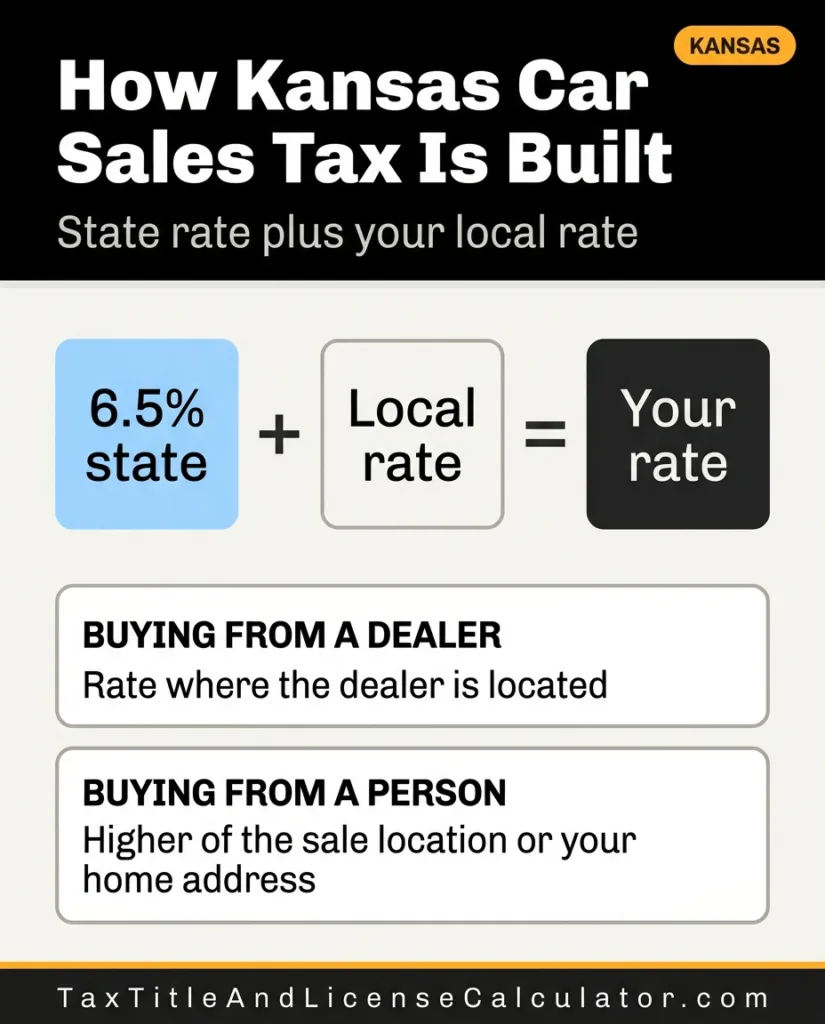
Kansas adds city, county and special district taxes to the 6.5% state rate. Which address counts depends on who sells you the car, per KDOR Pub. KS-1526:
- From a Kansas dealer: the combined rate where the dealer is located.
- From a private seller: the county treasurer charges the higher of two rates: where the sale took place, or your registration address.
- From out of state: the rate where you live, minus credit for tax paid to the other state.
Find any address’s rate with KDOR’s Address Tax Rate Locator. Local rates can change each quarter. The latest changes took effect October 1, 2026.
How Kansas Vehicle Sales Tax Is Figured
Sales tax = (price + taxable dealer fees − trade-in − dealer discount − qualifying rebate) × (6.5% + local rate)
Kansas taxes the full selling price, including options, freight, dealer prep and the dealer’s administrative (doc) fee. Interest, finance charges and GAP insurance aren’t taxed.
Does a trade-in lower the tax?
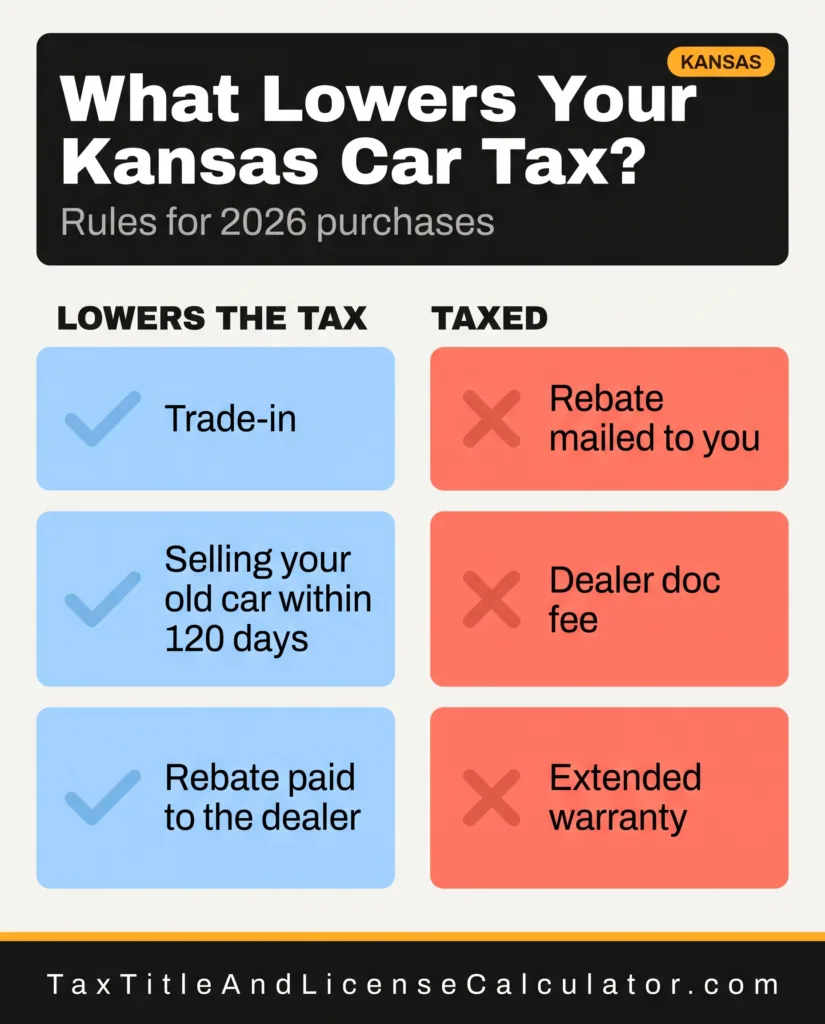
Yes. A trade-in to a dealer comes off the taxable price. In a private sale, the fair market value of a vehicle you trade to the seller also comes off.
What is the Kansas 120-day rule?
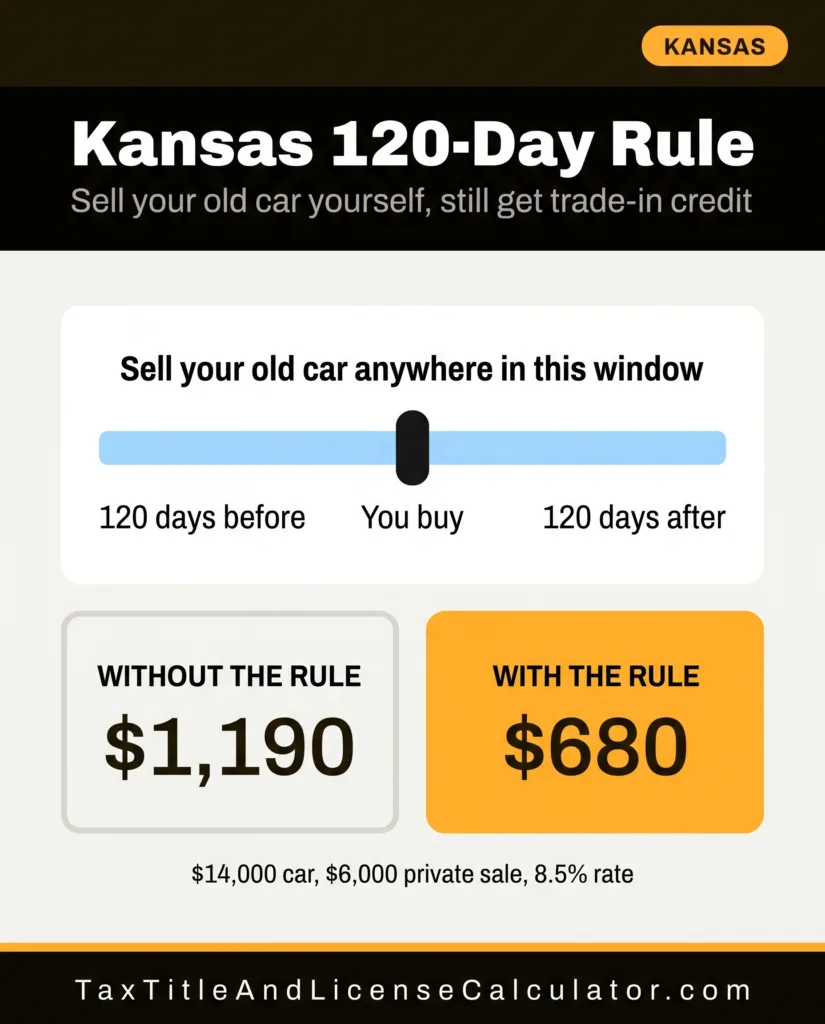
Since January 1, 2025, you can get trade-in credit even if you sell your old car yourself. Sell it privately within 120 days before or after you buy, and you pay tax only on the difference, per KDOR Notice 24-19.
Bring both bills of sale to the county treasurer when you register. Already paid the full tax? Ask KDOR for a refund with Form ST-21VT. The names, price and date on your bill of sale must match the title record.
Are rebates taxed in Kansas?
It depends who gets the money. A manufacturer cash rebate that’s shown on the bill of sale and paid to the dealer isn’t taxed. That exemption no longer has an end date, per Notice 24-01. A rebate mailed to you is taxed. A dealer discount always lowers the taxable price.
Are doc fees and warranties taxed?
Yes. The dealer’s administrative or doc fee is part of the taxable price. Extended warranties and service contracts are taxed too.
How Much Is Car Sales Tax in Kansas?
| Taxable price | 7.5% combined | 9% combined | 10% combined |
|---|---|---|---|
| $10,000 | $750 | $900 | $1,000 |
| $20,000 | $1,500 | $1,800 | $2,000 |
| $30,000 | $2,250 | $2,700 | $3,000 |
| $40,000 | $3,000 | $3,600 | $4,000 |
| $50,000 | $3,750 | $4,500 | $5,000 |
These combined rates are examples. Look up the real rate for your dealer or address before you buy.
Kansas Tax, Title and Tag Examples
Example 1: New SUV from a Kansas dealer
Assumptions: $32,000 price, $399 doc fee, $1,500 manufacturer rebate paid to the dealer and shown on the bill of sale, $8,000 trade-in. The dealer’s combined rate is 9%, and the SUV weighs under 4,500 lbs.
| Item | Amount |
|---|---|
| Price | $32,000.00 |
| Plus doc fee | +$399.00 |
| Minus rebate paid to the dealer | −$1,500.00 |
| Minus trade-in | −$8,000.00 |
| Taxable price | $22,899.00 |
| State tax (6.5%) | $1,488.44 |
| Local tax (2.5%) | $572.48 |
| Title | $10.00 |
| Registration with surcharges | $42.25 |
| Estimated total, before property tax | $2,113.17 |
If the rebate were mailed to you instead, the taxable price would be $24,399 and the tax $135 higher.
Example 2: Private sale using the 120-day rule
You buy a used car from a neighbor for $14,000. Two months later, you sell your old car yourself for $6,000. Your combined rate is 8.5%.
| Item | Amount |
|---|---|
| Price minus your private sale ($14,000 − $6,000) | $8,000.00 |
| Sales tax (8.5%) | $680.00 |
| Title | $10.00 |
| Registration with surcharges | $42.25 |
| Estimated total, before property tax | $732.25 |
Without the 120-day rule, the tax would be $1,190. If you pay that first and sell later, claim the $510 difference back with Form ST-21VT.
Example 3: A car from your mother
Your mother signs her car over to you. Transfers between immediate family are exempt from sales tax with Form TR-215. You still pay the $10 title, $42.25 registration and the property tax.
If your brother sells you his car, that’s different. Siblings aren’t immediate family under Kansas rules, so the sale is taxed.
Private Sales and Family Transfers
A private sale is taxed. You pay the county treasurer when you register, using the higher local rate described above. Bring the signed title with the price filled in, plus proof of insurance, per the Division of Vehicles.
Immediate family means parents, grandparents, children and grandchildren, plus their spouses. Transfers of cars, light trucks up to 12,000 lbs, motorcycles and trailers between them are exempt. Use Form TR-215, the Affidavit of Relationship. A true gift must have no payment at all.
Buying Out of State or Moving to Kansas
Kansas residents buying in another state
You owe Kansas compensating use tax at your home rate when you register. You get credit for sales tax paid to the other state, up to what Kansas would charge. If you paid less, you pay the difference.
Shopping across the state line in the Kansas City area? Our Missouri vehicle sales tax guide explains what Missouri dealers charge. Any used car with an out-of-state title also needs a $20 VIN inspection.
Nonresidents buying from a Kansas dealer
A nonresident pays no Kansas sales tax if the vehicle won’t be registered or based in Kansas and leaves the state within 10 days. The dealer completes Form ST-8B, often called a 10-day drive-out permit. You’ll pay tax at home instead.
Neighbors can check our Oklahoma car tax and fees page or our Colorado tax, title and license calculator to see what they’ll owe when they register at home.
New residents
Moving to Kansas with a car you used in your old state? Use tax usually isn’t due if the car’s first real use was outside Kansas for at least six months. You still pay the title, registration, VIN inspection and property tax.
See also: Utah: a 4.85% state rate, local tax and an age-based yearly fee.
Exemptions: What Counts and What Doesn’t
- Exempt: immediate family transfers, true gifts, sales to the U.S. government, and nonresident 10-day drive-outs.
- Not exempt: sales between siblings, cousins or friends.
- Disabled veterans: a new Kansas exemption for 100% disabled veterans started July 1, 2026. It doesn’t cover vehicles, per KDOR Notice 26-01.
Kansas Title, Tags and Property Tax
After sales tax, you’ll pay the county treasurer a $10 title fee, your registration (tag) fee, and vehicle property tax. For most cars under 4,500 lbs, registration is $42.25 with surcharges.
Property tax is the cost that varies the most. It’s based on your vehicle’s value and age plus your local mill levy. Estimate it with KDOR’s vehicle property tax lookup.
See the full list of Kansas title and registration fees for every vehicle type, the EV tag fees, plates and penalties.
Deadline: register within 60 days of buying the car. Penalties start on day 61, per KDOR.
How to Calculate Kansas Tax, Title and License by Hand
- Start with the price. Add the doc fee and any service contract.
- Subtract your trade-in, or your old car’s private sale price if it’s within 120 days.
- Subtract a dealer discount and any rebate paid to the dealer.
- Look up the combined rate (dealer address, or the higher rate for a private sale).
- Multiply. That’s your sales tax.
- Add the $10 title and $42.25 registration ($52.25 over 4,500 lbs).
- Add your property tax estimate and the $1.50 lien fee if you have a loan.
What This Estimate Includes
- 6.5% state sales tax plus the local rate you enter
- Trade-in and dealer-paid rebate deductions
- $10 title
- Registration by weight, or the EV and hybrid tag fee
What This Estimate Does Not Include
- Vehicle property tax (varies by county and vehicle)
- The $12.25 surcharges, unless shown as a separate line
- Lien, VIN inspection and personalized plate fees
- Late penalties
- Insurance, loan interest and dealer add-ons
Common Mistakes to Avoid
- Using only 6.5%. Every Kansas buyer pays a local rate too.
- Using your home rate at a dealer. A Kansas dealer charges the rate at its own location.
- Missing the 120-day window. Selling your old car yourself counts only within 120 days of the purchase.
- Assuming every rebate is tax-free. A rebate mailed to you is taxed.
- Calling a sibling sale a family transfer. Only parents, grandparents, children, grandchildren and their spouses qualify.
- Forgetting property tax. It’s due when you register and can cost more than the tag fee.
- Registering late. Penalties start on day 61.
Frequently Asked Questions
What is the vehicle sales tax in Kansas?
6.5% state tax plus your local rate. Combined rates usually run from about 7.5% to 10% or more.
How much is sales tax on a $30,000 car in Kansas?
$2,700 at a 9% combined rate, or $1,950 at the 6.5% state rate alone. Your local rate sets the final number.
Do you pay sales tax on a private car sale in Kansas?
Yes. You pay the county treasurer when you register, at the higher of the sale location’s rate or your home rate.
Does selling my car myself lower my Kansas sales tax?
Yes, if you sell it within 120 days before or after buying the new one. You pay tax only on the difference.
Is a car from a family member taxed in Kansas?
Not if it comes from a parent, grandparent, child or grandchild, or their spouse. File Form TR-215. A sale between siblings is taxed.
Do out-of-state buyers pay Kansas sales tax?
No, if they’re true nonresidents and the car leaves Kansas within 10 days on a dealer’s ST-8B permit.
Official Sources
- Kansas Department of Revenue: Pub. KS-1526, Business Taxes for Motor Vehicle Transactions
- KDOR: Notice 24-19, 120-day used vehicle sale credit (effective January 1, 2025)
- KDOR: Form ST-21VT, refund for a vehicle sold within 120 days
- KDOR: Notice 24-01, manufacturer cash rebate exemption
- KDOR: Notice 26-01, sales tax exemption for certain disabled veterans (May 15, 2026)
- KDOR: Local sales tax rate changes (October 1, 2026)
- KDOR: Address Tax Rate Locator
- KDOR Division of Vehicles: Titles and Tags
- KDOR Division of Vehicles: Title a used vehicle
- KDOR: Vehicle property tax lookup
- Johnson County Treasurer: Motor vehicle fees (2026)
- U.S. Department of Energy AFDC: Kansas EV and hybrid registration fees (K.S.A. 8-143)
This page is an independent estimate tool and guide. It isn’t affiliated with the Kansas Department of Revenue or any county treasurer. Rates and fees change, so confirm your amount with your county tag office before you pay.
William researches vehicle taxes, title fees, registration charges and DMV requirements across the United States. His work focuses on turning state-specific fee schedules, tax guidance, registration requirements and statutory information into practical explanations for vehicle buyers and owners. He cross-checks calculator inputs against official state revenue departments, motor vehicle agencies and published fee schedules, paying particular attention to differences between sales tax, title fees, registration charges and local or county taxes. He also reviews state-level changes so that calculator results and supporting articles reflect the latest available requirements rather than relying on outdated third-party estimates.
About this site →