Virginia Tax, Title and License Calculator
See also: Maryland: a 6.5% excise tax at titling.
See also: Delaware: no sales tax, but a 5.25% document fee.
See also: District of Columbia: a title excise tax from 1% to 11% by weight and city MPG.
Compare nearby states
Virginia charges a 4.15% motor vehicle sales and use tax on a car’s price, with a $75 minimum. A trade-in doesn’t lower it, but rebates do. A title is $15, and registration is $30.75 a year for most cars. EVs and fuel-efficient cars also pay a yearly highway use fee.
Use this Virginia tax, title and license calculator to estimate the tax and DMV fees on a new or used car. The guide below covers each rule, plus the local fees and personal property tax you’ll pay later.
Checked against the Virginia DMV, the DMV highway use fee chart for July 1, 2026 to June 30, 2027, and the Code of Virginia on October 13, 2026. This is an independent estimate. The DMV and your locality set the final amounts.
Virginia Car Tax and Fees at a Glance
| Charge | Amount | Notes |
|---|---|---|
| Sales and use tax | 4.15%, $75 minimum | No trade-in credit; rebates lower it |
| Title | $15 | Once |
| Registration, 4,000 lbs or less | $30.75 a year | Passenger cars |
| Registration, over 4,000 lbs | $35.75 a year | Passenger cars |
| Highway use fee, EV | $135.63 a year | July 2026 to June 2027 |
| Highway use fee, 25+ mpg car | $7.05 to $103.48 a year | Based on MPG |
| Local vehicle license fee | Varies | Most cities and counties |
| Personal property tax | Varies | Billed yearly by your locality |
On this page14 sections
- Virginia Car Tax and Fees at a Glance
- How Virginia Sales and Use Tax Is Calculated
- How Much Is Car Tax in Virginia?
- Virginia Title and Registration Fees
- Virginia Highway Use Fee (HUF)
- Local Vehicle Fees and Personal Property Tax
- Private Sales, Gifts and New Residents
- Virginia Inspections
- How to Use a VA Tax, Title and License Calculator by Hand
- What This Estimate Includes
- What This Estimate Does Not Include
- Common Mistakes to Avoid
- Frequently Asked Questions
- Official Sources
How Virginia Sales and Use Tax Is Calculated
SUT = (price + processing fee − rebates) × 4.15%, minimum $75
Virginia collects the tax when the car is titled. Dealers figure it for you. The rate is the same everywhere in the state, with no local add-on.
Does a trade-in lower the tax in Virginia?
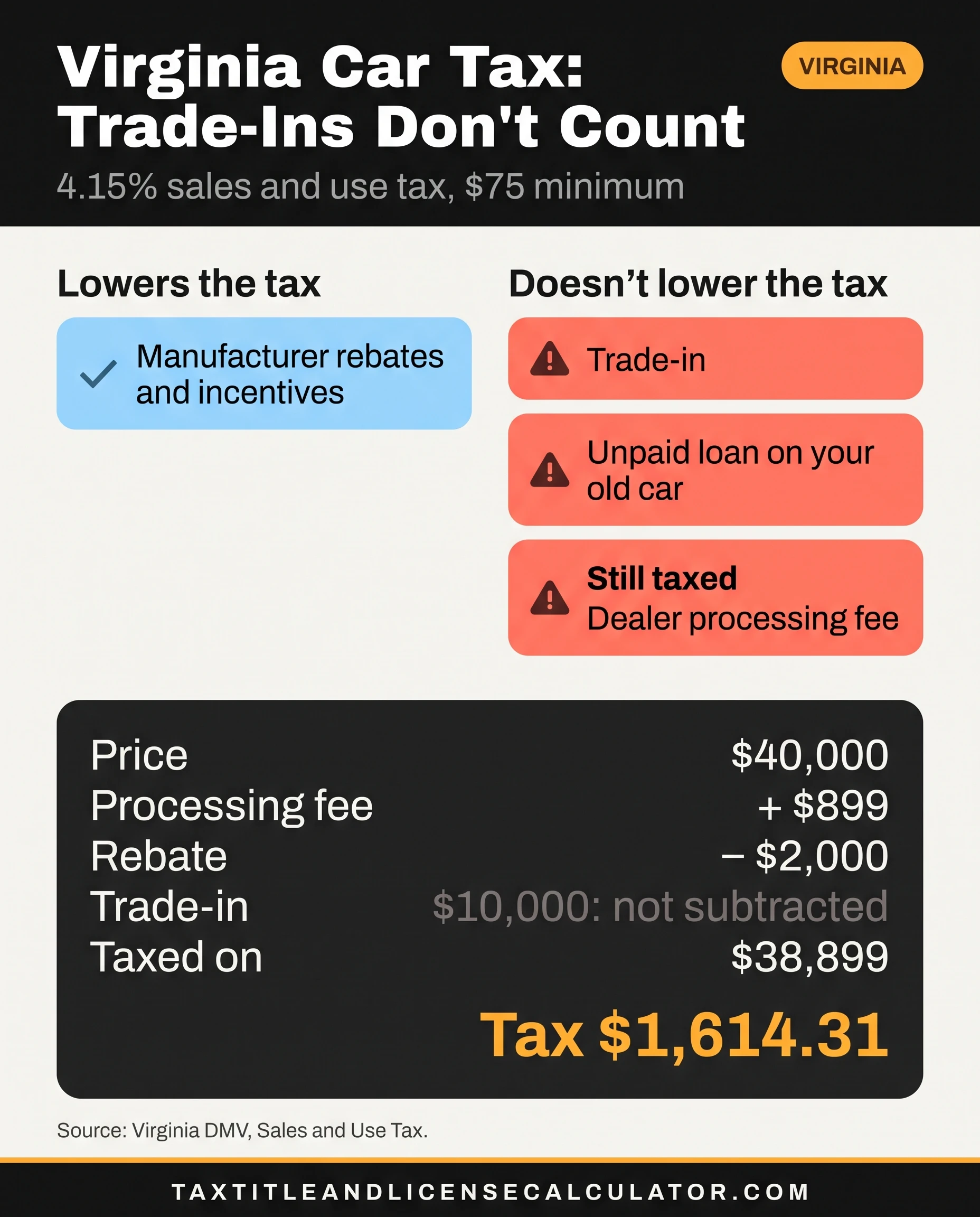
No. Trade-in credits, unpaid liens and other unpaid credits don’t reduce the taxable price. A $40,000 car with a $10,000 trade-in is still taxed on $40,000. That costs $415 more than a state that subtracts the trade-in.
Nearby states differ a lot. North Carolina’s 3% highway use tax does subtract a dealer trade-in, Tennessee caps its local tax, and South Carolina caps its one-time fee at $500.
Do rebates lower the tax?
Yes. Rebates and incentives reduce the gross sales price before the 4.15% is applied.
Is the dealer processing fee taxed?
Yes. The processing fee is part of the gross sales price.
How Much Is Car Tax in Virginia?
| Taxable price | Sales and use tax (4.15%) |
|---|---|
| $20,000 | $830 |
| $30,000 | $1,245 |
| $40,000 | $1,660 |
| $50,000 | $2,075 |
Example 1: New car from a Richmond dealer
Assumptions: $40,000 price, $899 processing fee, $2,000 rebate, $10,000 trade-in, under 4,000 lbs, gas engine under 25 mpg.
| Item | Amount |
|---|---|
| Price + processing fee − rebate (trade-in isn’t subtracted) | $38,899.00 |
| Sales and use tax (4.15%) | $1,614.31 |
| Title | $15.00 |
| Registration, 1 year | $30.75 |
| Estimated total at the DMV | $1,660.06 |
Add your local vehicle license fee and, later, personal property tax. If the car were a 40-mpg hybrid, add a $55.27 highway use fee.
Example 2: Private sales
You buy an 8-year-old car from a neighbor for $15,000. The tax is $622.50. On a $1,200 beater, the tax would be $49.80, so the $75 minimum applies instead.
Virginia Title and Registration Fees
| Fee | Amount |
|---|---|
| Title | $15 |
| Passenger car registration, 4,000 lbs or less | $30.75 a year |
| Passenger car registration, over 4,000 lbs | $35.75 a year |
Virginia cut these by $10 in 2020, so older guides showing $40.75 and $45.75 are out of date. You can register for one or two years.
Virginia Highway Use Fee (HUF)
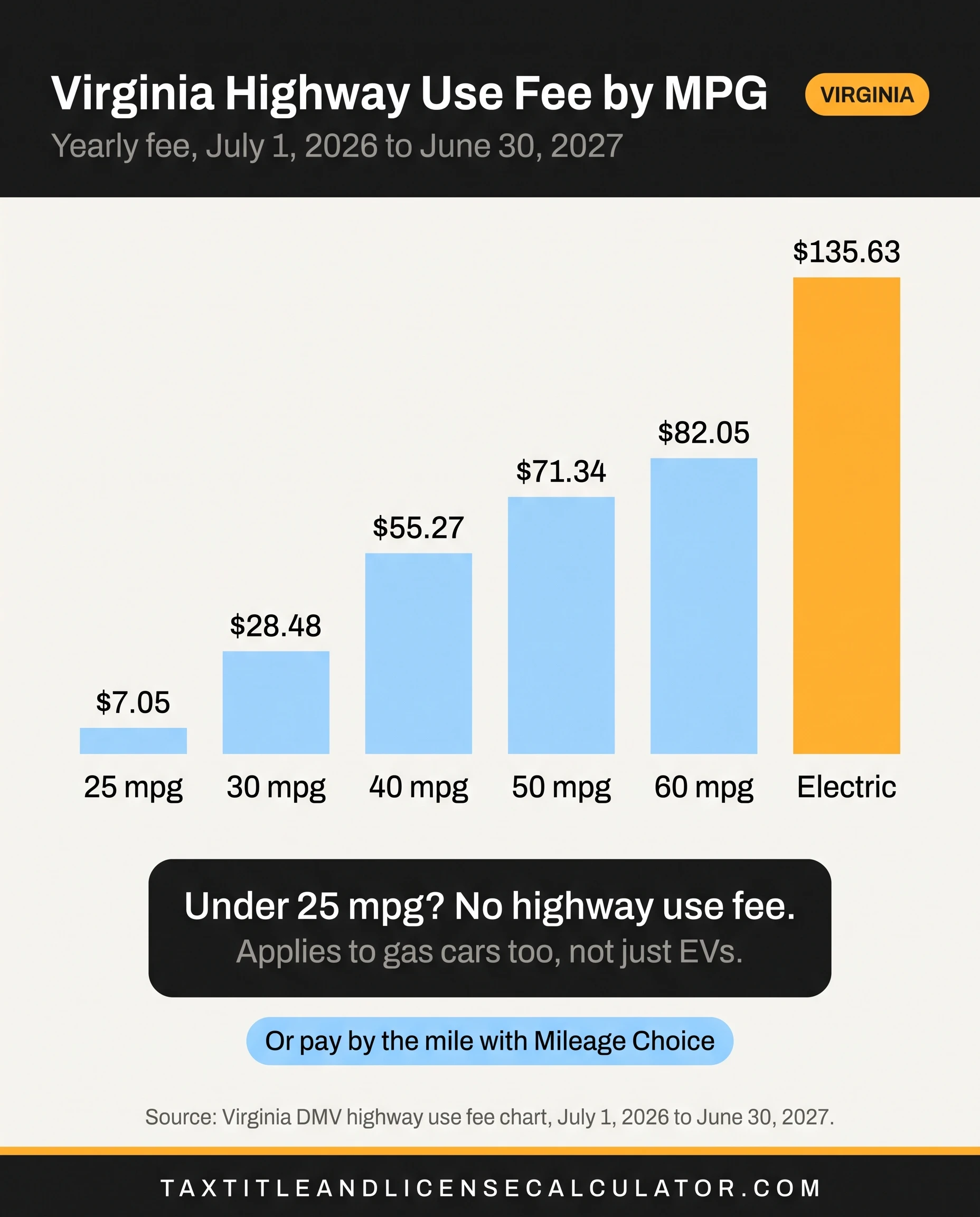
The highway use fee makes up for gas tax that efficient cars don’t pay. It applies to electric vehicles and to any car rated 25 mpg combined or better, not just hybrids. You can pay it with your registration or through the Mileage Choice Program instead.
| Vehicle | Yearly HUF (July 1, 2026 to June 30, 2027) |
|---|---|
| Electric | $135.63 |
| 25 mpg | $7.05 |
| 30 mpg | $28.48 |
| 40 mpg | $55.27 |
| 50 mpg | $71.34 |
| 60 mpg | $82.05 |
Local Vehicle Fees and Personal Property Tax
Most of Virginia’s yearly car cost is local. Most cities and counties charge a vehicle license fee and send a yearly personal property tax bill based on the car’s value. Rates vary a lot by locality, and the state’s Personal Property Tax Relief Act lowers the bill on part of the value for personal-use cars. Check your city or county treasurer for your rate.
Private Sales, Gifts and New Residents
Private sales
The price the seller writes on the title serves as the bill of sale. For a car less than 5 years old, file Form SUT-1A if the price isn’t within $1,500 of its NADA trade-in value. For older cars, a signed bill of sale (or Form SUT 1) fixes a blank or wrong price.
Gifts
A gift to your spouse, son, daughter or parent is exempt. Siblings and grandchildren aren’t on the list. If a son, daughter or parent takes over a loan on the car, the loan amount is taxed.
New residents and military
If you already hold a valid title or registration in your name from another state or a branch of the U.S. Armed Forces, you generally don’t pay SUT when you first title in Virginia. If you’ve owned the car less than 12 months, you’ll need proof you paid sales tax elsewhere. Without it, Virginia taxes the car’s fair market value.
Some 100% service-connected disabled veterans can get an exemption for a vehicle they own and use.
Virginia Inspections
Most passenger cars need a yearly safety inspection at a licensed station. Cars registered in Northern Virginia also need an emissions inspection every two years.
How to Use a VA Tax, Title and License Calculator by Hand
- Start with the price and add the processing fee.
- Subtract rebates. Don’t subtract a trade-in.
- Multiply by 4.15%. If the result is under $75, use $75.
- Add the $15 title.
- Add $30.75 (4,000 lbs or less) or $35.75 registration.
- Add the highway use fee if the car is electric or 25+ mpg.
- Plan for your local license fee and personal property tax.
What This Estimate Includes
- 4.15% sales and use tax with the $75 minimum
- Rebates subtracted, trade-ins not
- $15 title and registration by weight
- Highway use fee for EVs
What This Estimate Does Not Include
- Highway use fee for gas and hybrid cars at 25+ mpg
- Local vehicle license fee
- Personal property tax
- Inspection fees, insurance and loan costs
Common Mistakes to Avoid
- Subtracting a trade-in. Virginia doesn’t allow it.
- Forgetting the processing fee is taxed.
- Thinking the HUF is only for EVs. Any 25+ mpg car pays it.
- Using old registration fees. They’re $30.75 and $35.75 now.
- Assuming a gift from a sibling is exempt. Only a spouse, son, daughter or parent qualifies.
- Forgetting personal property tax. Your locality bills it every year.
Frequently Asked Questions
- What is the car sales tax in Virginia?
It’s 4.15% of the gross sales price, with a $75 minimum, and it’s the same statewide.
Does a Virginia car tax title and license calculator subtract my trade-in?
No. Virginia doesn’t let a trade-in lower the sales and use tax. Rebates and incentives do lower it.
How much is tax on a $30,000 car in Virginia?
It’s $1,245, whether or not you trade in a car.
Does the Virginia highway use fee apply to hybrids?
Yes, if the car is rated 25 mpg combined or better. A 50-mpg hybrid pays $71.34 a year under the 2026–27 chart.
Is a car gifted by my parents taxed in Virginia?
No. Gifts to a son or daughter from a parent are exempt, unless you take over a loan on the car.
Official Sources
- Virginia DMV: Sales and Use Tax
- Virginia DMV: Highway Use Fee
- Virginia DMV: 2026 Highway Use Fee chart
- Code of Virginia 58.1-2403: SUT exemptions
- Code of Virginia 46.2-694: Registration fees
This page is an independent estimate tool and guide. It isn’t affiliated with the Virginia DMV or any locality. Rates and fees can change, so confirm your total before you pay.
William researches vehicle taxes, title fees, registration charges and DMV requirements across the United States. His work focuses on turning state-specific fee schedules, tax guidance, registration requirements and statutory information into practical explanations for vehicle buyers and owners. He cross-checks calculator inputs against official state revenue departments, motor vehicle agencies and published fee schedules, paying particular attention to differences between sales tax, title fees, registration charges and local or county taxes. He also reviews state-level changes so that calculator results and supporting articles reflect the latest available requirements rather than relying on outdated third-party estimates.
About this site →