DC Tax, Title and License Calculator
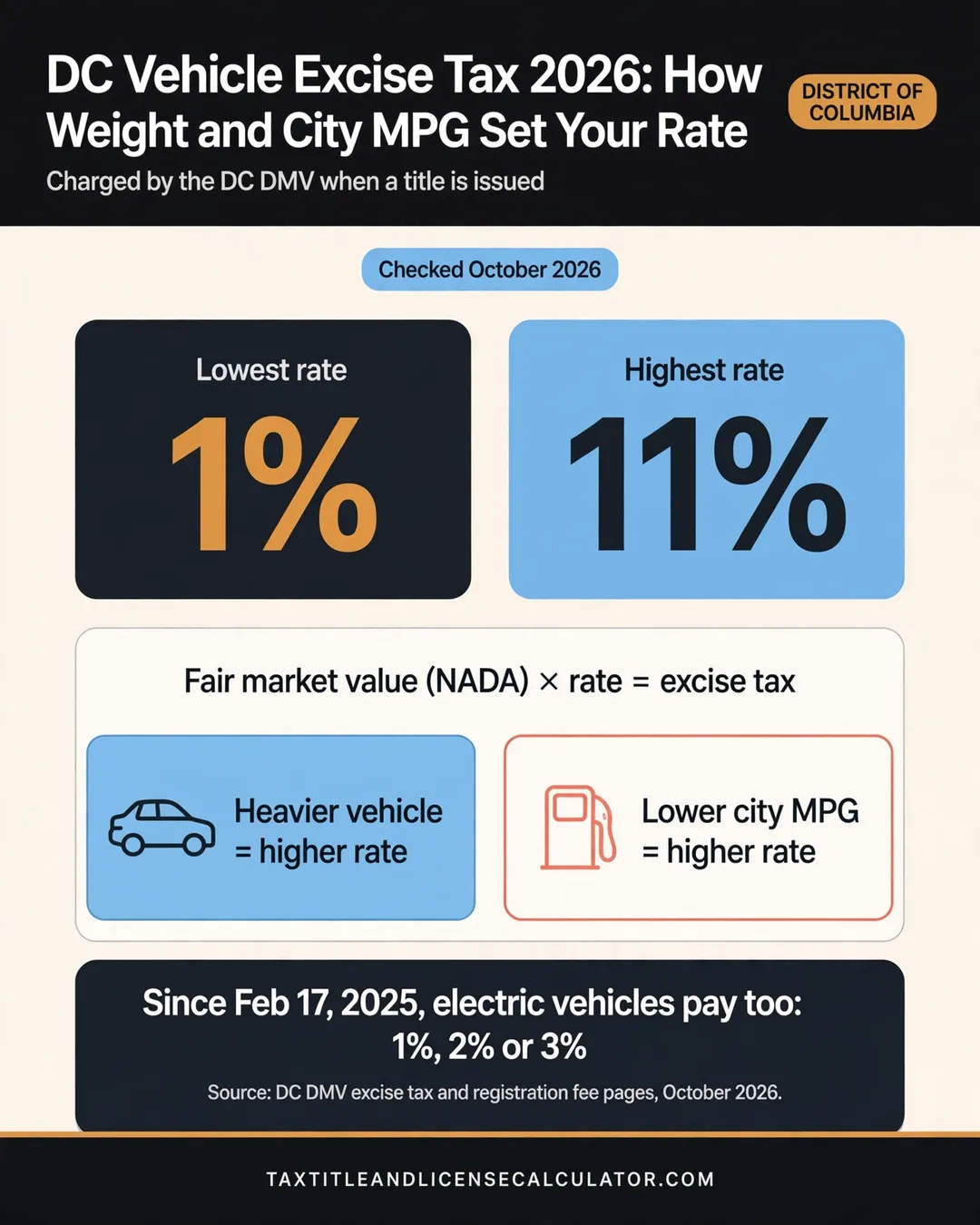
The District of Columbia (DC) doesn't charge a flat sales tax on cars. It charges an excise tax when you title a vehicle. The rate runs from 1% to 11% of the car's value. It depends on the vehicle's weight and its city miles per gallon (MPG). Electric cars pay too.
Use this DC tax, title and license calculator to estimate your costs. Below are the full rate table, the 2026 registration fees, the exemption list and three worked examples.
Checked against the DC Department of Motor Vehicles (DMV) on October 22, 2026. This is an independent estimate. The DC DMV sets your final amount.
DC Car Costs at a Glance
| Charge | Amount | Notes |
|---|---|---|
| Title excise tax | 1% to 11% | Of NADA fair market value; set by weight and city MPG |
| Title | $30 | |
| Lien recording | $20 | Only if financed |
| Registration, under 3,500 lbs | $70 | Rate from March 30, 2026 |
| Registration, 3,500–4,999 lbs | $175 | |
| Registration, 5,000–5,999 lbs | $300 | |
| Registration, 6,000 lbs and up | $550 | |
| Registration, new battery electric under 5,000 lbs | $40 | First two years only |
On this page16 sections
- DC Car Costs at a Glance
- How the DC Excise Tax Is Calculated
- DC Excise Tax Rate Table
- Trade-Ins, Rebates and Private Sales in DC
- How Much Is Car Tax in DC?
- DC Title and Lien Fees
- DC Registration Fees by Weight (2026)
- Can I Pay Less With the EITC?
- Exemptions and Special Cases in DC
- Moving to DC or Buying Out of State
- How to Calculate DC Tax, Title and License Costs by Hand
- What This Estimate Includes
- What This Estimate Does Not Include
- Common Mistakes to Avoid
- Frequently Asked Questions
- Official Sources
How the DC Excise Tax Is Calculated
Excise tax = fair market value × rate for your weight and city MPG
DC collects the tax when it issues your title. It applies to fair market value, which the DMV takes from the NADA Business Guide for the Eastern Region at the time you apply. That may differ from the price on your bill of sale.
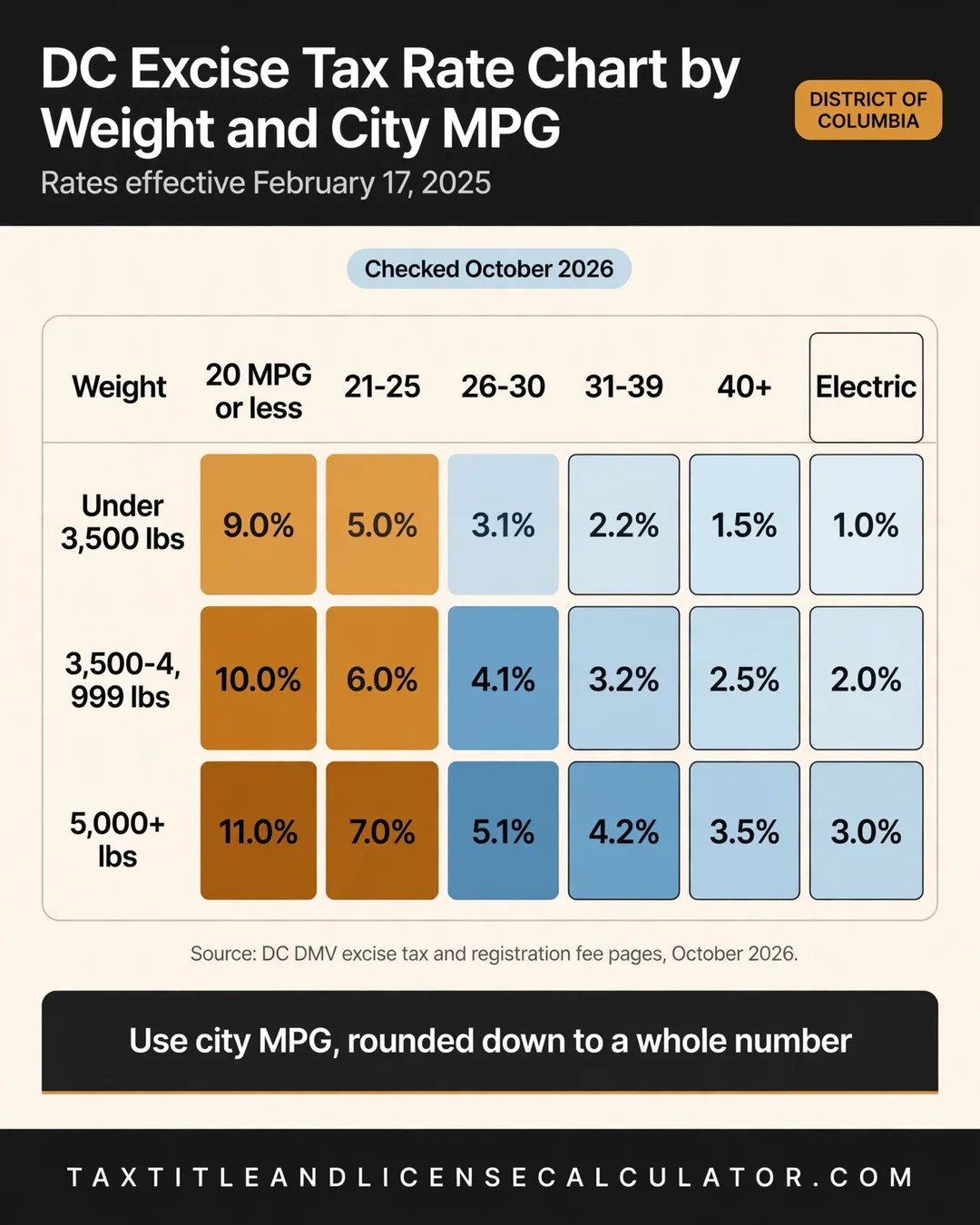
Since February 17, 2025, the rate depends on two things: the vehicle's unladen weight and its city MPG. The DMV rounds MPG down to a whole number. A 27.9 MPG car is treated as 27 MPG.
Why do EVs pay excise tax now?
The Motor Vehicle Excise Tax Amendment Act of 2024 ended the electric vehicle exemption. Electric cars now pay 1%, 2% or 3% by weight. That's lower than most gas cars, but it isn't zero.
DC Excise Tax Rate Table
| Unladen weight | 20 MPG or less | 21–25 MPG | 26–30 MPG | 31–39 MPG | 40+ MPG | Electric |
|---|---|---|---|---|---|---|
| 3,499 lbs or less | 9.0% | 5.0% | 3.1% | 2.2% | 1.5% | 1.0% |
| 3,500–4,999 lbs | 10.0% | 6.0% | 4.1% | 3.2% | 2.5% | 2.0% |
| 5,000 lbs or more | 11.0% | 7.0% | 5.1% | 4.2% | 3.5% | 3.0% |
Use the city MPG on the window sticker or on fueleconomy.gov. Highway MPG doesn't count. Before February 2025, DC used flat rates of 6%, 7% and 8%. Some websites still show them.
Trade-Ins, Rebates and Private Sales in DC
DC's excise tax uses the fair market value from the NADA guide, not the price you paid. A trade-in or a rebate on the bill of sale isn't part of the calculation.
The same value rule applies when you buy from a person. D.C. Code lets the DMV ask for the purchase date and price. The DMV still decides the fair market value. Use the DMV's online excise tax estimator before you buy.
How Much Is Car Tax in DC?
Example 1: Hybrid sedan
Assumptions: $28,000 fair market value, 3,300 lbs, 45 city MPG, no loan.
| Item | Amount |
|---|---|
| Excise tax at 1.5% | $420.00 |
| Title | $30.00 |
| Registration, under 3,500 lbs | $70.00 |
| Estimated total | $520.00 |
Example 2: Gas SUV with a loan
Assumptions: $38,000 fair market value, 4,200 lbs, 24 city MPG, car loan.
| Item | Amount |
|---|---|
| Excise tax at 6.0% | $2,280.00 |
| Title | $30.00 |
| Lien recording | $20.00 |
| Registration, 3,500–4,999 lbs | $175.00 |
| Estimated total | $2,505.00 |
Example 3: New electric SUV
Assumptions: $52,000 fair market value, 4,600 lbs, battery electric, brand new, no loan.
| Item | Amount |
|---|---|
| Excise tax at 2.0% | $1,040.00 |
| Title | $30.00 |
| Registration, battery electric Class V | $40.00 |
| Estimated total | $1,110.00 |
After two years, that EV's registration moves to the weight classes. At 4,600 lbs, that's $175 a year.
DC Title and Lien Fees
| Fee | Amount |
|---|---|
| Title (new or replacement) | $30 |
| Duplicate title | $30 |
| Lien recording | $20 per lien |
| Title information request | $7 |
DC Registration Fees by Weight (2026)
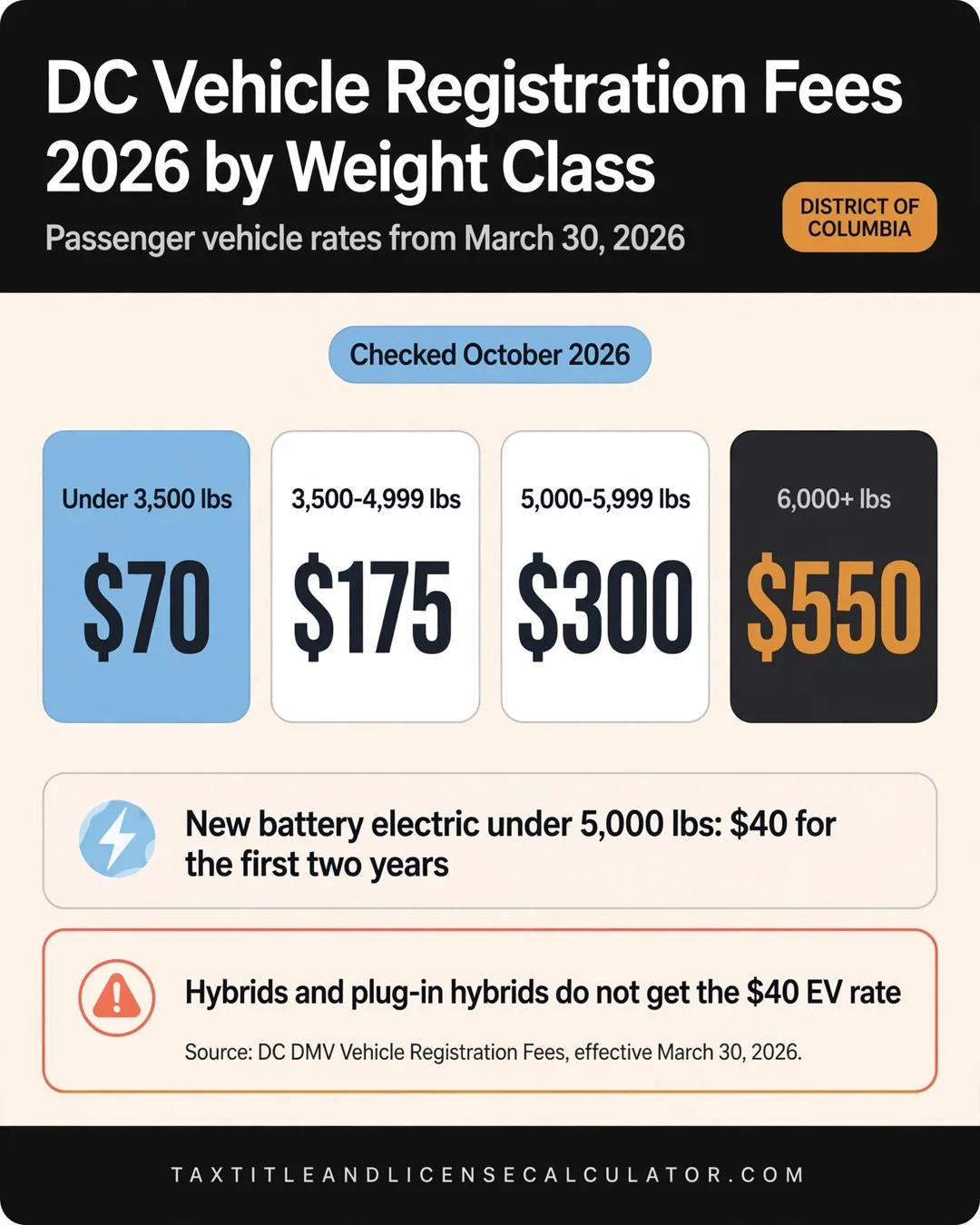
DC changed its passenger registration fees on March 30, 2026. The DMV lists them as annual fees.
| Class | Weight | Fee |
|---|---|---|
| I | Under 3,500 lbs | $70 |
| II | 3,500–4,999 lbs | $175 |
| III | 5,000–5,999 lbs | $300 |
| IV | 6,000 lbs and up | $550, plus $75 per 1,000 lbs over 10,000 |
| V | New battery electric, under 5,000 lbs | $40 |
| VII | 3,500 lbs and up with disability tags | $70 |
The Class V rate is for the first two years of a brand-new battery electric car. A hybrid or plug-in hybrid doesn't qualify. A battery electric car under 5,000 lbs may also subtract 1,000 lbs from its weight when finding its class.
Can I Pay Less With the EITC?
Yes, for some filers. People who claimed the DC Earned Income Tax Credit (EITC) on their latest return may pay by weight class instead. The rates are 6%, 7% or 8%. They can also use the MPG table. They pay whichever is lower.
You must show Office of Tax and Revenue (OTR) paperwork before the DMV issues the title. Ask the DMV what to bring.
Exemptions and Special Cases in DC
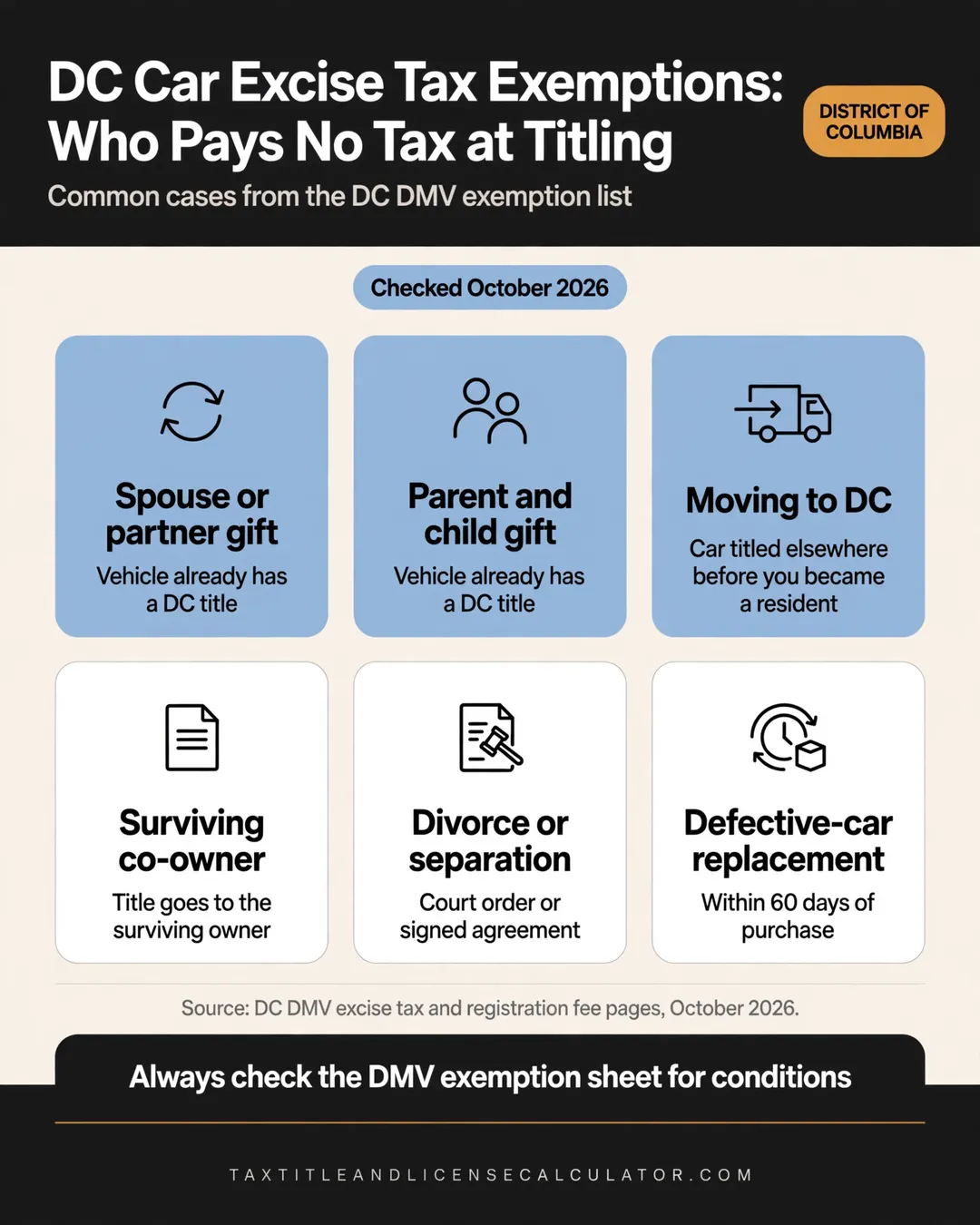
DC's excise tax doesn't apply in a number of cases. Here are the ones that matter most to car buyers:
- Gifts between spouses, domestic partners, or parent and child, if the vehicle already has a DC title.
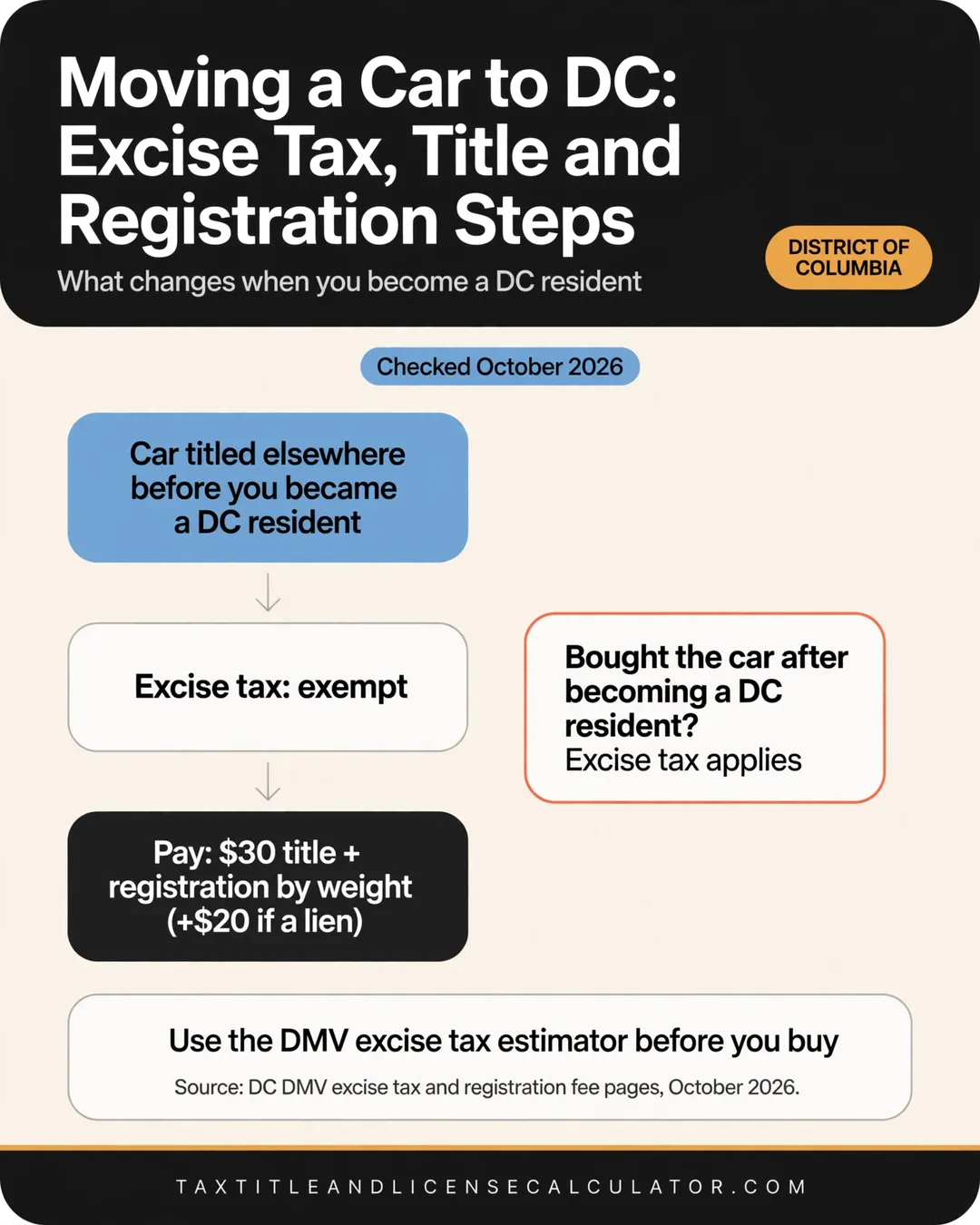
- Vehicles moving to DC. Cars titled or registered elsewhere by a non-resident before the person became a DC resident.
- Surviving co-owner. Title issued to the surviving owner after a co-owner dies.
- Divorce or separation, when a court order or signed written agreement sets the new owner.
- Defective-vehicle replacement. A new car from a dealer within 60 days of the first purchase. The tax adjusts for any difference in value.
- Other cases: rentals and taxis, repossessions, insurance claim titles, trusts where the owner is the trustee.
The DMV's exemption sheet lists no military exemption. The sheet is "an aid." The law itself controls.
Moving to DC or Buying Out of State
What if I move to DC with my car?
If you owned and titled the car elsewhere before you became a DC resident, the excise tax is exempt. You still pay the title fee and registration. Many people commute from Maryland and Virginia. Those states have their own rules, so ask before you retitle.
What if I buy a car outside DC?
DC charges its excise tax when it issues a title, so you pay it when you title the car in DC. Check the DMV estimator first. Neighbors differ. Delaware charges a document fee, Pennsylvania charges 6% plus local add-ons and West Virginia charges 6% at titling.
How to Calculate DC Tax, Title and License Costs by Hand
- Find the car's NADA fair market value (the DMV estimator shows it).
- Find the unladen weight and the city MPG. Round MPG down.
- Look up your rate in the table. Electric cars use the last column.
- Multiply value by the rate. That's the excise tax.
- Add $30 for the title and $20 if you have a loan.
- Add registration by weight class, or $40 for a new battery electric car under 5,000 lbs.
- If you claimed the DC EITC, compare the 6%, 7% or 8% option and use the lower result.
What This Estimate Includes
- Title excise tax by weight and city MPG
- EV excise tax rates
- Title and lien fees
- Registration by weight class and the new EV class
- Exemption notes
What This Estimate Does Not Include
- The 2.5% DMV card service fee
- Tag transfer ($12) and other plate fees
- Inspection and emissions costs
- Parking permits
- Insurance, loan interest and dealer fees
Common Mistakes to Avoid
- Using the old 6%, 7% and 8% rates. They ended February 17, 2025.
- Using price instead of fair market value. DC taxes the NADA value.
- Using highway MPG. The table uses city MPG, rounded down.
- Assuming EVs are exempt. They're taxed now.
- Expecting the $40 EV registration on a used or hybrid car. It's for new battery electric cars for two years.
- Expecting a trade-in deduction. DC gives none.
- Skipping the exemption sheet. A gift to a spouse, partner or child can be tax-free with a DC title.
Frequently Asked Questions
Does DC have sales tax on cars?
No. DC charges a title excise tax from 1% to 11% instead.
What does a DC tax, title and license calculator cover?
It covers excise tax, title, lien and registration fees.
How much is the tax on a $40,000 car in DC?
It depends. A 4,000 lb, 35 MPG car pays 3.2%, or $1,280. A 5,200 lb, 18 MPG truck pays 11%, or $4,400. A 3,000 lb, 42 MPG hybrid pays 1.5%, or $600.
How much is a title in DC?
It's $30, plus $20 if you have a loan.
How much is registration in DC?
$70 under 3,500 lbs, $175 for 3,500 to 4,999 lbs, $300 for 5,000 to 5,999 lbs and $550 at 6,000 lbs and up.
Do electric cars pay excise tax in DC?
Yes, since February 17, 2025. The rate is 1%, 2% or 3% by weight.
Does a trade-in lower the DC excise tax?
No. The tax uses fair market value, not the price you paid.
Are gifts between family taxed?
Not between spouses, domestic partners or a parent and child, if the vehicle already has a DC title.
What if I move to DC?
A car you titled elsewhere before becoming a DC resident is exempt from the excise tax.
Can I pay less with the EITC?
Yes. If you claimed the DC EITC, you may pay 6%, 7% or 8% by weight, or the MPG rate, whichever is lower.
Official Sources
- DC DMV: Vehicle Title and Excise Tax Fees
- DC DMV: Vehicle Registration Fees
- DC DMV: Motor Vehicle Excise Tax Exemption Categories (amended February 5, 2025)
- D.C. Code § 50-2201.03
This page is an independent estimate tool and guide. It isn't affiliated with the DC DMV or the District of Columbia government. Rates and fees can change, so confirm your total before you pay.
Compare nearby states
William researches vehicle taxes, title fees, registration charges and DMV requirements across the United States. His work focuses on turning state-specific fee schedules, tax guidance, registration requirements and statutory information into practical explanations for vehicle buyers and owners. He cross-checks calculator inputs against official state revenue departments, motor vehicle agencies and published fee schedules, paying particular attention to differences between sales tax, title fees, registration charges and local or county taxes. He also reviews state-level changes so that calculator results and supporting articles reflect the latest available requirements rather than relying on outdated third-party estimates.
About this site →