Kentucky Vehicle Registration Fee Calculator
Compare nearby states
Kentucky charges a 6% motor vehicle usage tax when you title a car, paid to your county clerk. You also pay a $9 title fee, a $21 registration (plate) fee and $22 to record a lien if you finance. After that, you pay property tax on the car each year when you renew.
Use this Kentucky vehicle registration fee calculator to estimate the usage tax and clerk fees on a new or used car, from a dealer or a private seller. The guide below shows each rule so you can check the math.
Checked against the Kentucky Department of Revenue, the Kentucky Transportation Cabinet and county clerk fee pages on October 13, 2026. This is an independent estimate. Your county clerk sets the final amount.
Kentucky Car Tax and Registration Fees at a Glance
| Charge | Amount | Notes |
|---|---|---|
| Motor vehicle usage tax | 6% of the retail price | One time, when the title moves to you |
| Title fee | $9 | One time |
| Registration (plate) | $21 a year | Standard plate; specialty plates cost more |
| Lien recording | $22 | Only if you finance |
| Clerk notary fee | $2 per signature | If the clerk notarizes your forms |
| Sheriff VIN inspection | About $15 | Cars coming from another state; varies by county |
| EV / plug-in hybrid fee | $126 a year (2025 amount) | Adjusted each January |
| Property tax | Varies | Yearly, paid with your renewal |
On this page14 sections
- Kentucky Car Tax and Registration Fees at a Glance
- How Kentucky Usage Tax Is Calculated
- How Much Tax Will You Pay on a Car in Kentucky?
- Kentucky Title, Registration and Clerk Fees
- Kentucky Property Tax on Vehicles
- Kentucky EV and Plug-In Hybrid Fee
- Private Sales and Family Transfers in Kentucky
- Moving to Kentucky or Buying Out of State
- How to Use a Kentucky Vehicle Registration Fee Calculator by Hand
- What This Estimate Includes
- What This Estimate Does Not Include
- Common Mistakes to Avoid
- Frequently Asked Questions
- Official Sources
How Kentucky Usage Tax Is Calculated
Usage tax = (retail price − trade-in) × 6%
Kentucky doesn’t charge regular sales tax on cars. It charges a usage tax instead, at the same 6% everywhere in the state. There’s no city or county add-on, and no cap. By contrast, South Carolina caps its one-time fee at $500.
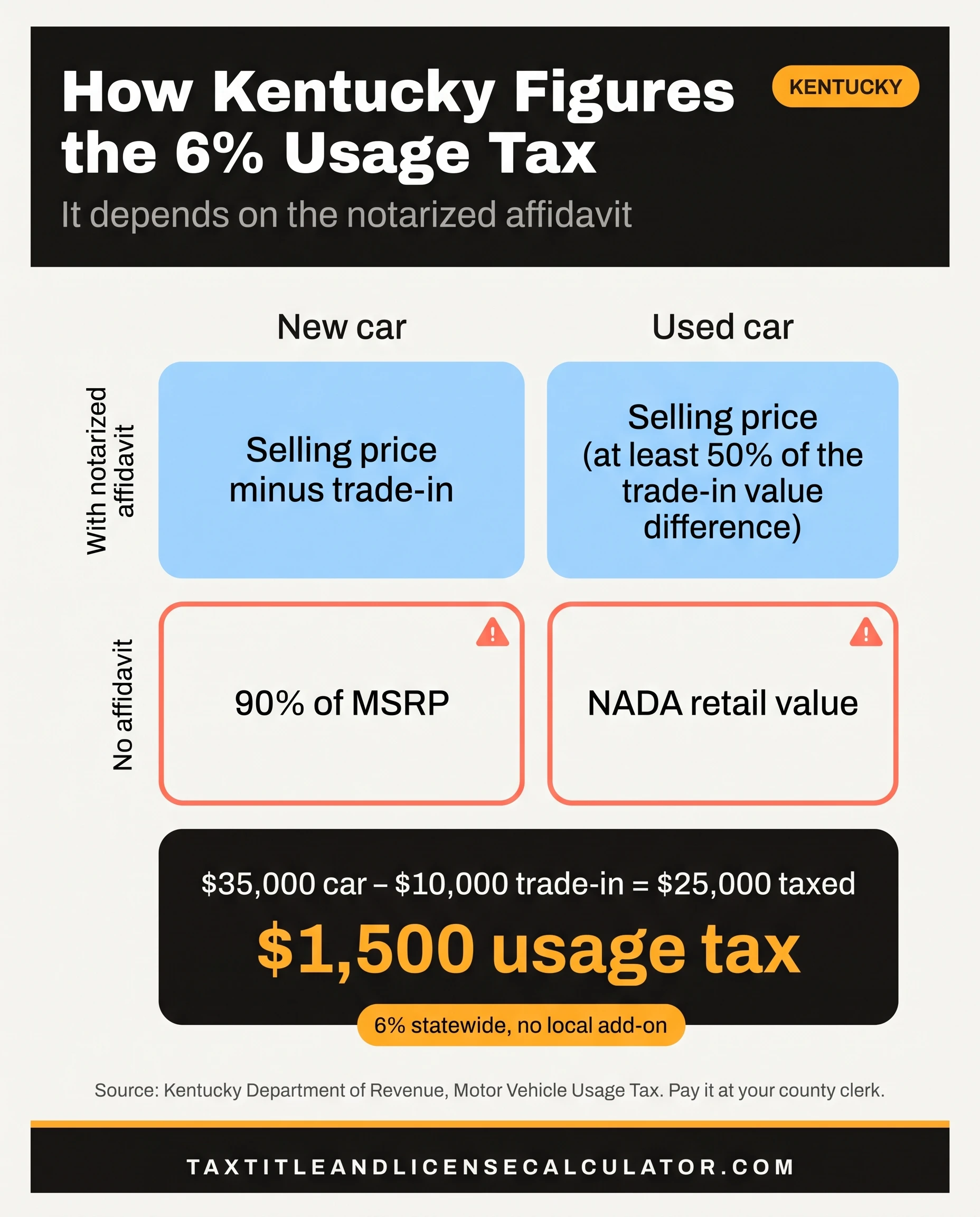
The tricky part is the “retail price.” Kentucky uses the price on a notarized Affidavit of Total Consideration (Form 71A100, or the section on title application TC 96-182). If you don’t bring one, the clerk uses a set value instead.
| Situation | What the 6% is charged on |
|---|---|
| New car, with notarized affidavit | The selling price, minus your trade-in |
| New car, no affidavit | 90% of the MSRP, including options and destination |
| Used car, with notarized affidavit | The selling price, but not less than 50% of the trade-in value difference |
| Used car, no affidavit | The NADA retail value from the clerk’s guide |
Does a trade-in lower the usage tax?
Yes, on new and used cars. New cars have had trade-in credit since July 1, 2014. A $35,000 car with a $10,000 trade-in is taxed on $25,000. If the clerk uses NADA retail value for your car, your trade-in is valued the same way.
Are rebates taxed?
The tax follows the total consideration listed on your affidavit. Ask the dealer how a manufacturer rebate is shown there before you sign, because that number is what the clerk taxes.
How Much Tax Will You Pay on a Car in Kentucky?
| Taxable price | Usage tax (6%) |
|---|---|
| $10,000 | $600 |
| $20,000 | $1,200 |
| $30,000 | $1,800 |
| $40,000 | $2,400 |
| $50,000 | $3,000 |
So a $30,000 car costs $1,800 in usage tax anywhere in Kentucky.
Example 1: New car from a Louisville dealer
Assumptions: $35,000 price on the notarized affidavit, $10,000 trade-in, financed, standard plate, Jefferson County.
| Item | Amount |
|---|---|
| Price minus trade-in | $25,000.00 |
| Usage tax (6%) | $1,500.00 |
| Title fee | $9.00 |
| Registration (plate) | $21.00 |
| Lien recording | $22.00 |
| Estimated total at the clerk | $1,552.00 |
Property tax comes later, with your first renewal. Add $126 a year if the car is an EV or plug-in hybrid.
Example 2: Private sale, with and without the affidavit
You buy a used car from a neighbor for $12,000. With a notarized affidavit showing $12,000, the usage tax is $720. Without one, the clerk uses NADA retail value. If that value is $13,500, you pay $810 instead.
Example 3: New car, no affidavit
A new car has a $40,000 MSRP with options and destination. With no affidavit, the tax is on 90% of MSRP: $36,000 × 6% = $2,160.
Kentucky Title, Registration and Clerk Fees
Everything is handled at your county clerk’s office. The state sets the main fees, so they’re the same in every county.
| Fee | Amount |
|---|---|
| Title application | $9 |
| Standard plate registration (first year and each renewal) | $21 |
| Lien statement recording | $22 |
| Duplicate title | $6 |
| Clerk notarization | $2 per signature |
| Faster (“speed”) title | Extra fee; amount varies by county |
Registration renews every year. For most individual owners, it’s due in your birth month, and you can renew online at drive.ky.gov or at the clerk.
Kentucky Property Tax on Vehicles
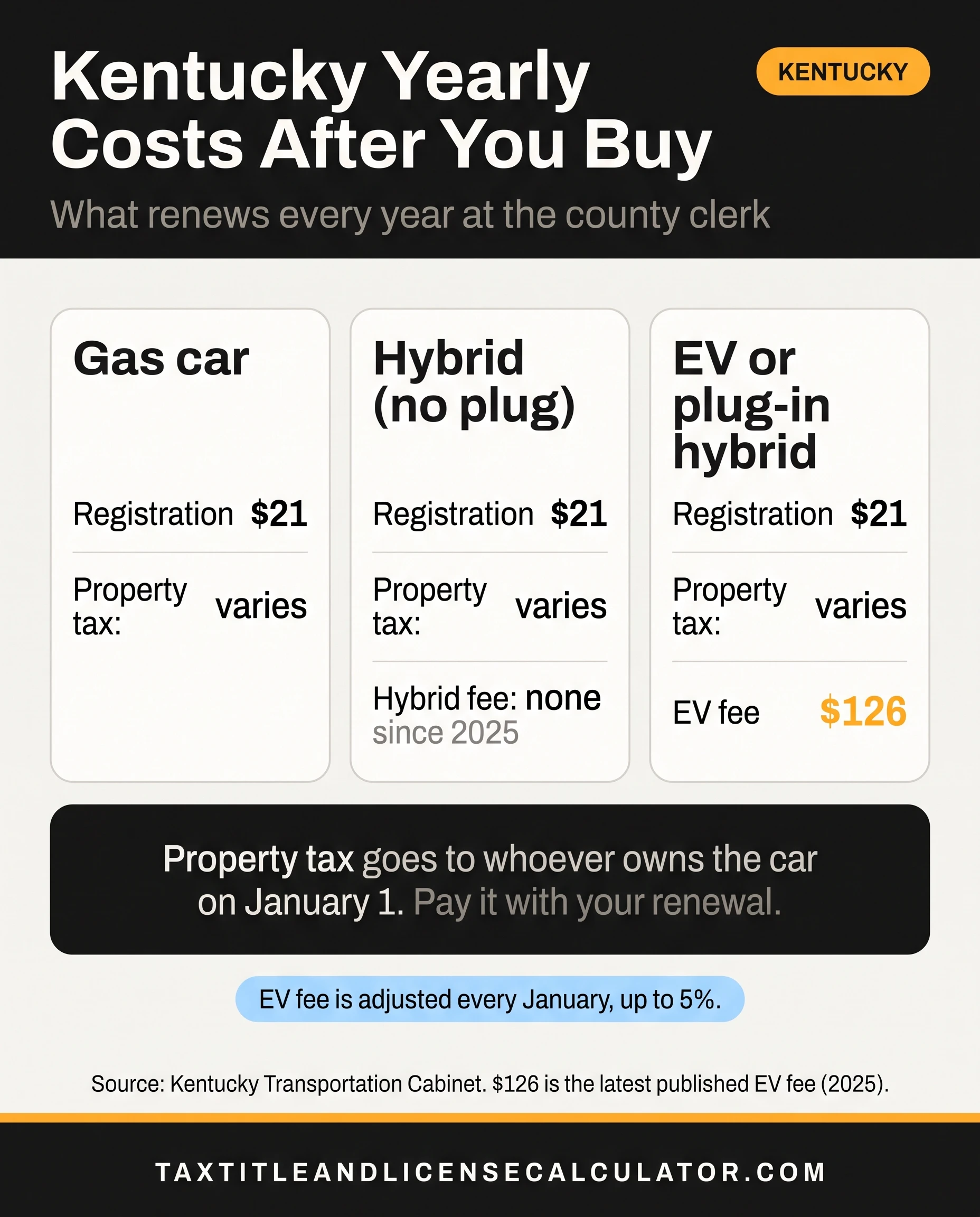
Kentucky taxes cars as property every year. The tax is based on the car’s value and the state and local rates where you live. The owner on January 1 gets the bill, and it’s paid with your registration renewal.
After you buy a car, the property tax becomes late after the end of your renewal month or the last day of the second month after the transfer, whichever comes first. Neighboring states do this differently: Indiana charges a yearly excise tax instead, while Kansas also collects county property tax when you register.
Kentucky EV and Plug-In Hybrid Fee
Kentucky charges a yearly ownership fee on electric cars and plug-in hybrids. It’s due at first registration and at every renewal.
| Vehicle | 2024 | 2025 |
|---|---|---|
| Electric vehicle (battery only) | $120 | $126 |
| Plug-in hybrid | $120 | $126 |
| Hybrid without a plug | $60 | No fee |
| Electric motorcycle | $60 | $63 |
The fee is adjusted each January by a construction cost index, with a cap of 5% a year. $126 is the latest amount KYTC has published, so check your renewal notice for the current figure.
Private Sales and Family Transfers in Kentucky
A private sale is taxed the same 6%. Both you and the seller sign the affidavit in front of a notary, then you take it to the clerk with the signed title. Without the affidavit, you’ll pay tax on NADA retail value, which is often higher.
Kentucky exempts a car that was already registered in Kentucky when it goes between a husband and wife, parent and child, stepparent and stepchild, or grandparent and grandchild. You sign an exempt transfer affidavit at the clerk.
Brothers and sisters aren’t on that list, so a sale between siblings is taxed. That’s different from Tennessee’s family exemption, which also covers siblings.
Moving to Kentucky or Buying Out of State
You have 15 days to title and register a car after you buy it or bring it into Kentucky. A car coming from another state also needs a sheriff’s VIN inspection before the clerk issues a Kentucky title.
New residents owe usage tax the first time they register here. Kentucky gives credit for tax paid to your old state if that state charges a similar tax and gives Kentucky the same credit. Bring proof, such as your old registration, title or purchase contract showing the tax paid.
Georgia is the exception. Kentucky hasn’t given credit for tax paid in Georgia since March 1, 2013, because Georgia doesn’t give similar credit back.
Military members
Cars sold by Kentucky dealers to nonresident members of the armed forces on duty in Kentucky are exempt from usage tax.
See also: Idaho: one 6% rate and registration based on vehicle age.
How to Use a Kentucky Vehicle Registration Fee Calculator by Hand
- Find the taxable price: the affidavit price, or 90% of MSRP (new) or NADA retail (used) if you have no affidavit.
- Subtract your trade-in.
- Multiply by 6%.
- Add the $9 title fee and $21 registration.
- Add $22 if you’re financing.
- Add $126 for an EV or plug-in hybrid.
- Plan for property tax at your first renewal.
What This Estimate Includes
- 6% motor vehicle usage tax
- Trade-in credit
- $9 title and $21 registration
- $22 lien fee if financed
- EV or plug-in hybrid fee
What This Estimate Does Not Include
- Yearly property tax (it depends on your county and city)
- Notary, speed title and sheriff inspection fees
- Specialty or personalized plates
- Dealer fees and add-ons
- Insurance and loan costs
Common Mistakes to Avoid
- Skipping the notarized affidavit. Without it, you’re taxed on 90% of MSRP or NADA retail value.
- Adding a local sales tax. Kentucky’s usage tax is a flat 6%, with no local rate.
- Assuming siblings are exempt. Only spouses, parents, children, stepparents, stepchildren, grandparents and grandchildren are.
- Missing the 15-day deadline to title the car.
- Budgeting the old EV fee. Plug-in hybrids pay the full EV fee now, and it was $126 in 2025.
- Expecting credit for Georgia tax. Kentucky doesn’t give it.
Frequently Asked Questions
- How much does it cost to register a car in Kentucky?
Registration is $21 a year for a standard plate. A new title is $9, a lien is $22, and the 6% usage tax applies when ownership changes.
- What is the sales tax on a car in Kentucky?
Kentucky charges a 6% motor vehicle usage tax instead of sales tax. It’s paid to the county clerk when you title the car.
Do I pay usage tax on a used car from a private seller?
Yes, 6% of the price on the notarized affidavit, or of NADA retail value if you don’t have one.
Is a car from my parents tax-free in Kentucky?
Yes, if the car was already registered in Kentucky. Transfers between parents and children, spouses, stepparents and stepchildren, and grandparents and grandchildren are exempt.
- Do I pay Kentucky usage tax when I move here?
Usually yes, but you get credit for tax paid to your old state if it gives Kentucky similar credit. Tax paid in Georgia isn’t credited.
- How much is the Kentucky EV fee?
It was $126 a year in 2025 for electric cars and plug-in hybrids. It’s adjusted each January, by up to 5%.
Official Sources
- Kentucky Department of Revenue: Motor Vehicle Usage Tax
- Kentucky Department of Revenue: Motor Vehicle Usage Tax FAQs
- Kentucky Revised Statutes 138.470: Exemptions from usage tax
- Kentucky Transportation Cabinet: Electric and Hybrid Vehicle Fee
- Jefferson County Clerk: Motor Vehicle Fees
- Logan County Clerk: Taxes and Fees
- McCracken County Clerk: New Vehicle
- Warren County Clerk: Moving Into Kentucky
This page is an independent estimate tool and guide. It isn’t affiliated with the Kentucky Department of Revenue, the Transportation Cabinet or any county clerk. Rates and fees can change, so confirm your total with your county clerk.
William researches vehicle taxes, title fees, registration charges and DMV requirements across the United States. His work focuses on turning state-specific fee schedules, tax guidance, registration requirements and statutory information into practical explanations for vehicle buyers and owners. He cross-checks calculator inputs against official state revenue departments, motor vehicle agencies and published fee schedules, paying particular attention to differences between sales tax, title fees, registration charges and local or county taxes. He also reviews state-level changes so that calculator results and supporting articles reflect the latest available requirements rather than relying on outdated third-party estimates.
About this site →