Vermont Tax, Title and License Calculator
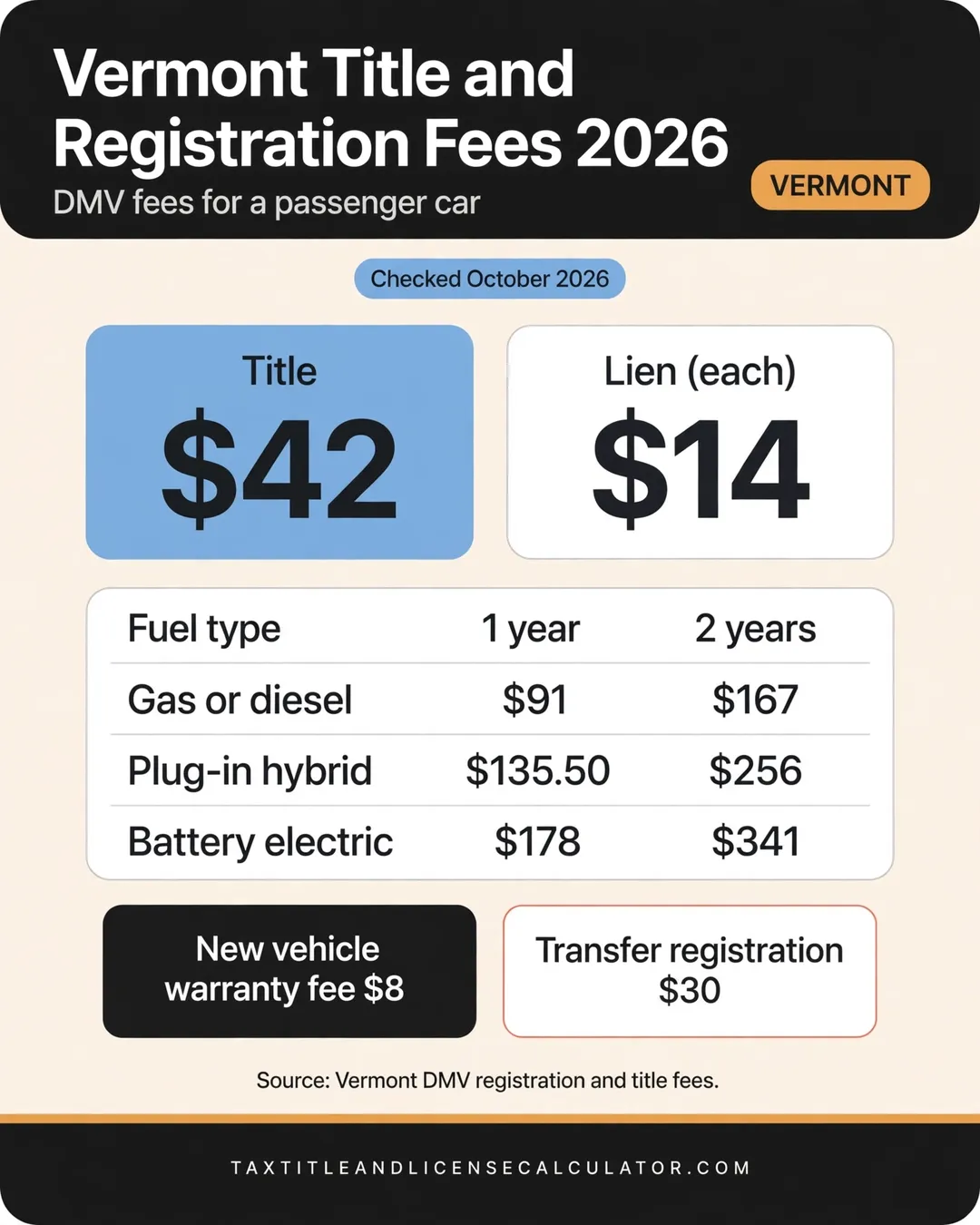
Vermont charges a 6% purchase and use tax instead of a sales tax. It applies to the price you pay or the car's J.D. Power clean trade-in value, whichever is higher. You also pay a $42 title fee and a registration fee of $91 for one year or $167 for two years.
Use this Vermont tax, title and license calculator to estimate your costs on a new or used vehicle. Below are the rules for trade-ins, gifts and newcomers, plus three worked examples.
Checked against the Vermont Department of Motor Vehicles (DMV) and Vermont law on October 22, 2026. This is an independent estimate. The DMV sets your final amount.
Vermont Car Tax and Fees at a Glance
| Charge | Amount | Notes |
|---|---|---|
| Purchase and use tax | 6% | Of the price or J.D. Power clean trade-in value, whichever is higher |
| Title | $42 | New, replacement or corrected |
| Lien | $14 | Each lien, if you have a loan |
| Registration, gas or diesel car | $91 / $167 | One year / two years |
| Registration, plug-in hybrid | $135.50 / $256 | One year / two years |
| Registration, electric | $178 / $341 | One year / two years |
| New vehicle warranty fee | $8 | New vehicles only |
| Transfer of registration | $30 | Moving a registration to another vehicle |
On this page13 sections
- Vermont Car Tax and Fees at a Glance
- How Vermont Purchase and Use Tax Is Calculated
- Trade-Ins and the Three-Month Sale Credit
- How Much Is Car Tax in Vermont?
- Vermont Title and Registration Fees
- Gifts, Newcomers, Out-of-State Purchases and Exemptions
- Example Receipt: New Car With a Trade-In
- How to Calculate Vermont Tax, Title and License Costs by Hand
- What This Estimate Includes
- What This Estimate Does Not Include
- Common Mistakes to Avoid
- Frequently Asked Questions
- Official Sources
How Vermont Purchase and Use Tax Is Calculated
Tax = 6% × the higher of (taxable price, J.D. Power clean trade-in value)
The tax is due when you register or title the car. At a dealer, the price includes the document fee, since Vermont counts it as part of the purchase price. Neighboring states work differently: Massachusetts charges 6.25% on the price after trade-in.
What is the J.D. Power rule?
The DMV compares what you paid with the J.D. Power clean trade-in value for the same make, model and year. It taxes the larger number. A $9,000 car with a $11,000 book value is taxed on $11,000.
If a car is worth less than the book value, a licensed Vermont dealer or an approved appraiser can complete a Dealer Appraisal (VD-012). The DMV then uses the higher of the appraisal or the price. It won't accept an appraisal that says the car isn't roadworthy.
Are dealer document fees taxed?
Yes. The DMV says the dealer's documentation fee is part of the purchase price, so it's taxed along with the car.

Trade-Ins and the Three-Month Sale Credit
Vermont lowers the tax in two ways when you replace a car. Both need the old car to have been registered or titled in your name.
- Trade-in at the dealer. The dealer takes the car as part of the deal. The value the seller allows comes off the taxable price.
- Sale within three months. You sell the old car on your own within three months before or after buying the new one. The credit is the sale amount, capped at the old car's J.D. Power clean trade-in value.
Only one sold car can be credited against one replacement. If you sell after you register the new car, apply for a refund on form VD-115 within one year of paying the tax. Military members who are deployed get extra time.

How Much Is Car Tax in Vermont?
Example 1: New financed car with a trade-in
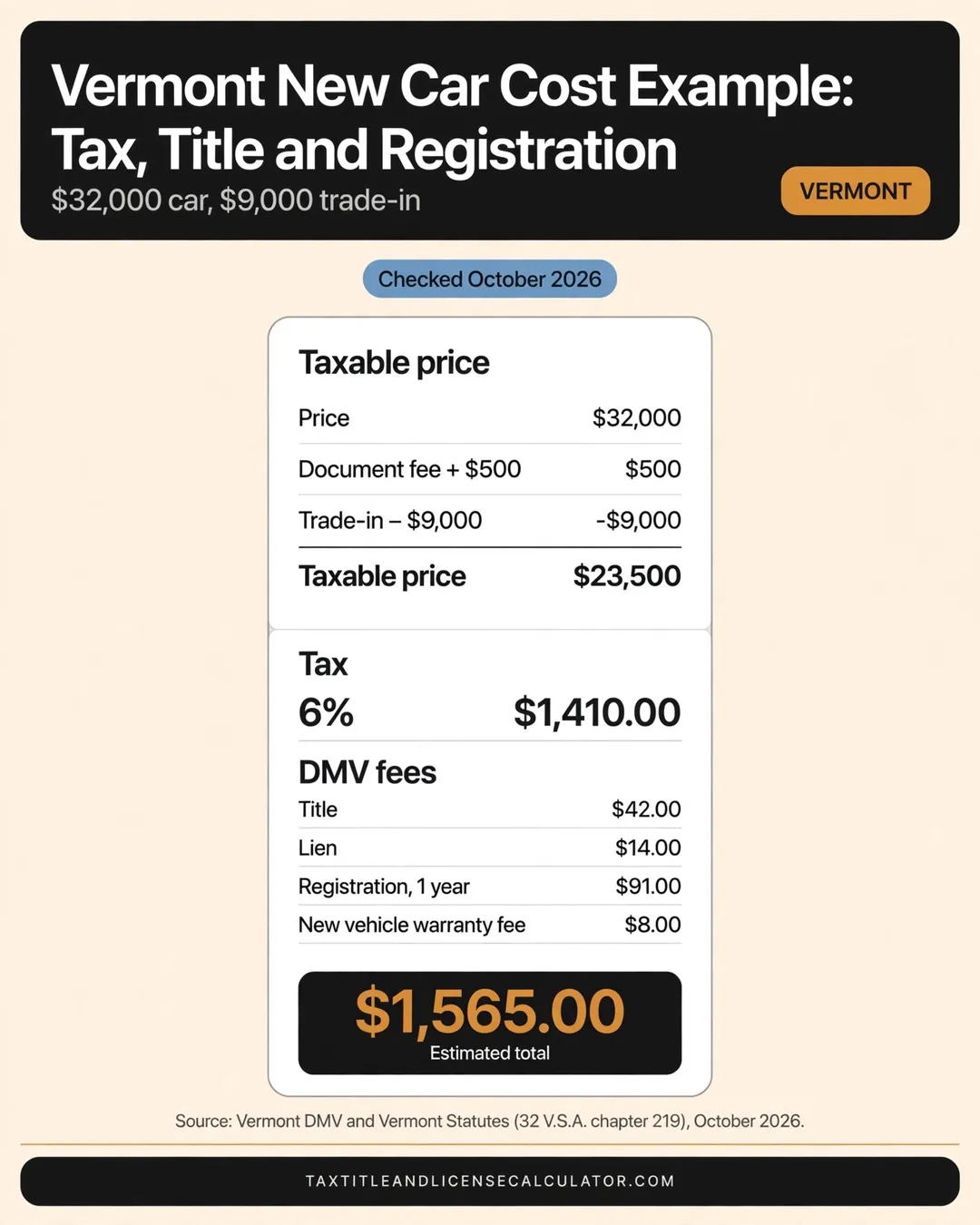
Assumptions: $32,000 price, $500 document fee, $9,000 trade-in allowance, loan, registered for one year, gas car.
| Item | Amount |
|---|---|
| Price + document fee − trade-in | $23,500.00 |
| Purchase and use tax at 6% | $1,410.00 |
| Title | $42.00 |
| Lien | $14.00 |
| Registration, one year | $91.00 |
| New vehicle warranty fee | $8.00 |
| Estimated total | $1,565.00 |
Example 2: Used car from a private seller
Assumptions: $9,000 price, $11,000 J.D. Power clean trade-in value, no loan, one-year registration.
| Item | Amount |
|---|---|
| Taxable value (higher of $9,000 and $11,000) | $11,000.00 |
| Purchase and use tax at 6% | $660.00 |
| Title | $42.00 |
| Registration, one year | $91.00 |
| Estimated total | $793.00 |
Example 3: New electric car
Assumptions: $45,000 price, no trade-in, no loan, battery electric, one-year registration.
| Item | Amount |
|---|---|
| Purchase and use tax at 6% of $45,000 | $2,700.00 |
| Title | $42.00 |
| Registration, electric, one year | $178.00 |
| New vehicle warranty fee | $8.00 |
| Estimated total | $2,928.00 |
There's no cap on a car's tax. The $2,486 maximum applies only to heavy trucks and similar vehicles.
Vermont Title and Registration Fees
| Vehicle | One year | Two years |
|---|---|---|
| Gas or diesel car or light truck | $91.00 | $167.00 |
| Plug-in hybrid | $135.50 | $256.00 |
| Battery electric | $178.00 | $341.00 |
The amounts include the $2 Clean Air Fund fee where it applies, and the EV infrastructure fee for plug-in and electric cars. Light trucks 6,100 pounds or more have their own fee chart. The title costs $42, and each lien adds $14.
Plates belong to you, not the car. If you gift a vehicle, the new owner needs new plates. Compare that with Connecticut, where towns send a yearly car tax bill.
How much do electric cars pay in Vermont?
Plug-in hybrids pay a $44.50 EV infrastructure fee for one year and $89 for two. Battery electric cars pay $89 for one year and $178 for two. These are included in the registration amounts above.
Gifts, Newcomers, Out-of-State Purchases and Exemptions
Are gifted cars taxed in Vermont?
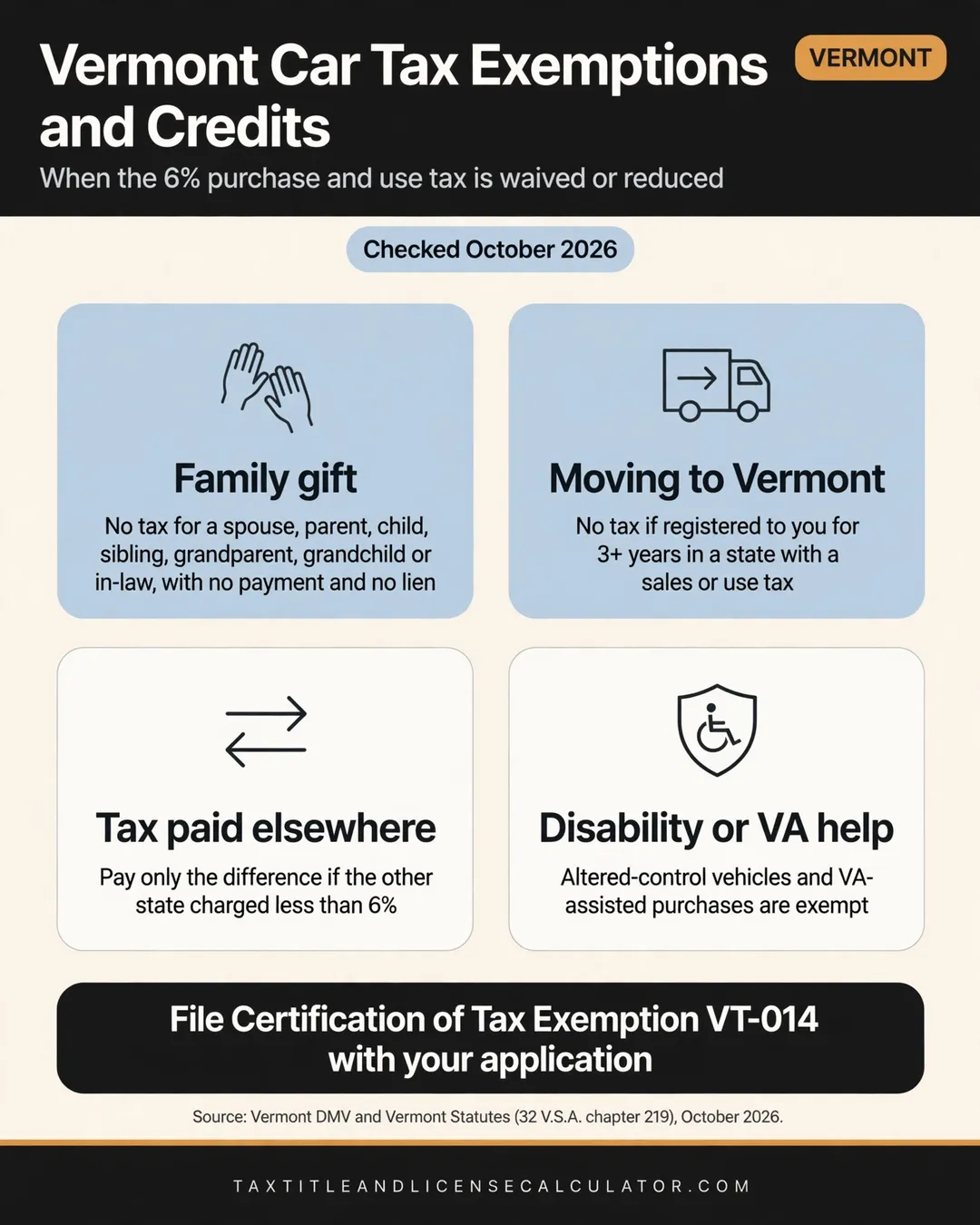
A gift is exempt if no payment of any kind is made. The car must be registered or titled in the donor's name, and the recipient must be one of these: spouse (or ex-spouse), parent, step-parent, child, step-child, sibling, step-sibling, grandparent, grandchild, in-law, or a trust for any of them.
Submit the Certification of Tax Exemption (VT-014), a signed title and a bill of sale with odometer statement (VT-005). The claim fails if the application lists a lienholder. Inherited vehicles also qualify.
What if I bought the car in another state?
Submit proof of the tax you paid. If it was less than Vermont's, you owe the difference. A retail installment agreement isn't proof. Buyers from New York dealers should keep the bill of sale and tax receipt.
What if I move to Vermont?
You can claim a credit if the vehicle was registered to you for three years or more in a state that has a sales or use tax. If not, the DMV taxes the J.D. Power value, with credit for any tax you paid elsewhere.
Other exemptions
- A vehicle with altered controls or a lifting device for a permanently disabled person, with a physician-signed VT-014.
- A vehicle bought with U.S. Department of Veterans Affairs assistance (VA Form 21-4502).
- Vehicles owned by qualifying religious or charitable groups.
- Transfers to a business you control (80% interest).
- Transfers to a former spouse within one year of a final divorce decree.
Example Receipt: New Car With a Trade-In
This graphic shows Example 1 line by line, so you can see where each dollar goes.
How to Calculate Vermont Tax, Title and License Costs by Hand
- Start with the price. Add the dealer document fee.
- Subtract the value your dealer allows for your trade-in.
- Look up the J.D. Power clean trade-in value for the car. If it is higher than your result, use it instead.
- Multiply by 6%.
- Subtract credit for a car you sold within three months, if it applies.
- Add the $42 title and $14 per lien.
- Add registration: $91, $135.50 or $178 for one year; $167, $256 or $341 for two years.
- Add the $8 warranty fee for a new vehicle.
What This Estimate Includes
- 6% purchase and use tax with the J.D. Power rule
- Trade-in treatment and the document fee
- Title and lien fees
- One- and two-year registration by fuel type
- The new vehicle warranty fee
What This Estimate Does Not Include
- The three-month sale credit
- Plate fees for special or vanity plates
- Vermont inspection fees
- Insurance, loan interest and optional products
- Dealer document fees (add them to the price yourself)
Common Mistakes to Avoid
- Taxing only the price. The J.D. Power value counts if it's higher.
- Forgetting the dealer document fee. It's taxable.
- Missing the three-month credit for a car you sold on your own.
- Claiming a gift with a lienholder on the application. It will be denied.
- Skipping the proof for tax paid elsewhere. An installment agreement isn't proof.
- Missing the one-year refund window.
- Using one-year fees for a two-year renewal.
- Assuming plates go with the car. They stay with the owner.
Frequently Asked Questions
What is the car tax in Vermont?
It's a 6% purchase and use tax on the price or J.D. Power clean trade-in value, whichever is higher.
Does a Vermont tax, title and license calculator include a trade-in?
Yes. A dealer trade-in lowers the taxable price. A car you sold within three months also earns a credit.
How much is the tax on a $30,000 car in Vermont?
It's $1,800 at 6%, before any trade-in credit, if the J.D. Power value is lower than $30,000.
How much is a title in Vermont?
It's $42. Each lien adds $14.
How much does it cost to register a car in Vermont?
A gas car costs $91 for one year or $167 for two.
Are dealer fees taxed in Vermont?
Yes. The dealer's documentation fee counts as part of the purchase price.
Is a family gift taxed?
No, if no payment is made and the donor is a listed relative.
What if I move to Vermont with my car?
No tax if it was registered to you for three or more years in a state with a sales or use tax.
How much do electric cars pay to register?
A battery electric car pays $178 for one year or $341 for two. A plug-in hybrid pays $135.50 or $256.
Can I dispute the J.D. Power value?
Yes. A licensed Vermont dealer or approved appraiser can submit form VD-012.
Official Sources
- Vermont DMV: Purchase and Use Tax
- Vermont DMV: Credits & Refunds
- Vermont DMV: Gifts
- Vermont DMV: Exemptions
- Vermont DMV: Registration Fees
- Vermont DMV: Title Fees
- Vermont DMV: EV Infrastructure Fee
- Vermont Statutes, 32 V.S.A. § 8902: Definitions
- Vermont Statutes, 32 V.S.A. § 8903: Tax imposed
- Vermont Statutes, 32 V.S.A. chapter 219: Motor Vehicle Purchase and Use Tax
This page is an independent estimate tool and guide. It isn't affiliated with the Vermont DMV or the state of Vermont. Rates and fees can change, so confirm your total before you pay.
See also: New Hampshire: no sales tax; a town permit fee based on list price and age.
Compare nearby states
William researches vehicle taxes, title fees, registration charges and DMV requirements across the United States. His work focuses on turning state-specific fee schedules, tax guidance, registration requirements and statutory information into practical explanations for vehicle buyers and owners. He cross-checks calculator inputs against official state revenue departments, motor vehicle agencies and published fee schedules, paying particular attention to differences between sales tax, title fees, registration charges and local or county taxes. He also reviews state-level changes so that calculator results and supporting articles reflect the latest available requirements rather than relying on outdated third-party estimates.
About this site →