Utah Vehicle Sales Tax Calculator
Utah charges a 4.85% state sales tax on a vehicle, plus a local rate set by the city or county. Combined rates start at 6.10% and climb higher in many cities. A trade-in lowers the price only when you swap vehicles in the same deal, and manufacturer rebates come off the price too.
Use this Utah vehicle sales tax calculator to estimate the tax, title and registration on a new or used car. Below, you'll find every rule, the yearly age-based fee, the 2026 EV fee and three worked examples.
Checked against the Utah DMV, the Utah State Tax Commission and the Utah Code on October 22, 2026. This is an independent estimate. The DMV sets your final amount.
Utah Car Tax and Fees at a Glance
| Charge | Amount | Notes |
|---|---|---|
| State sales tax | 4.85% | 4.70% sales tax plus 0.15% for Medicaid expansion |
| Local sales tax | Varies | Combined rates start at 6.10% |
| Title | $6 | Once |
| Registration | $58.25 a year | Cars, trucks and SUVs up to 14,000 lbs (2026 amount) |
| Extra registration fee | $7.50 a year | Charged on most vehicles |
| Age-based uniform fee | $10 to $150 a year | Set by model year, paid at every renewal |
| Driver education fee | $2.50 | Every registration |
| Uninsured motorist fee | $1 | Every registration |
| Corridor fee | $10 | 11 counties, including Salt Lake, Utah, Davis and Weber |
| Air pollution control fee | $2 or $3 | 5 counties; not charged on EVs |
| EV fee | $180 a year in 2026 | $280 from January 1, 2027 |
On this page15 sections
- Utah Car Tax and Fees at a Glance
- How Utah Vehicle Sales Tax Is Calculated
- How Much Is Car Sales Tax in Utah?
- Utah Title, Registration and Small Fees
- Utah's Age-Based Uniform Fee
- Utah Electric Vehicle, Plug-In Hybrid and Hybrid Fees
- What a New Car Really Costs at Registration in Utah
- Private Sales, Family Sales and Out-of-State Purchases
- Utah Inspections
- How to Calculate Utah Tax, Title and License Costs by Hand
- What This Estimate Includes
- What This Estimate Does Not Include
- Common Mistakes to Avoid
- Frequently Asked Questions
- Official Sources
How Utah Vehicle Sales Tax Is Calculated
Sales tax = (price + document fee − rebate − same-deal trade-in) × combined rate
Utah's state rate is 4.85%. That's 4.70% sales tax plus 0.15% that pays for Medicaid expansion. Every sale also carries a 1.00% local tax and a 0.25% county tax, so the lowest combined rate anywhere in Utah is 6.10%. Cities and counties can add more for transit, tourism and other projects. The Tax Commission publishes the full list, and it changes by quarter.
Which local rate applies to my car?
It depends on who sells it. If a dealer sells you the car, the rate comes from the dealer's location. If a private seller sells it, the rate comes from the address where you'll register the car. Logan's combined rate is 7.30%, and unincorporated Cache County is 7.00%.
That makes Utah different from New Mexico, which charges one flat 4% excise tax in every town. In Utah, two buyers with the same car can pay different tax.
What counts as the price?
The price includes everything you give for the car: cash, a loan payoff and a trade-in. A dealer's document service fee is taxable. So is an extended warranty or service contract. State title, registration and license fees that the dealer collects for you aren't taxed.
Does a trade-in lower the tax in Utah?
Yes, but only in one situation. The trade must be a vehicle-for-vehicle swap in the same deal, written on the same paperwork with set amounts. A credit toward a future purchase doesn't count. Selling your old car to someone else first doesn't count either.
If you trade in a leased car, you must buy it first and pay the tax before the trade works.
Do rebates lower the tax in Utah?
Yes. The Tax Commission treats manufacturer rebates as nontaxable, whether you take the money or the dealer keeps it as your down payment. A $1,500 rebate on a car taxed at 7.25% saves you about $109.

How Much Is Car Sales Tax in Utah?
These figures use two combined rates: 6.10%, the lowest in the state, and 7.25% as a middle example. Look up your own rate before you buy.
| Taxable price | At 6.10% | At 7.25% |
|---|---|---|
| $20,000 | $1,220 | $1,450 |
| $30,000 | $1,830 | $2,175 |
| $40,000 | $2,440 | $2,900 |
| $50,000 | $3,050 | $3,625 |
Example 1: New SUV from a Salt Lake County dealer
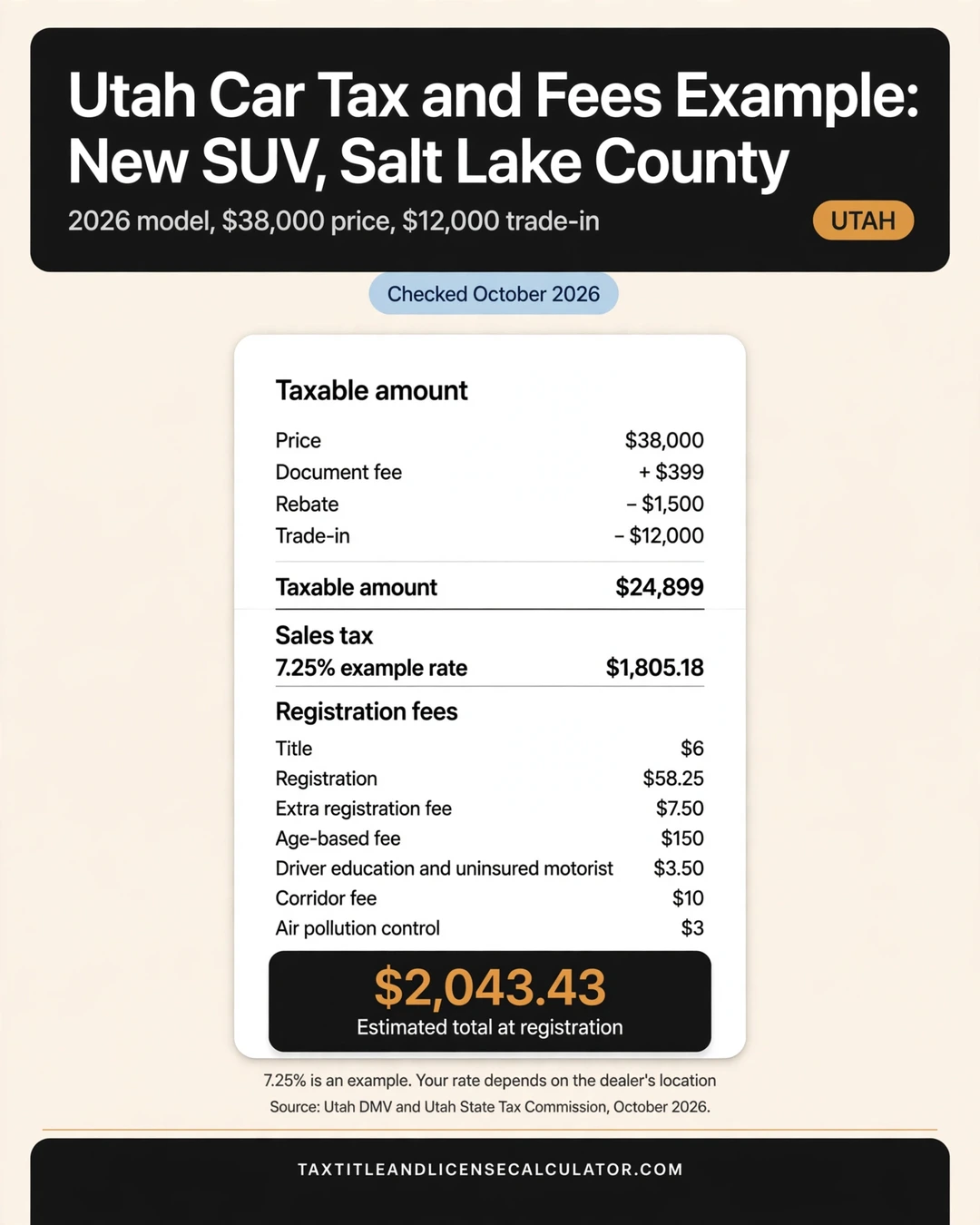
Assumptions: $38,000 price, $399 document fee, $1,500 rebate, $12,000 trade-in in the same deal, 2026 model year, gas engine, 7.25% combined rate (for illustration).
| Item | Amount |
|---|---|
| Price + document fee − rebate − trade-in | $24,899.00 |
| Sales tax at 7.25% | $1,805.18 |
| Title | $6.00 |
| Registration | $58.25 |
| Extra registration fee | $7.50 |
| Age-based fee (2026 model) | $150.00 |
| Driver education + uninsured motorist fees | $3.50 |
| Corridor fee (Salt Lake County) | $10.00 |
| Air pollution control fee (Salt Lake County) | $3.00 |
| Estimated total | $2,043.43 |
Example 2: Used car from a private seller in Logan
Assumptions: 2020 car, $15,000 price, bought from a private seller, registered in Logan (7.30%).
| Item | Amount |
|---|---|
| Sales tax at 7.30%, paid to the DMV | $1,095.00 |
| Title | $6.00 |
| Registration | $58.25 |
| Extra registration fee | $7.50 |
| Age-based fee (2018 to 2020 models) | $80.00 |
| Driver education + uninsured motorist fees | $3.50 |
| Air pollution control fee (Cache County) | $3.00 |
| Estimated total | $1,253.25 |
Example 3: New electric car in Utah County
Assumptions: $50,000 price, no trade-in, 2026 model, 7.25% combined rate (for illustration), annual EV fee. Electric cars don't pay the air pollution control fee.
| Item | Amount |
|---|---|
| Sales tax at 7.25% | $3,625.00 |
| Title | $6.00 |
| Registration | $58.25 |
| Extra registration fee | $7.50 |
| Age-based fee (2026 model) | $150.00 |
| EV fee (2026) | $180.00 |
| Driver education + uninsured motorist fees | $3.50 |
| Corridor fee (Utah County) | $10.00 |
| Estimated total | $4,040.25 |
On January 1, 2027, that EV fee becomes $280, so the same car would cost $100 more to renew.
Utah Title, Registration and Small Fees
| Fee | Amount | Who pays |
|---|---|---|
| Title (new or duplicate) | $6 | Everyone |
| Registration, 12 months | $58.25 | Vehicles up to 14,000 lbs; the statute says $44, but Utah adjusts it for inflation every January |
| Extra registration fee | $7.50 | Most vehicles; the statute says $7, adjusted for 2026 |
| Driver education fee | $2.50 | Every car registration |
| Uninsured motorist identification fee | $1 | Every car registration |
| Corridor fee | $10 | Salt Lake, Davis, Utah, Weber, Summit, Wasatch, Iron, Box Elder, Washington, Tooele and Morgan counties |
| Air pollution control fee | $3 in Salt Lake, Davis and Cache; $2 in Utah and Weber | Not on electric vehicles |
| Temporary permit | $6 (30 days); $2.50 (96 hours) | If you need to drive before registering |
Utah renews registration every year. A six-month option exists for cars, and electric vehicles can register for 24 months at double the 12-month fee. Because the amounts are indexed to inflation, check them each January. The state's Fee Estimator uses the current figures. Duplicate titles and title corrections also cost $6.
Utah's Age-Based Uniform Fee
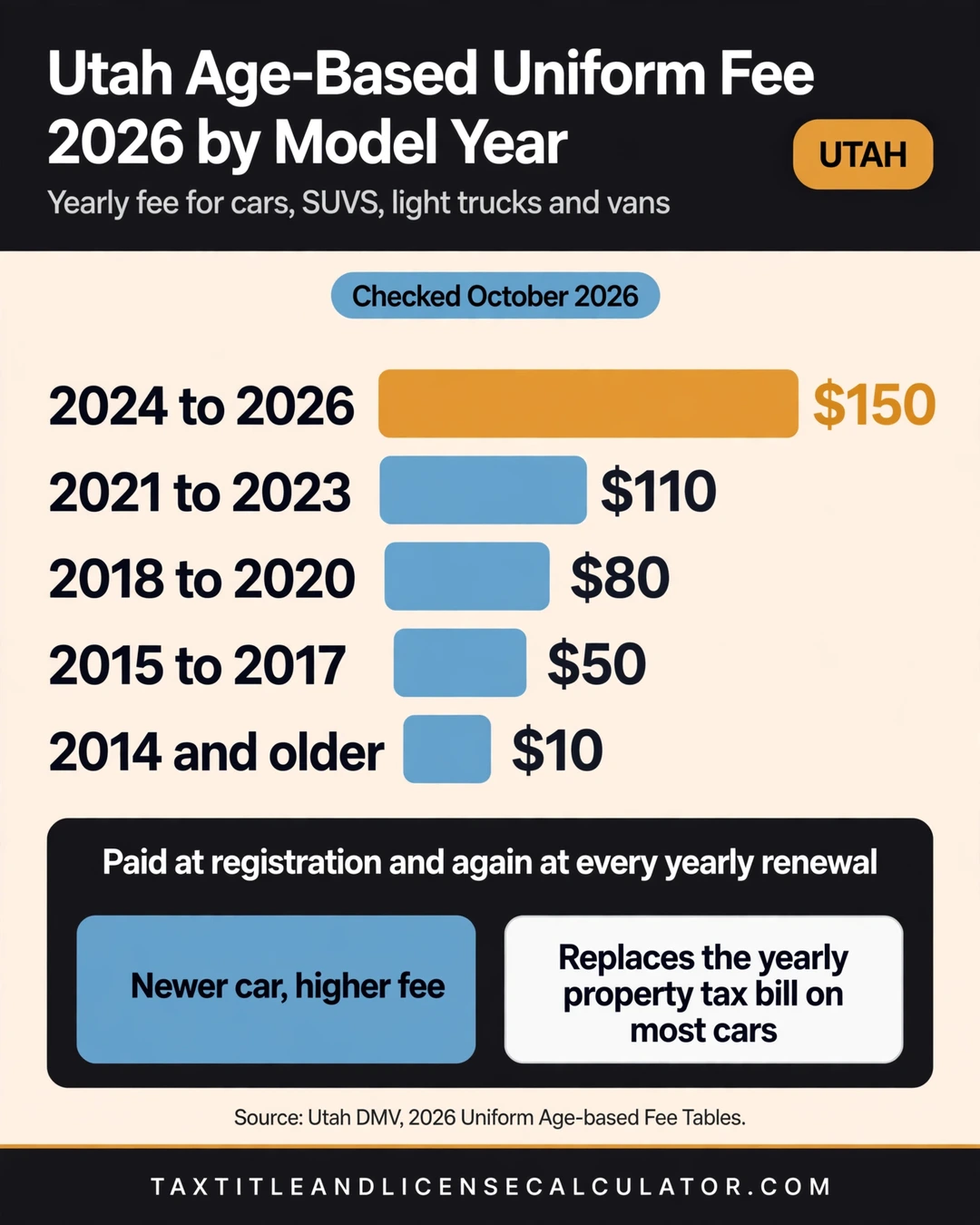
Utah doesn't send a separate property tax bill for most cars. Instead, you pay a uniform age-based fee at registration and every renewal. It's based on the model year, and it applies to cars, light trucks, SUVs and vans. The newer the vehicle, the more it costs.
| Model year | Yearly fee (2026 table) |
|---|---|
| 2024 to 2026 | $150 |
| 2021 to 2023 | $110 |
| 2018 to 2020 | $80 |
| 2015 to 2017 | $50 |
| 2014 and older | $10 |
The fee changes when the car crosses into a new age group, usually in January. It's worth checking if you're comparing a 2023 and a 2024 model: that's a $40 difference every year. Nebraska charges a yearly motor vehicle tax based on price and age in a similar way, though Nebraska's amount depends on the original price.
Utah Electric Vehicle, Plug-In Hybrid and Hybrid Fees
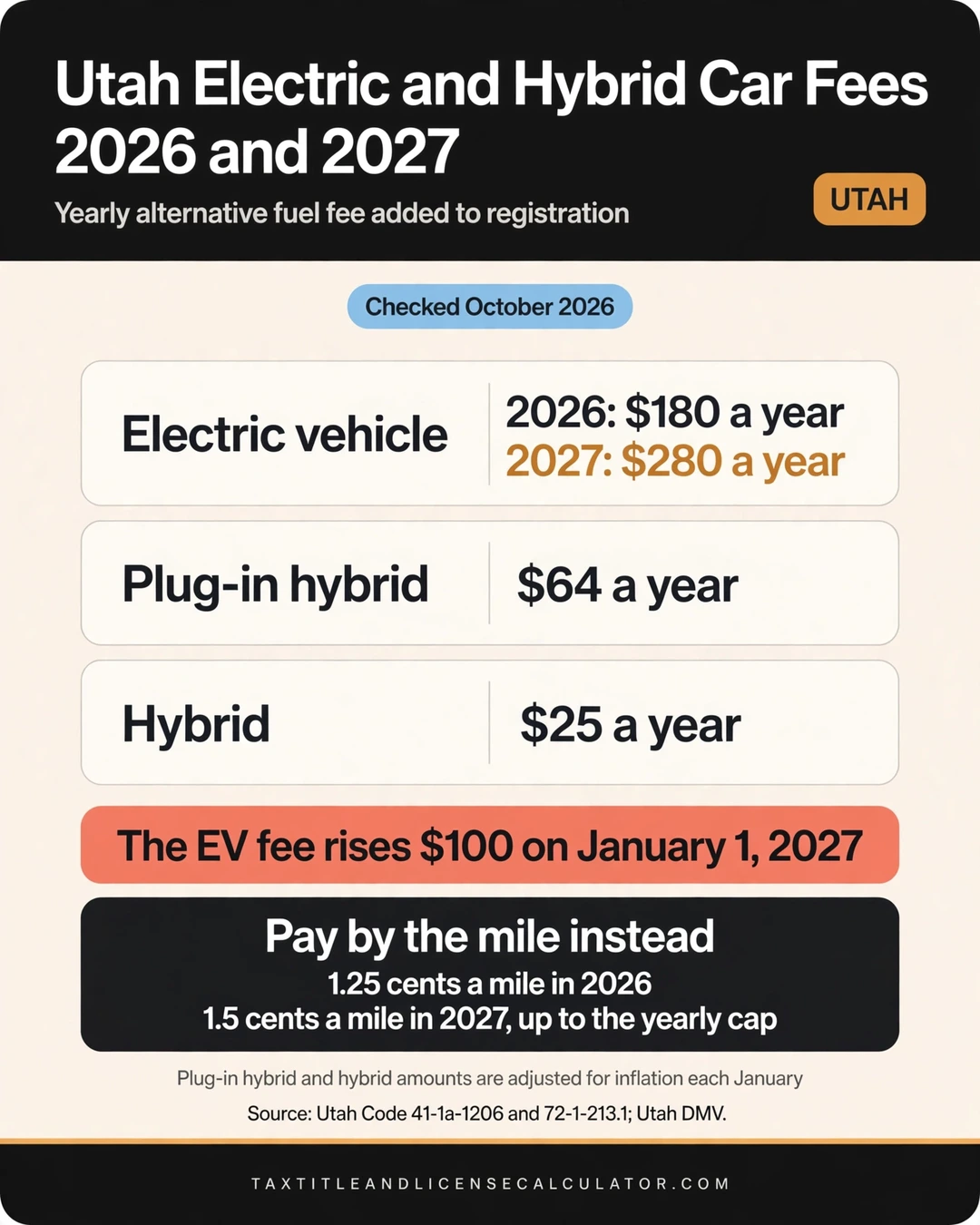
Utah adds a yearly alternative fuel fee to registration for electric and hybrid vehicles. It makes up for the fuel tax these cars don't pay. The EV fee is the biggest jump in the state's fee history: $180 in 2026, then $280 from January 1, 2027.
| Vehicle | Yearly fee | Notes |
|---|---|---|
| Electric | $180 (2026), $280 (2027) | Equals the road usage charge cap in state law |
| Plug-in hybrid | $64 | 2026 adjusted amount; changes each January |
| Hybrid | $25 | 2026 adjusted amount; changes each January |
Can I pay by the mile instead?
Electric vehicle owners can join Utah's road usage charge program instead of paying the flat fee. You pay by the mile, up to the same yearly cap. The rate is 1.25 cents a mile in 2026 and 1.5 cents a mile in 2027. If you drive less than about 14,400 miles in 2026, the per-mile option costs less than $180.
Other states charge less. Wisconsin adds $175 a year for electric cars, and Minnesota's electric surcharge starts at $150.
What a New Car Really Costs at Registration in Utah
Most buyers focus on the sales tax. In Utah, the fees add up too. The next graphic shows Example 1 line by line, so you can see where a $2,000 bill comes from on a $38,000 SUV.
Private Sales, Family Sales and Out-of-State Purchases
Do I pay sales tax on a private car sale in Utah?
Yes. You pay it to the DMV when you register the car, using the rate for your registration address. If a dealer sold you the car, the dealer collects the tax instead, and you don't pay it again at the DMV. The price you report must be the price you actually paid.
The Tax Commission reviews prices. Report too little and you can owe the extra tax, plus a fraud penalty of 100% of the tax or $500, whichever is greater. By comparison, Arizona doesn't tax private-party sales at all.
Is there a family exemption in Utah?
No. The DMV says Utah has no sales tax exemption for family-to-family vehicle purchases. If a parent sells you a car for $5,000, you owe tax on $5,000. If nothing is paid and no loan is taken over, ask the DMV what paperwork it needs before you register.
What if I buy a car in another state?
You get credit for sales or use tax that was properly due and paid to the other state. If that state's rate is lower than your Utah rate, you pay the difference. If it's higher, you don't get a refund. A car delivered to you inside Utah is taxed by Utah even if you drive it out afterward.
New to Utah or in the military
New residents must register their vehicles within 60 days of moving. The Tax Commission treats you as a resident if you live in Utah six months or more in a year. Military members stationed in Utah aren't exempt from Utah vehicle sales tax.

See also: Wyoming: a 4% state sales tax plus local taxes.
See also: Nevada: dealer sales tax and a yearly governmental services tax.
See also: Oregon: no sales tax, but a 0.5% vehicle privilege tax.
Utah Inspections
Utah doesn't require a safety inspection to register most passenger cars. Emissions tests are required in Salt Lake, Davis, Utah, Weber and Cache counties. How often you test depends on the county and the model year, so check with your county emissions office. New cars with a manufacturer's statement of origin and electric vehicles are exempt.
A VIN inspection is needed the first time a vehicle is titled in Utah, unless it's a new car bought from a Utah dealer. A DMV employee can do it at no charge.
How to Calculate Utah Tax, Title and License Costs by Hand
- Start with the price. Add the dealer's document fee and any extended warranty.
- Subtract any manufacturer rebate.
- Subtract your trade-in only if it's a vehicle-for-vehicle swap in the same deal.
- Multiply by your combined rate. Dealer sale: use the dealer's location. Private sale: use your registration address.
- Add $6 for the title, $58.25 for registration and the $7.50 extra registration fee.
- Add the age-based fee for your model year ($10 to $150).
- Add $3.50 for the driver education and uninsured motorist fees.
- Add the corridor fee ($10) and air pollution control fee ($2 or $3) if your county charges them.
- Add $180 if the car is electric, or the plug-in or hybrid fee if it applies.
The state's own Fee Estimator on the Utah Motor Vehicle Portal can confirm the final figure with your address and VIN.
What This Estimate Includes
- State and local sales tax with trade-in and rebate rules
- $6 title, registration and the extra registration fee
- Age-based uniform fee by model year
- Driver education and uninsured motorist fees
- EV, plug-in hybrid and hybrid fees
What This Estimate Does Not Include
- County corridor and air pollution control fees (check your county)
- Dealer document fee amount (the dealer sets it)
- Emissions test fees
- Insurance, loan interest and optional products
- Late registration penalties
Common Mistakes to Avoid
- Using a flat statewide rate. Utah's tax changes by city and county.
- Subtracting a trade-in that isn't a same-deal swap. Selling your old car separately doesn't lower the tax.
- Forgetting the document fee is taxed.
- Missing the age-based fee. It can be $150 a year on a new car.
- Using the old EV fee. It's $180 in 2026 and $280 in 2027.
- Using the $44 registration fee from the statute. Utah adjusts it every year, and it's $58.25 in 2026.
- Assuming family sales are tax-free. Utah has no family exemption.
- Reporting a low price on a private sale. The penalty can be 100% of the tax or $500.
Frequently Asked Questions
What is the car sales tax in Utah?
It's 4.85% at the state level, plus your local rate. Combined rates start at 6.10%, and most buyers pay more.
Does a Utah vehicle sales tax calculator subtract a trade-in?
Only for a vehicle-for-vehicle trade in the same deal. A credit toward a later purchase or a separate sale of your old car doesn't lower the tax.
How much is sales tax on a $30,000 car in Utah?
At a 7.25% combined rate, it's $2,175. At the 6.10% minimum, it's $1,830.
How much does it cost to register a car in Utah?
Registration is $58.25 a year in 2026, plus a $7.50 extra fee. You also pay a $6 title, the age-based fee ($10 to $150), $3.50 in small fees, and county fees where they apply.
How much is the Utah EV registration fee?
It's $180 a year in 2026 and $280 from January 1, 2027. You can pay by the mile instead, up to the same cap.
Are rebates taxed in Utah?
No. Manufacturer rebates lower the taxable price. The dealer's document fee is taxed.
Do I need an emissions test in Utah?
Only in Salt Lake, Davis, Utah, Weber and Cache counties. New cars and EVs are exempt. Utah has no safety inspection for most passenger cars.
How long do I have to register a car in Utah?
New residents have 60 days. If you buy from a dealer, the dealer usually handles the title and registration.
Official Sources
- Utah DMV: Registration Taxes & Fees
- Utah DMV: 2026 Uniform Age-based Fee Tables
- Utah DMV: Summary of Common Fees
- Utah DMV: Inspections
- Utah State Tax Commission: Sales and Use Tax Rates
- Utah State Tax Commission: Publication 5, Motor Vehicle Sales Tax
- Utah Legislature: Vehicle Registration report (July 2026)
- Utah Road Usage Charge Program
- Utah Code 41-1a-1206: Registration fees
- Utah Code 72-1-213.1: Road usage charge
This page is an independent estimate tool and guide. It isn't affiliated with the Utah DMV or the Utah State Tax Commission. Rates and fees can change, so confirm your total before you pay.
Compare nearby states
Colorado →
State sales tax plus local rates that vary by city and county.
Arizona →
Dealer sales taxed; private sales aren’t.
New Mexico →
One flat 4% excise tax, no local add-on.
Nebraska →
Sales tax plus a yearly tax based on price and age.
Kansas →
State and local sales tax, paid at registration.
Texas →
A flat 6.25% motor vehicle sales tax.
Wyoming →A 4% state sales tax plus local taxes.Nevada →Dealer sales tax and a yearly governmental services tax.Oregon →No sales tax, but a 0.5% vehicle privilege tax.
William researches vehicle taxes, title fees, registration charges and DMV requirements across the United States. His work focuses on turning state-specific fee schedules, tax guidance, registration requirements and statutory information into practical explanations for vehicle buyers and owners. He cross-checks calculator inputs against official state revenue departments, motor vehicle agencies and published fee schedules, paying particular attention to differences between sales tax, title fees, registration charges and local or county taxes. He also reviews state-level changes so that calculator results and supporting articles reflect the latest available requirements rather than relying on outdated third-party estimates.
About this site →