Connecticut Tax, Title and License Calculator
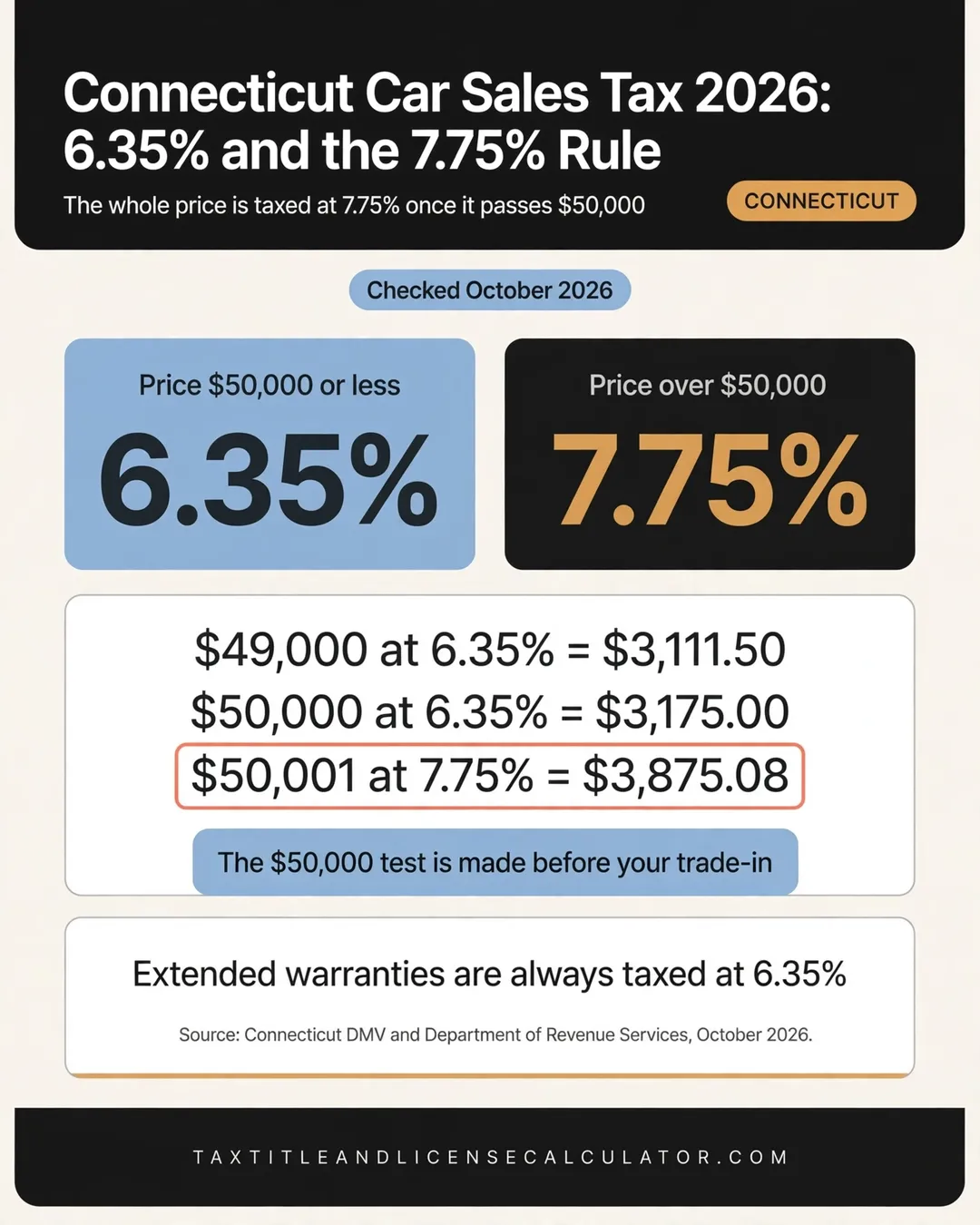
Connecticut charges a 6.35% sales tax on most cars. If the price is over $50,000, the whole price is taxed at 7.75%. You also pay a $25 title fee and a registration fee of $120 for three years. Your town sends a separate car tax bill every year.
Use this Connecticut tax, title and license calculator to estimate your costs on a new or used car. Below are the rules for trade-ins, rebates, private sales and gifts, plus three worked examples.
Checked against the Connecticut DMV, the Department of Revenue Services (DRS) and Connecticut law on October 22, 2026. This is an independent estimate. The DMV sets your final amount.
Connecticut Car Tax and Fees at a Glance
| Charge | Amount | Notes |
|---|---|---|
| Sales tax, price $50,000 or less | 6.35% | After trade-in and dealer discount |
| Sales tax, price over $50,000 | 7.75% | Whole price, not just the part over $50,000 |
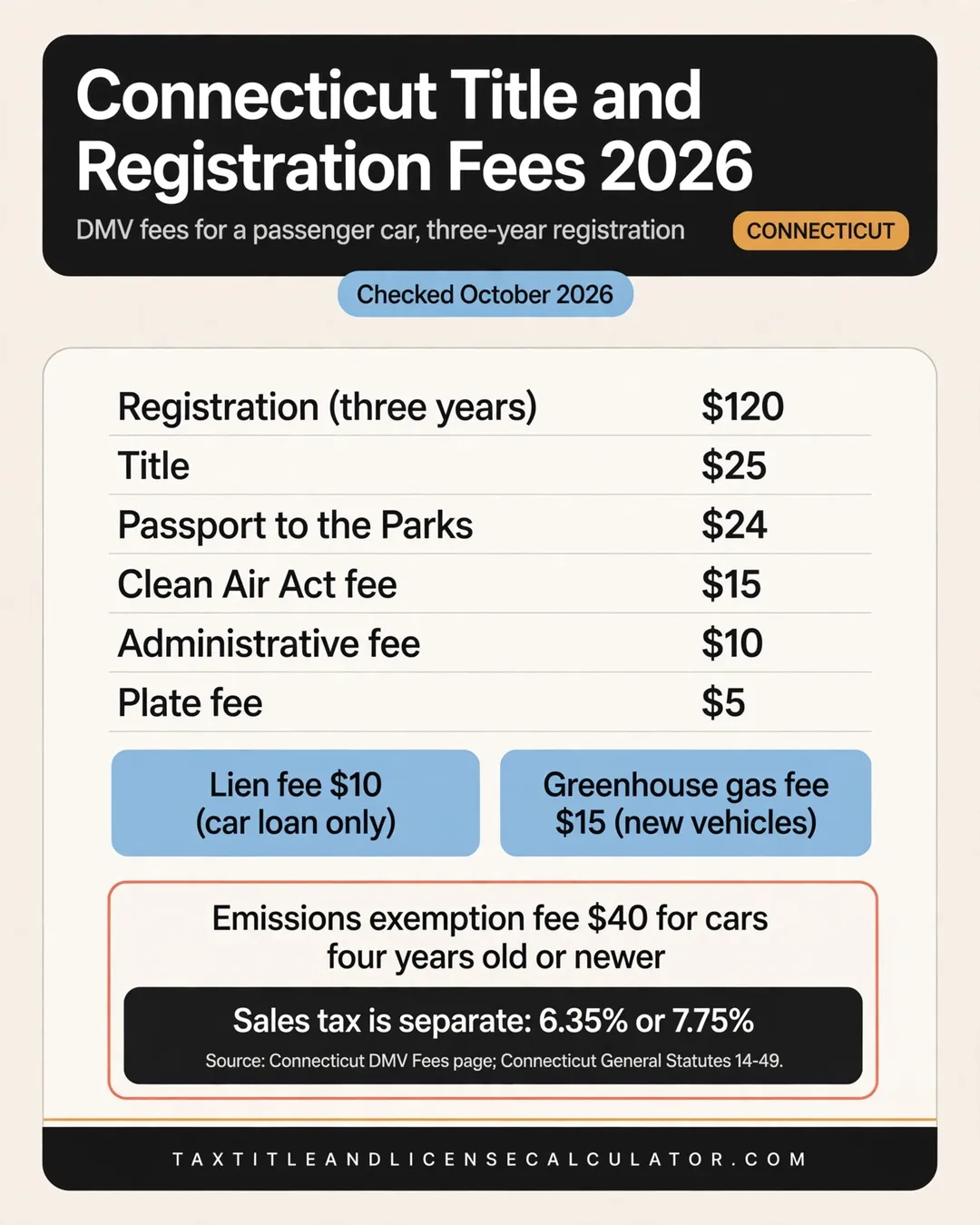
| Title | $25 | Plus $10 for a lien, if you have a loan |
| Registration, passenger car | $120 | For three years |
| Plate fee | $5 | |
| Administrative fee | $10 | |
| Clean Air Act fee | $15 | Not charged on electric cars |
| Passport to the Parks fee | $24 | Pays for state parks access |
| Greenhouse gas fee | $15 | New vehicles with a certificate of origin |
| Emissions exemption fee | $40 | Vehicles four years old or newer |
On this page13 sections
- Connecticut Car Tax and Fees at a Glance
- How Connecticut Sales Tax Is Calculated
- How Much Is Car Sales Tax in Connecticut?
- Connecticut Title, Registration and DMV Fees
- Connecticut's Yearly Car Tax From Your Town
- Electric and Hybrid Vehicle Rules
- Private Sales, Family Transfers, Gifts and Newcomers
- How to Calculate Connecticut Tax, Title and License Costs by Hand
- What This Estimate Includes
- What This Estimate Does Not Include
- Common Mistakes to Avoid
- Frequently Asked Questions
- Official Sources
How Connecticut Sales Tax Is Calculated
Sales tax = (price + taxable fees − trade-in − dealer discount) × 6.35% (or 7.75%)
At a dealer, tax is based on the purchase price. Connecticut gives full credit for your trade-in. A private sale works differently: the state uses the higher of the bill of sale or the NADA average trade-in value.
Why does the tax jump to 7.75% over $50,000?
Connecticut taxes passenger vehicles with a sales price over $50,000 at 7.75%. The test is the price before your trade-in. A $52,000 car with a $20,000 trade-in is still a 7.75% sale, taxed on $32,000. Taxable add-ons count toward the $50,000.
| Price | Rate | Sales tax |
|---|---|---|
| $49,000 | 6.35% | $3,111.50 |
| $50,000 | 6.35% | $3,175.00 |
| $50,001 | 7.75% | $3,875.08 |
That one extra dollar costs about $700. Extended warranties and service contracts are the exception, because they're always taxed at 6.35%. Massachusetts taxes the price after trade-in too, but it uses a flat 6.25% rate.
What is taxed and what isn't?
| Taxed | Not taxed |
|---|---|
| Dealer conveyance or document fees | Trade-in value |
| Shipping or freight | Dealer discount |
| VIN etching, paint sealant, rust protection, floor mats and similar add-ons | Registration and title fees |
| Manufacturer rebates (unless already deducted from the price) | Cash down payments and loan payoffs |
| Extended warranties and service contracts (at 6.35% only) | Equipment installed for a disabled driver |
A manufacturer rebate doesn't lower your tax. A dealer discount does. Keep that difference in mind when comparing offers.

How Much Is Car Sales Tax in Connecticut?
Example 1: New financed car from a dealer
Assumptions: $35,000 price, $500 dealer document fee, $10,000 trade-in, car loan, new car with a certificate of origin.
| Item | Amount |
|---|---|
| Price + document fee − trade-in | $25,500.00 |
| Sales tax at 6.35% | $1,619.25 |
| Title | $25.00 |
| Registration (three years) | $120.00 |
| Plate, administrative, Clean Air | $30.00 |
| Passport to the Parks | $24.00 |
| Greenhouse gas fee | $15.00 |
| Emissions exemption fee | $40.00 |
| Lien fee | $10.00 |
| Estimated total | $1,883.25 |
Example 2: $52,000 SUV with a trade-in, paid in cash
Assumptions: $52,000 price, $20,000 trade-in, no loan, new vehicle. Because the price is over $50,000, the 7.75% rate applies to the $32,000 left after the trade-in.
| Item | Amount |
|---|---|
| Taxable amount ($52,000 − $20,000) | $32,000.00 |
| Sales tax at 7.75% | $2,480.00 |
| Title | $25.00 |
| Registration (three years) | $120.00 |
| Plate, administrative, Clean Air | $30.00 |
| Passport to the Parks | $24.00 |
| Greenhouse gas fee | $15.00 |
| Emissions exemption fee | $40.00 |
| Estimated total | $2,734.00 |
Example 3: Used car from a private seller
Assumptions: five-year-old car, $12,000 bill of sale, NADA average trade-in value of $13,500, no loan. Connecticut taxes the higher number.
| Item | Amount |
|---|---|
| Sales tax at 6.35% of $13,500 | $857.25 |
| Title | $25.00 |
| Registration (three years) | $120.00 |
| Plate, administrative, Clean Air | $30.00 |
| Passport to the Parks | $24.00 |
| Estimated total | $1,056.25 |
Those totals assume the vehicle is a passenger car, SUV or van. Trucks and combination vehicles can pay a different registration fee.
Connecticut Title, Registration and DMV Fees
| Fee | Amount | Notes |
|---|---|---|
| Title | $25 | Replacement title is also $25 |
| Lien fee | $10 | Only with a car loan |
| Registration, passenger car, SUV or van | $120 | Three years under state law; renewal notices show the exact period |
| Plate fee | $5 | |
| Administrative fee | $10 | |
| Clean Air Act fee | $15 | Not charged on electric cars |
| Passport to the Parks | $24 | Raised from $15 on July 1, 2025 |
| Greenhouse gas fee | $15 | Vehicles with a certificate of origin |
| Emissions exemption fee | $40 | Cars four years old or newer; not charged on electric cars |
| Title only (no registration) | $35 | $25 title + $10 administrative |
Connecticut registration is a three-year fee. Drivers 65 or older can renew for one year at a prorated price. The DMV fee table lists the $120 without the term, so don't be surprised if some websites show different numbers.
A $25 title is cheap for the region. Maryland sets a $200 title fee, for example. Your final DMV bill also depends on plate type and vehicle class.
Connecticut's Yearly Car Tax From Your Town
Connecticut also taxes vehicles as property. Your town sends a bill every year, whether or not the car is registered. This is a separate tax from the sales tax and it doesn't appear on the DMV paperwork.
Car tax = average retail value × 70% × mill rate ÷ 1,000
The value is set by your local assessor on October 1. The assessment is 70% of average retail value. State law caps the motor vehicle mill rate at 32.46 mills, and some towns charge less. Many towns bill the main amount by July 1.
| Retail value | Assessed at 70% | Tax at 32.46 mills | Tax at 27.75 mills |
|---|---|---|---|
| $20,000 | $14,000 | $454.44 | $388.50 |
| $30,000 | $21,000 | $681.66 | $582.75 |
| $40,000 | $28,000 | $908.88 | $777.00 |
Your own bill depends on your town's rate. A car registered between October 2 and July 31 usually appears on a supplemental bill due January 1. Ask your town tax collector for the exact rate.

Electric and Hybrid Vehicle Rules
Electric cars pay the same $120 registration but skip two fees: the $15 Clean Air Act fee and the $40 emissions exemption fee. Connecticut doesn't charge an extra yearly electric vehicle fee. A 2026 bill to raise the EV registration fee to $345 didn't become law.
The state's CHEAPR program offers rebates of up to $5,000 to residents who buy or lease an eligible electric, plug-in hybrid or fuel cell car. Amounts and funding change, so check the Department of Energy and Environmental Protection (DEEP) page before you buy. A rebate doesn't change your sales tax.
Private Sales, Family Transfers, Gifts and Newcomers
How is a private-party sale taxed?
You pay the DMV when you register. The tax is 6.35% (7.75% over $50,000) on the NADA average trade-in value or the bill of sale, whichever is higher. Write the real price on the Application for Registration and Title (form H-13B). If the seller gives you a deal, the state may still tax the book value.
Which family transfers are exempt?
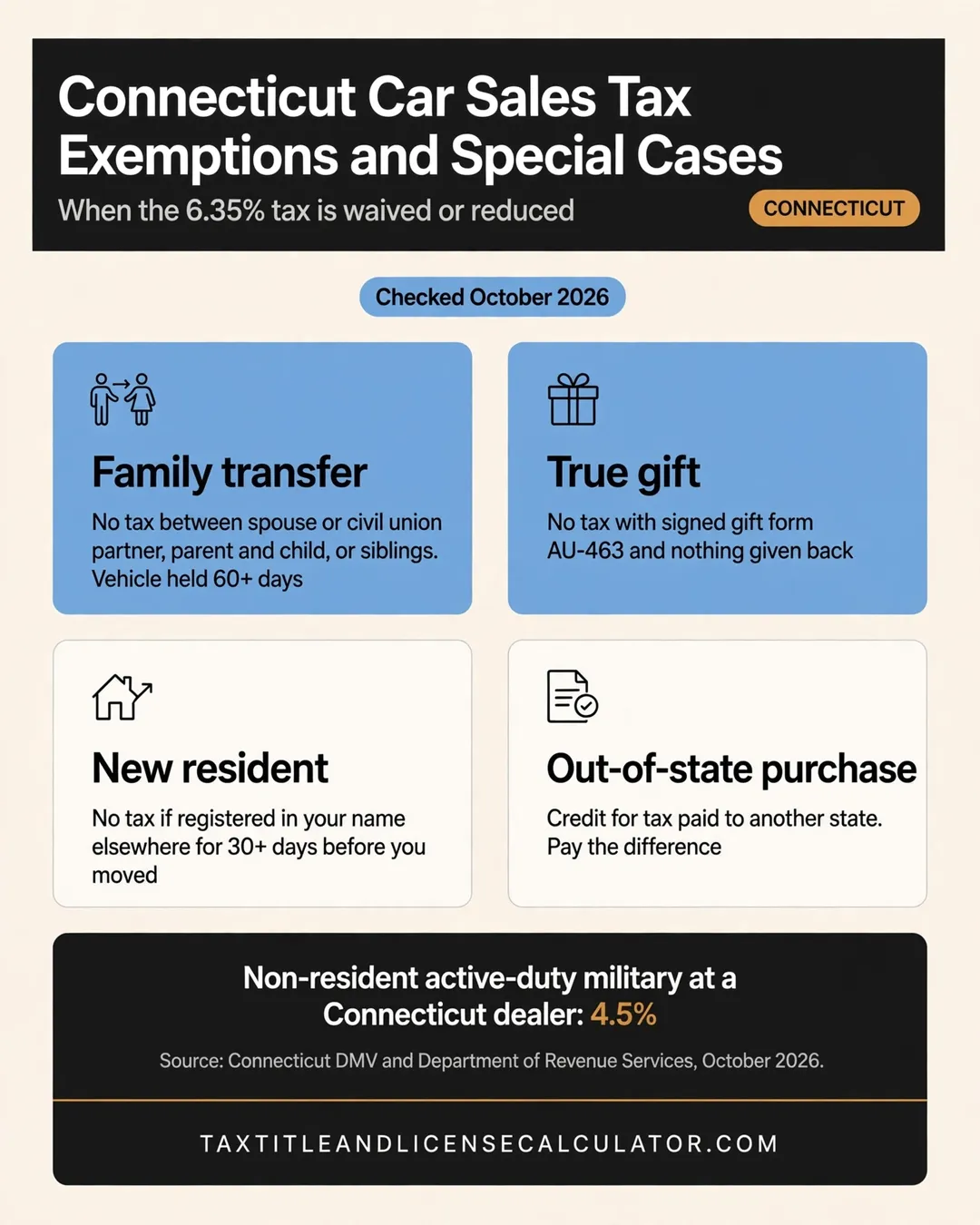
No tax is due on a vehicle transferred or sold between a spouse or civil union partner, a parent and child, or brothers and sisters. The vehicle must have been in the giver's name for at least 60 days and taxed on its last sale. Grandparents and cousins aren't on the list.
Is a gifted vehicle taxed?
No sales tax applies to a true gift, but the giver must sign a Motor Vehicle or Vessel Gift Declaration (AU-463). The giver can't get anything back, not even cash, services or a loan payoff. The giver may owe Connecticut gift tax. Pennsylvania exempts gifts between close family too, though its list of relatives differs.
What if I just moved to Connecticut?
You don't owe sales tax if the vehicle was registered in your name in another state for at least 30 days before you became a Connecticut resident. Complete section 5 of form H-13B with the purchase and registration dates. Otherwise, tax applies.
What if I bought out of state?
Connecticut credits sales tax you paid to another state. Bring the purchase invoice and the tax receipt. If you paid less than 6.35%, you pay the difference to the DMV. Buyers from New York or New Jersey dealers should keep both documents. Foreign taxes get no credit.
Are military members exempt?
Not if you're a Connecticut resident, who pay the same 6.35% (7.75%). Active-duty members stationed in Connecticut who live in another state pay a reduced 4.5% at a Connecticut dealer, using form CERT-135.
See also: Oregon: no sales tax, but a 0.5% vehicle privilege tax.
See also: Vermont: a 6% purchase and use tax.
See also: New Hampshire: no sales tax; a town permit fee based on list price and age.
How to Calculate Connecticut Tax, Title and License Costs by Hand
- Start with the price. Add dealer fees, freight and add-ons.
- Subtract your trade-in and any dealer discount. Don't subtract a manufacturer rebate.
- For a private sale, use the higher of the bill of sale or the NADA average trade-in value.
- Check the price before the trade-in. Over $50,000, use 7.75%. Otherwise use 6.35%.
- Multiply the taxable amount by that rate.
- Add $25 for the title and $10 if you have a loan.
- Add $120 for registration, then $5 plate, $10 administrative, $15 Clean Air and $24 Passport to the Parks.
- Add $15 (new vehicle) and $40 (four years old or newer) if they apply. Skip Clean Air and the $40 fee for an electric car.
- Budget for the separate yearly car tax from your town.
What This Estimate Includes
- 6.35% and 7.75% sales tax with trade-in and fee rules
- Title and lien fees
- Registration, plate, administrative, Clean Air and Passport to the Parks fees
- Greenhouse gas and emissions exemption fees
- Family, gift, new-resident and military rules
What This Estimate Does Not Include
- Your town's yearly property tax on the car
- Emissions test station fees
- Vanity or special plate fees
- Insurance, loan interest and optional products
- CHEAPR or other rebates
Common Mistakes to Avoid
- Testing the $50,000 line after the trade-in. The state tests the price before it.
- Subtracting a manufacturer rebate. It stays taxable unless the price already reflects it.
- Forgetting that dealer document fees are taxed.
- Using the wrong registration term. The $120 covers three years.
- Skipping the town car tax. It arrives as a separate bill.
- Writing a low price on a private sale. The state taxes the higher NADA value.
- Missing the 60-day family rule. The giver must have held the car for 60 days.
- Skipping form AU-463 on a gift.
- Assuming a title with a lien is $35. It's $25 plus a $10 lien fee.
Frequently Asked Questions
What is the car sales tax in Connecticut?
It's 6.35%. For vehicles with a price over $50,000 it's 7.75%.
Does a Connecticut tax, title and license calculator subtract a trade-in?
Yes. Connecticut gives full trade-in credit at a dealer. The $50,000 rate test is made before the trade-in.
How much is sales tax on a $30,000 car in Connecticut?
It's $1,905 at 6.35%, before any trade-in or dealer discount.
How much does it cost to register a car in Connecticut?
Registration is $120 for three years, plus a $5 plate fee, $10 administrative fee, $15 Clean Air fee and $24 Passport to the Parks fee.
How much is a title in Connecticut?
It's $25, plus $10 if there's a lien.
Is there sales tax on a used car in Connecticut?
Yes. A dealer taxes the price. A private sale is taxed on the higher of the bill of sale or NADA value.
What is the Connecticut car tax bill?
It's a yearly property tax from your town, based on 70% of the car's value and a mill rate capped at 32.46.
Who is exempt from Connecticut vehicle sales tax?
Spouses or civil union partners, parents and children, brothers and sisters (with a 60-day holding rule), true gifts and certain new residents.
Do electric vehicles pay extra in Connecticut?
No extra yearly fee exists. EVs skip the Clean Air and emissions exemption fees.
What if I buy a car in another state?
Connecticut credits the sales tax you paid. If it was less than 6.35%, you pay the difference when you register.
Official Sources
- Connecticut DMV: DMV fees
- Connecticut DMV: Sales tax on first-time registrations
- Connecticut DMV: Sales tax calculator tables for out-of-state dealers
- Connecticut DRS: Sales and Use Tax Information
- Connecticut DRS: Special Notice 2011(10), motor vehicle dealers
- Connecticut General Statutes Chapter 246, section 14-49 and 14-49b
- Connecticut OPM: Mill Rates
- Connecticut DEEP: EVConnecticut incentives (CHEAPR)
This page is an independent estimate tool and guide. It isn't affiliated with the Connecticut DMV, DRS or the state of Connecticut. Rates and fees can change, so confirm your total before you pay.
Compare nearby states
New York →
State sales tax plus a county rate.
Massachusetts →
A flat 6.25% tax on the price after trade-in.
New Jersey →
A 6.625% rate on the price after trade-in.
Pennsylvania →
6% sales tax, with higher rates in two counties.
Oregon →No sales tax, but a 0.5% vehicle privilege tax.
Vermont →A 6% purchase and use tax.New Hampshire →No sales tax; a town permit fee based on list price and age.
William researches vehicle taxes, title fees, registration charges and DMV requirements across the United States. His work focuses on turning state-specific fee schedules, tax guidance, registration requirements and statutory information into practical explanations for vehicle buyers and owners. He cross-checks calculator inputs against official state revenue departments, motor vehicle agencies and published fee schedules, paying particular attention to differences between sales tax, title fees, registration charges and local or county taxes. He also reviews state-level changes so that calculator results and supporting articles reflect the latest available requirements rather than relying on outdated third-party estimates.
About this site →