Pennsylvania Tax, Title and License Calculator
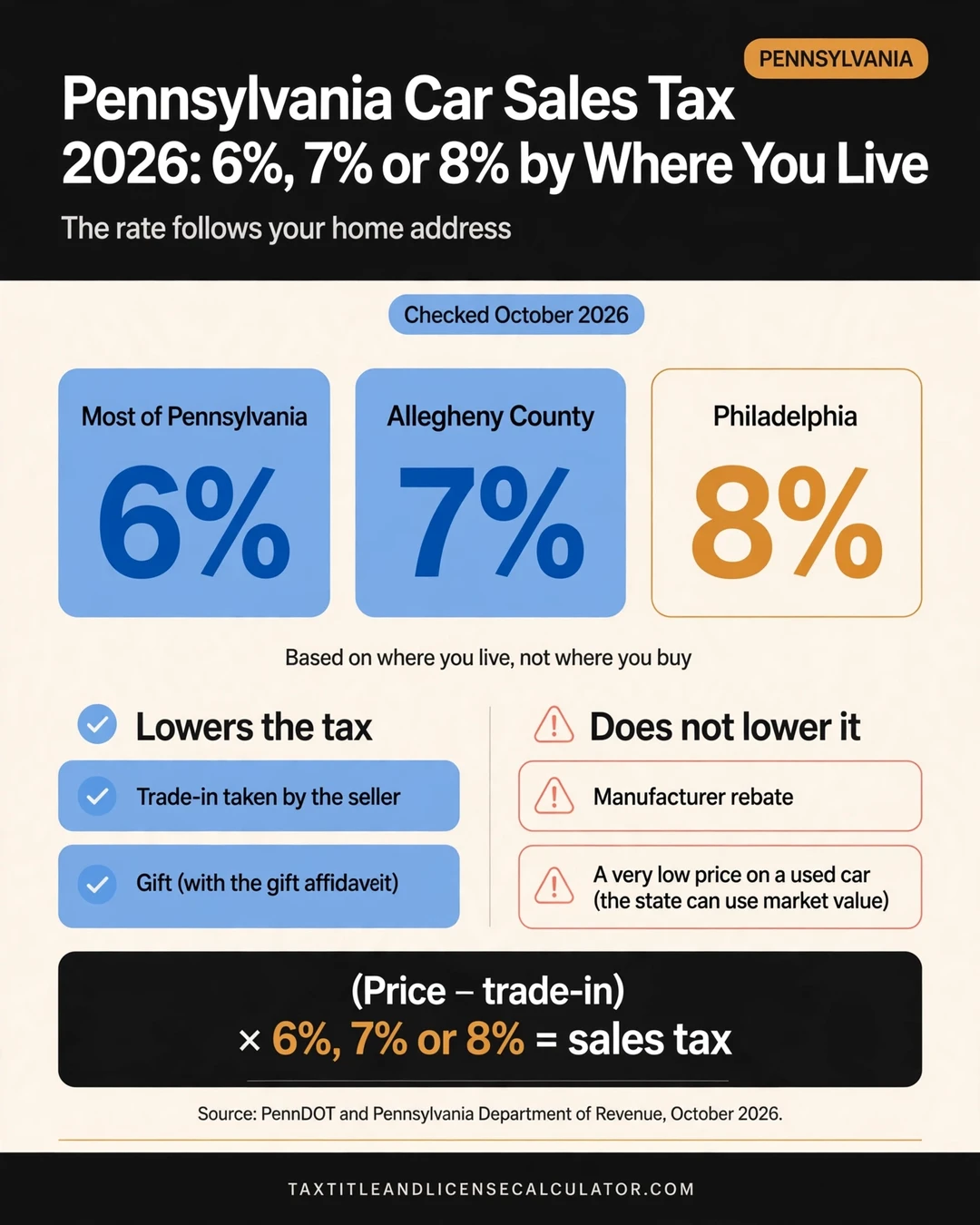
Pennsylvania charges 6% sales tax on a vehicle. Allegheny County residents pay 7%, and Philadelphia residents pay 8%. You also pay a $72 title fee and a $48 registration fee for a standard car. Manufacturer rebates don't lower the tax, but a trade-in does.
Use this Pennsylvania tax, title and license calculator (PA) to estimate the total on a new or used vehicle. Below, you'll find every rule, plus three worked examples.
Checked against PennDOT, the Pennsylvania Department of Revenue and the Pennsylvania Code on October 22, 2026. This is an independent estimate. PennDOT and the Department of Revenue set your final amount.
Pennsylvania Car Tax and Fees at a Glance
| Charge | Amount | Notes |
|---|---|---|
| Sales tax | 6% | Of the price or the market value, whichever applies |
| Sales tax, Allegheny County | 7% | 6% state plus 1% local |
| Sales tax, Philadelphia | 8% | 6% state plus 2% local |
| Certificate of title | $72 | Also the fee for a duplicate |
| Lien recording | $36 | If you have a car loan |
| Registration, passenger car | $48 a year | $96 for two years; includes a standard plate |
| County fee for local use | $5 a year | Only in participating counties |
| Electric vehicle road user charge | $250 a year | $500 for two years |
| Plug-in hybrid road user charge | $63 a year | $126 for two years |
On this page13 sections
- Pennsylvania Car Tax and Fees at a Glance
- How Pennsylvania Vehicle Sales Tax Is Calculated
- How Much Is Car Sales Tax in Pennsylvania?
- Pennsylvania Title, Lien and Registration Fees
- Pennsylvania Electric and Plug-In Hybrid Road User Charge
- What a New Car Really Costs at Registration in Pennsylvania
- Private Sales, Gifts, Out-of-State Purchases and Inspections
- How to Calculate Pennsylvania Tax, Title and License Costs by Hand
- What This Estimate Includes
- What This Estimate Does Not Include
- Common Mistakes to Avoid
- Frequently Asked Questions
- Official Sources
How Pennsylvania Vehicle Sales Tax Is Calculated
Sales tax = (price − trade-in) × your local rate (6%, 7% or 8%)
Pennsylvania's state rate is 6%. Allegheny County adds 1% and Philadelphia adds 2%. The rate depends on where you live, not where you buy. These are the only two local add-ons for vehicles, so everyone else pays 6%.
Compare that with neighbors. Ohio charges 5.75% plus county tax, New Jersey charges 6.625%, and New York adds local tax to a 4% state rate.
Is the tax based on the price or the market value?
The fact sheet says Pennsylvania tax is 6% of the purchase price or the current market value of the vehicle. In most cases they're close. If you pay far less than a car is worth, the state can tax the market value instead.
Does a trade-in lower the tax in Pennsylvania?
Yes. When the seller takes your trade-in, the tax is figured on the difference between the price of the vehicle you're buying and the value of your trade-in. A $7,000 trade-in on a $32,000 vehicle leaves $25,000 to tax.
Do rebates lower the tax in Pennsylvania?
No. The Department of Revenue figures the tax on the price without deducting the manufacturer's rebate. A $1,000 rebate doesn't save you $60. Louisiana does it differently, since Louisiana subtracts manufacturer rebates from the taxable price.
How Much Is Car Sales Tax in Pennsylvania?
| Taxable price | At 6% | At 7% (Allegheny) | At 8% (Philadelphia) |
|---|---|---|---|
| $20,000 | $1,200 | $1,400 | $1,600 |
| $30,000 | $1,800 | $2,100 | $2,400 |
| $40,000 | $2,400 | $2,800 | $3,200 |
| $50,000 | $3,000 | $3,500 | $4,000 |
Example 1: Financed new car in Allegheny County
Assumptions: $32,000 price, $7,000 trade-in, $1,000 manufacturer rebate (not deducted), 7% Allegheny rate, car loan, standard one-year registration.
| Item | Amount |
|---|---|
| Price − trade-in | $25,000.00 |
| Sales tax at 7% | $1,750.00 |
| Certificate of title | $72.00 |
| Lien recording | $36.00 |
| Registration, one year | $48.00 |
| Estimated total | $1,906.00 |
Example 2: Used car from a private seller, 6% area
Assumptions: $12,000 price, which is close to market value, no trade-in, no loan.
| Item | Amount |
|---|---|
| Sales tax at 6% of $12,000 | $720.00 |
| Certificate of title | $72.00 |
| Registration, one year | $48.00 |
| Estimated total | $840.00 |
Example 3: Financed electric car in Philadelphia
Assumptions: $50,000 price, no trade-in, 8% Philadelphia rate, car loan, one-year registration.
| Item | Amount |
|---|---|
| Sales tax at 8% of $50,000 | $4,000.00 |
| Certificate of title | $72.00 |
| Lien recording | $36.00 |
| Registration, one year | $48.00 |
| Electric vehicle road user charge | $250.00 |
| Estimated total | $4,406.00 |
In counties with a local-use fee, add $5. Dealers may also add documentation fees, which aren't included above.
Pennsylvania Title, Lien and Registration Fees
| Fee | Amount | Notes |
|---|---|---|
| Certificate of title | $72 | Also the fee for a duplicate title |
| Lien recording | $36 | Per lien, on top of the title fee |
| Registration, one year | $48 | Passenger car; may qualify for reduced fees |
| Registration, two years | $96 | Includes a standard plate on first issue |
| Standard plate replacement | $14 | Defaced, lost or stolen |
| Transfer of registration plate | $11 | Moving a plate to another vehicle |
| County fee for local use | $5 a year | Only in participating counties |
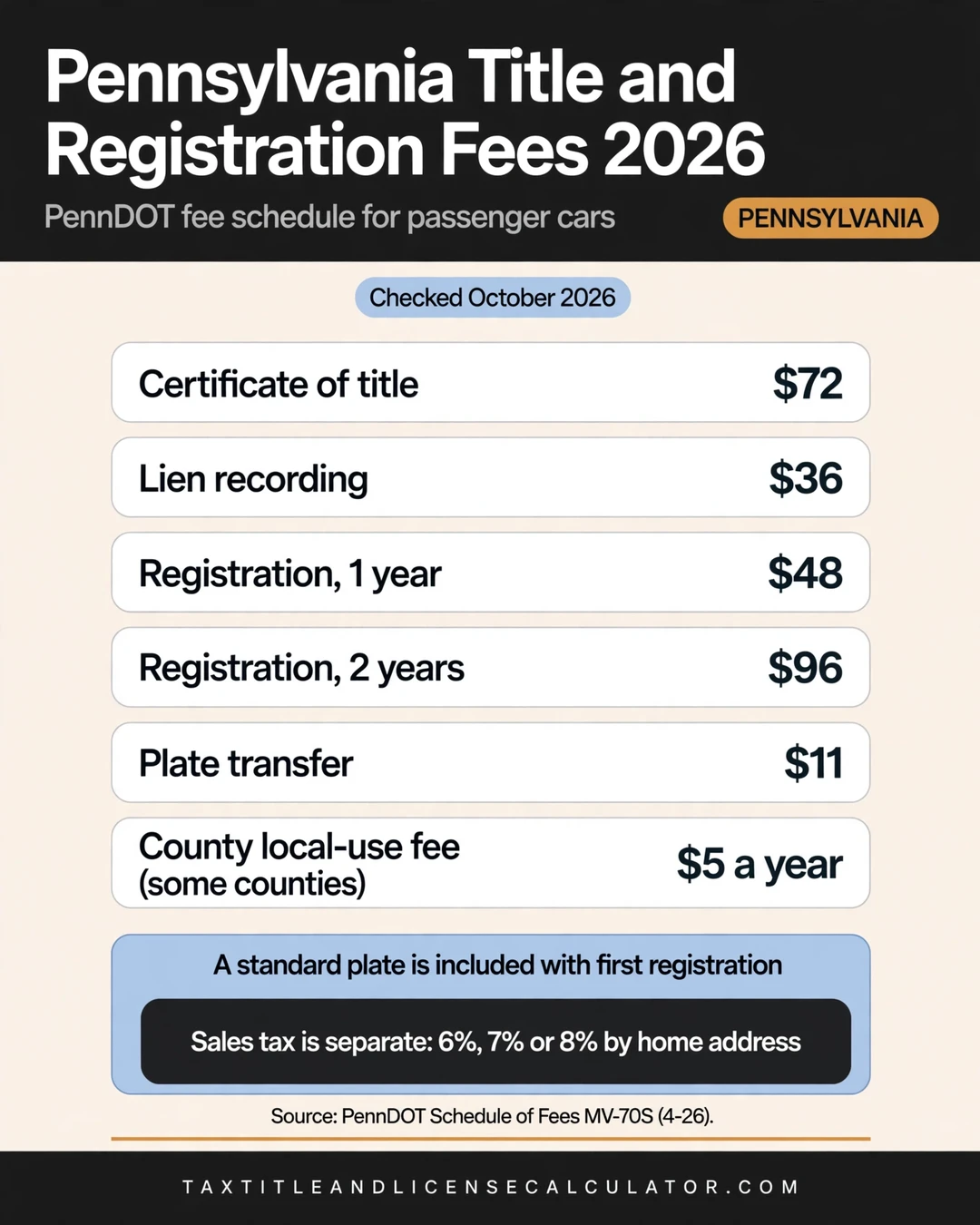
These come from PennDOT's fee schedule (form MV-70S, revised 4-26). PennDOT or an authorized agent, such as a notary or tag service, processes the paperwork. Specialty plates cost extra.
Pennsylvania Electric and Plug-In Hybrid Road User Charge
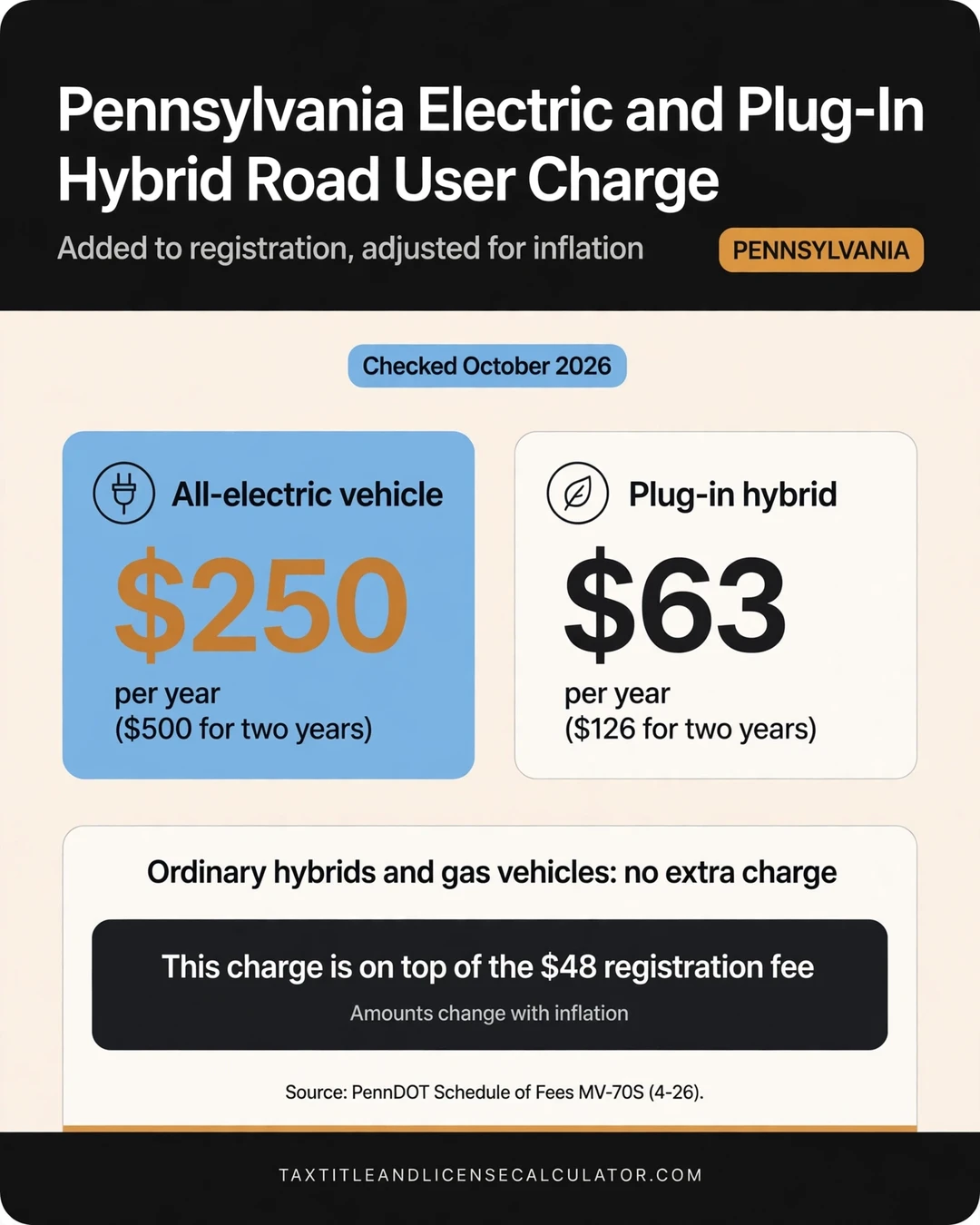
Pennsylvania adds a road user charge to the registration of electric and plug-in hybrid vehicles. It replaces fuel tax these vehicles don't pay. The amounts adjust with inflation.
| Vehicle | One year | Two years |
|---|---|---|
| All-electric | $250 | $500 |
| Plug-in hybrid | $63 | $126 |
Ordinary hybrids and gas vehicles don't pay it. For comparison, Idaho adds $140 a year for electric cars, so Pennsylvania's charge is higher.
What a New Car Really Costs at Registration in Pennsylvania
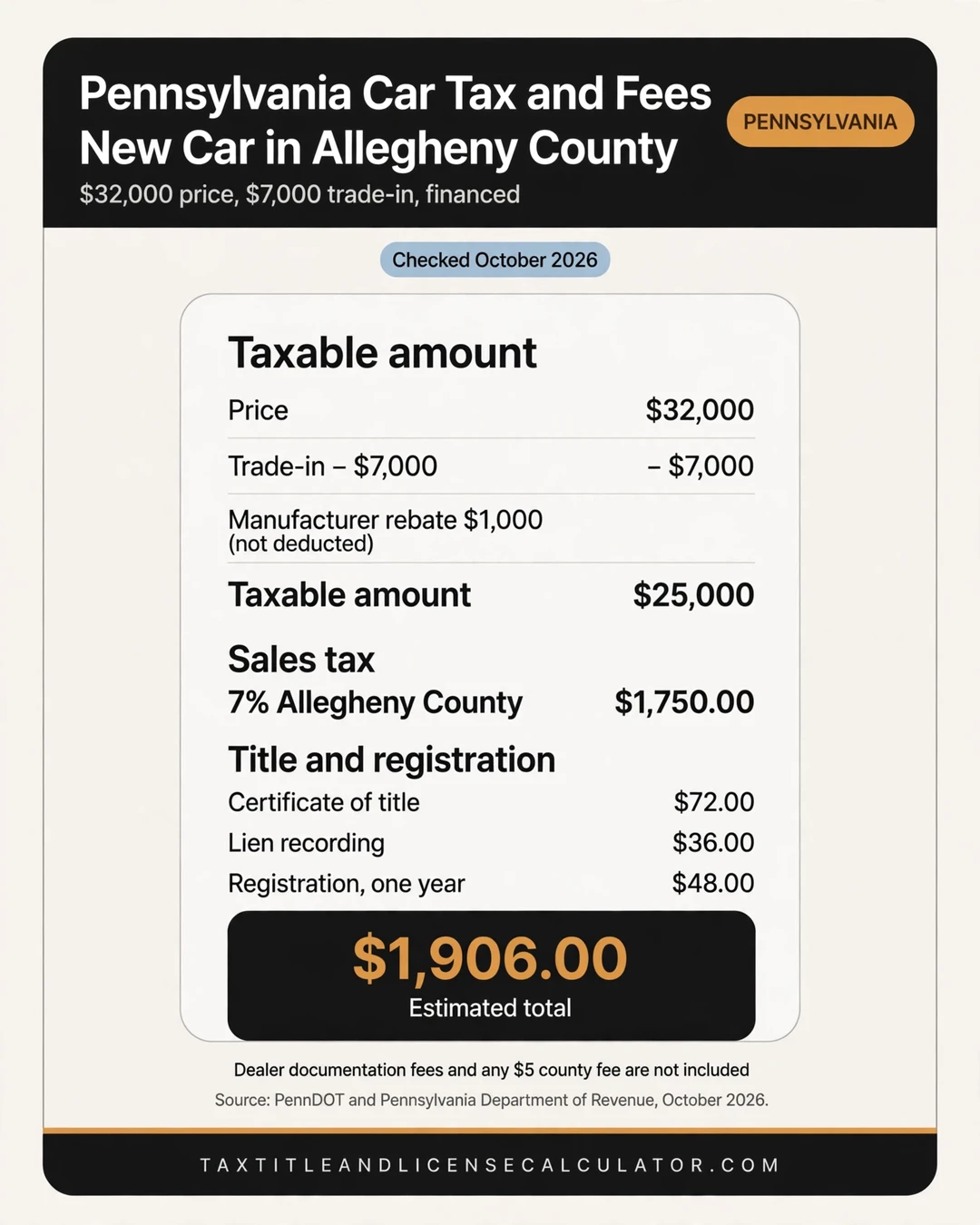
The sales tax is most of the bill, but title, lien and registration fees add about $150. The graphic below shows Example 1 line by line.
Private Sales, Gifts, Out-of-State Purchases and Inspections
Do I pay tax on a private sale in Pennsylvania?
Yes. You pay when you title the car, through PennDOT or an authorized agent. Pennsylvania watches for low prices. If you pay less than 80% of market value, the agent completes Form MV-3, and the Department of Revenue can bill the extra tax with penalty and interest.
This also applies when buyer and seller are not at "arm's length", such as friends or business partners. Keep a bill of sale, repair bills or a dealer appraisal that explains a low price.
Are gifts taxed in Pennsylvania?
No. A vehicle received as a gift is not subject to sales tax. You must show that the giver paid tax when they bought it, or you must pay use tax on its current market value. Complete Form MV-13ST, Affidavit of Gift, with your title application.
What if I buy a car in another state?
Pennsylvania credits sales tax you paid to another state, if that state gives a similar credit for Pennsylvania tax. The credit can't exceed 6%, or 7% in Allegheny County and 8% in Philadelphia. Form REV-227 lists the states, and you need proof of payment.
New residents and inspections
New residents must apply for a Pennsylvania title and registration within 20 days. You must surrender your out-of-state title. A used vehicle also needs a safety inspection within 10 days of sale unless it has a valid sticker. Some counties require emissions tests too.

How to Calculate Pennsylvania Tax, Title and License Costs by Hand
- Start with the price. For a used car, check that it is close to market value.
- Subtract a trade-in the seller takes. Don't subtract a manufacturer rebate.
- Multiply by 6%, 7% (Allegheny County) or 8% (Philadelphia). Subtract tax you paid to another state if it qualifies.
- Add $72 for the title.
- Add $36 if you have a loan.
- Add $48 for a one-year registration ($96 for two years).
- Add $250 for an electric vehicle or $63 for a plug-in hybrid.
- Add $5 if your county charges a local-use fee.
PennDOT or your agent can confirm the final amount.
What This Estimate Includes
- 6%, 7% or 8% sales tax with trade-in rules
- $72 title and $36 lien fees
- One-year registration
- Electric and plug-in hybrid road user charge
- Gift and out-of-state credit rules
What This Estimate Does Not Include
- Dealer documentation fees
- Agent or notary service fees
- County fee for local use (where it applies)
- Specialty plates and inspection costs
- Insurance, loan interest and optional products
Common Mistakes to Avoid
- Using 6% in Allegheny County or Philadelphia. The rate is 7% or 8%.
- Subtracting a manufacturer rebate. It doesn't lower the tax.
- Reporting a very low price. The state can tax the market value, plus penalty.
- Skipping the gift form. MV-13ST helps prevent a review.
- Assuming any state's tax gets credit. The other state must give a similar credit.
- Forgetting the lien fee when you finance.
- Missing the EV charge. It is $250 a year.
- Waiting past 20 days as a new resident.
Frequently Asked Questions
What is the sales tax on a car in Pennsylvania?
It's 6%. Allegheny County residents pay 7%, and Philadelphia residents pay 8%.
Does a Pennsylvania tax, title and license calculator subtract a trade-in?
Yes. If the seller takes your trade-in, you pay tax on the difference.
How much is sales tax on a $30,000 car in Pennsylvania?
It's $1,800 at 6%, $2,100 at 7% and $2,400 at 8%.
How much is a title in Pennsylvania?
A certificate of title is $72. A lien adds $36.
How much does it cost to register a car in Pennsylvania?
A passenger car is $48 for one year or $96 for two years.
How much is the Pennsylvania EV fee?
Electric vehicles pay a $250 road user charge a year. Plug-in hybrids pay $63.
Are manufacturer rebates taxed in Pennsylvania?
Yes. The tax is figured on the price without deducting the rebate.
Is a gifted car taxed in Pennsylvania?
No, with Form MV-13ST. The giver must have paid tax, or you pay use tax on current market value.
Do I get credit for sales tax paid in another state?
Yes, if that state gives a similar credit. It can't exceed Pennsylvania's rate.
Do I need an inspection after buying a used car in Pennsylvania?
Yes. A used vehicle needs a safety inspection within 10 days of sale unless it has a valid sticker.
Official Sources
- PennDOT: Schedule of Fees, MV-70S
- PennDOT: Buying or Selling Your Vehicle in Pennsylvania
- PennDOT: Title Application Fact Sheet (MV-1)
- PennDOT: Vehicle Sales and Use Tax Return Guidelines, Publication 457
- PennDOT: Motor Vehicle Information for New Residents
- Pennsylvania Department of Revenue: Motor Vehicle Understated Value Program
- 61 Pa. Code 31.45: Credit against tax
- 61 Pa. Code 33.2: Purchase price
This page is an independent estimate tool and guide. It isn't affiliated with PennDOT or the Pennsylvania Department of Revenue. Rates and fees can change, so confirm your total before you pay.
Compare nearby states
Ohio →
5.75% state tax plus a county rate.
New Jersey →
A 6.625% rate on the price after trade-in.
New York →
A 4% state rate plus local tax by county.
Maryland →A 6.5% excise tax at titling.
Connecticut →A 6.35% sales tax plus a town car tax.
Delaware →No sales tax, but a 5.25% document fee.
District of Columbia →A title excise tax from 1% to 11% by weight and city MPG.
See also: Maryland: a 6.5% excise tax at titling.
See also: Connecticut: a 6.35% sales tax plus a town car tax.
See also: Delaware: no sales tax, but a 5.25% document fee.
See also: District of Columbia: a title excise tax from 1% to 11% by weight and city MPG.
William researches vehicle taxes, title fees, registration charges and DMV requirements across the United States. His work focuses on turning state-specific fee schedules, tax guidance, registration requirements and statutory information into practical explanations for vehicle buyers and owners. He cross-checks calculator inputs against official state revenue departments, motor vehicle agencies and published fee schedules, paying particular attention to differences between sales tax, title fees, registration charges and local or county taxes. He also reviews state-level changes so that calculator results and supporting articles reflect the latest available requirements rather than relying on outdated third-party estimates.
About this site →